40
Imogen Cunningham
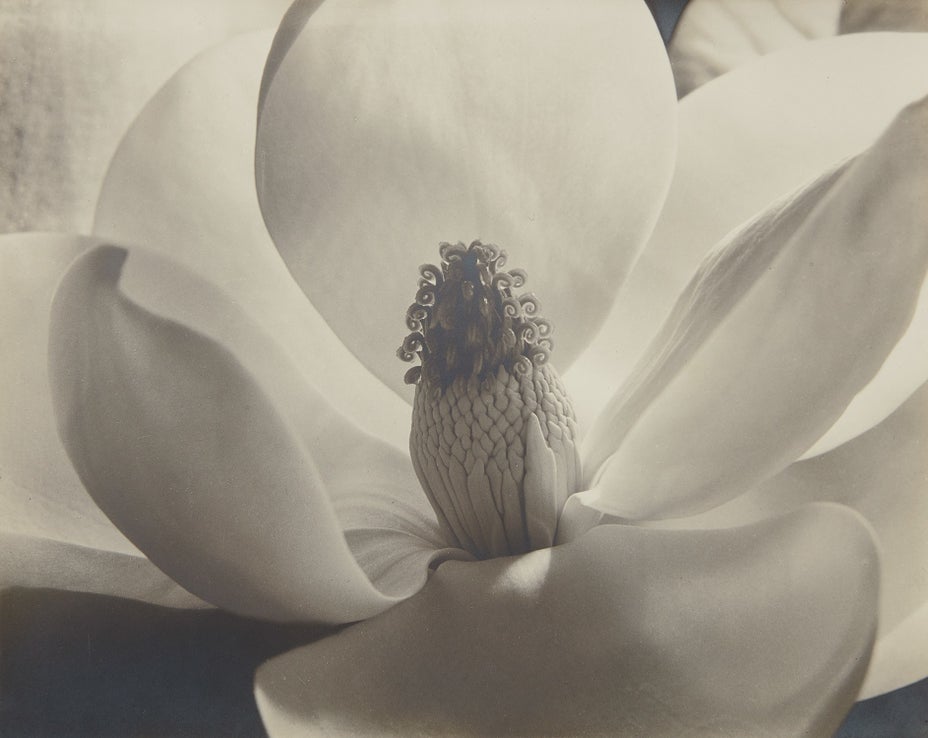
Magnolia Blossom ('Formen Einer Blume')
Estimate
$100,000–150,000
Sold For
$100,000
1925
Gelatin silver print.
7 1/4 x 9 3/8 in. (18.4 x 23.8 cm)
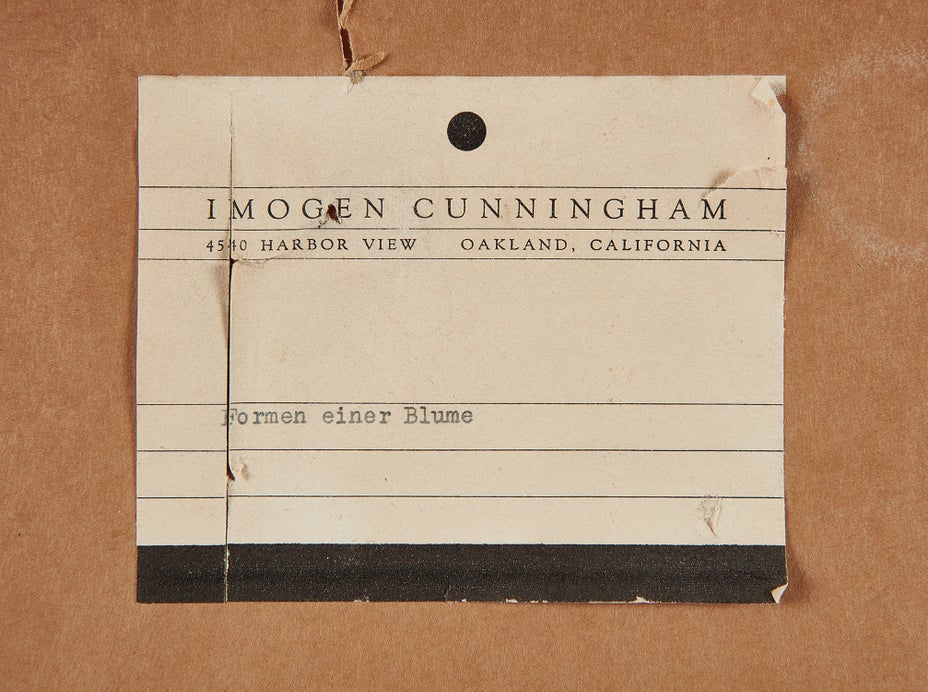
Signed and dated in pencil on the mount; accompanied by the original mat with typed title, 'Formen Einer Blume,' on the photographer’s ‘4540 Harbor View, Oakland, California’ label on the reverse.
Full-Cataloguing
Magnolia Blossom has become the signature image from the series of flower studies Imogen Cunningham created in the 1920s. Along with Calla (lot 36), Magnolia Blossom was one of eight botanical studies by Cunningham shown in the pivotal 1929 Film und Foto exhibition in Stuttgart. Fluent in German, Cunningham had studied photography and photo-chemistry in Germany in the 1910s, and the title she gave to Magnolia Blossom for Film und Foto was ‘Formen Einer Blume.’ It was exhibited under the German title in several other European venues thereafter, and it is this title which appears on her Harbor View studio label accompanying this lot. It is possible that the print offered here was an early exhibition print.
The present print showcases Cunningham’s skills not only as a photographer, but also as a printer. Her deft management of tones, from the pristine white of the petals to the deep blacks that punctuate the composition, enhances both the detail and drama of the subject, drama not always evident in prints of the image on other papers. Her handling of the blossom’s central stamen is particularly compelling and is rendered here with a level of clarity that is equal parts science and poetry.
Cunningham printed the photograph offered here on a lustrous matte-surface gelatin silver paper. In the early 1930s, Cunningham, along with Edward Weston, Ansel Adams, and other photographers associated with the anti-Pictorial Group f.64, would transition to photographic papers with harder, glossier surfaces. This photograph’s matte surface, as well as its format and presentation, indicate an early printing of this iconic work.
This photograph comes originally from the collection of photographer B. F. Stein. Several of Stein’s portraits of Cunningham were held in the collection of Cunningham’s friend Peg Frankel (www.pegsart.com). The Smithsonian Institution’s collection of Cunningham’s letters has correspondence between the two dating to 1975.
The present print showcases Cunningham’s skills not only as a photographer, but also as a printer. Her deft management of tones, from the pristine white of the petals to the deep blacks that punctuate the composition, enhances both the detail and drama of the subject, drama not always evident in prints of the image on other papers. Her handling of the blossom’s central stamen is particularly compelling and is rendered here with a level of clarity that is equal parts science and poetry.
Cunningham printed the photograph offered here on a lustrous matte-surface gelatin silver paper. In the early 1930s, Cunningham, along with Edward Weston, Ansel Adams, and other photographers associated with the anti-Pictorial Group f.64, would transition to photographic papers with harder, glossier surfaces. This photograph’s matte surface, as well as its format and presentation, indicate an early printing of this iconic work.
This photograph comes originally from the collection of photographer B. F. Stein. Several of Stein’s portraits of Cunningham were held in the collection of Cunningham’s friend Peg Frankel (www.pegsart.com). The Smithsonian Institution’s collection of Cunningham’s letters has correspondence between the two dating to 1975.