

The Modern Form: Property from the Collection of Betty and Stanley Sheinbaum
1Ο
Henri Matisse
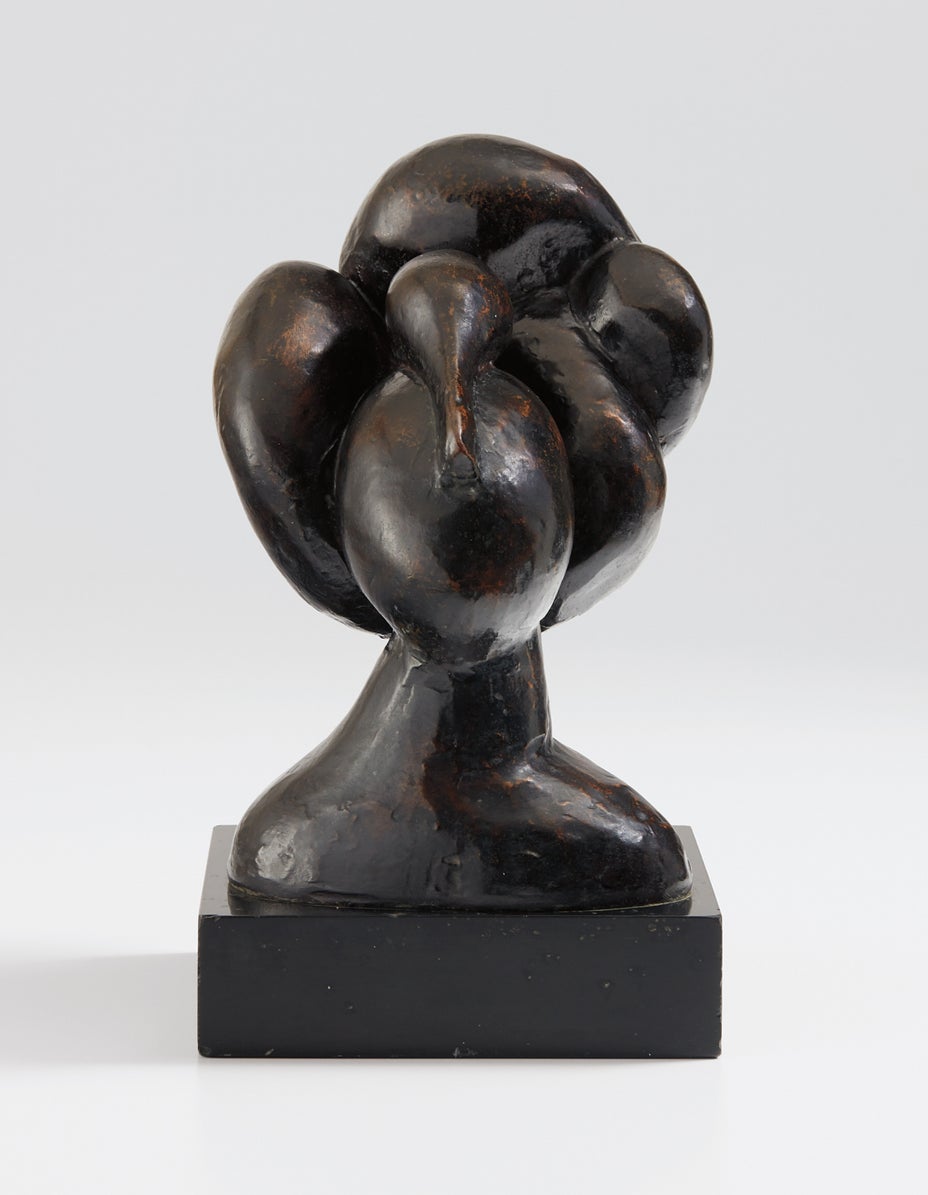
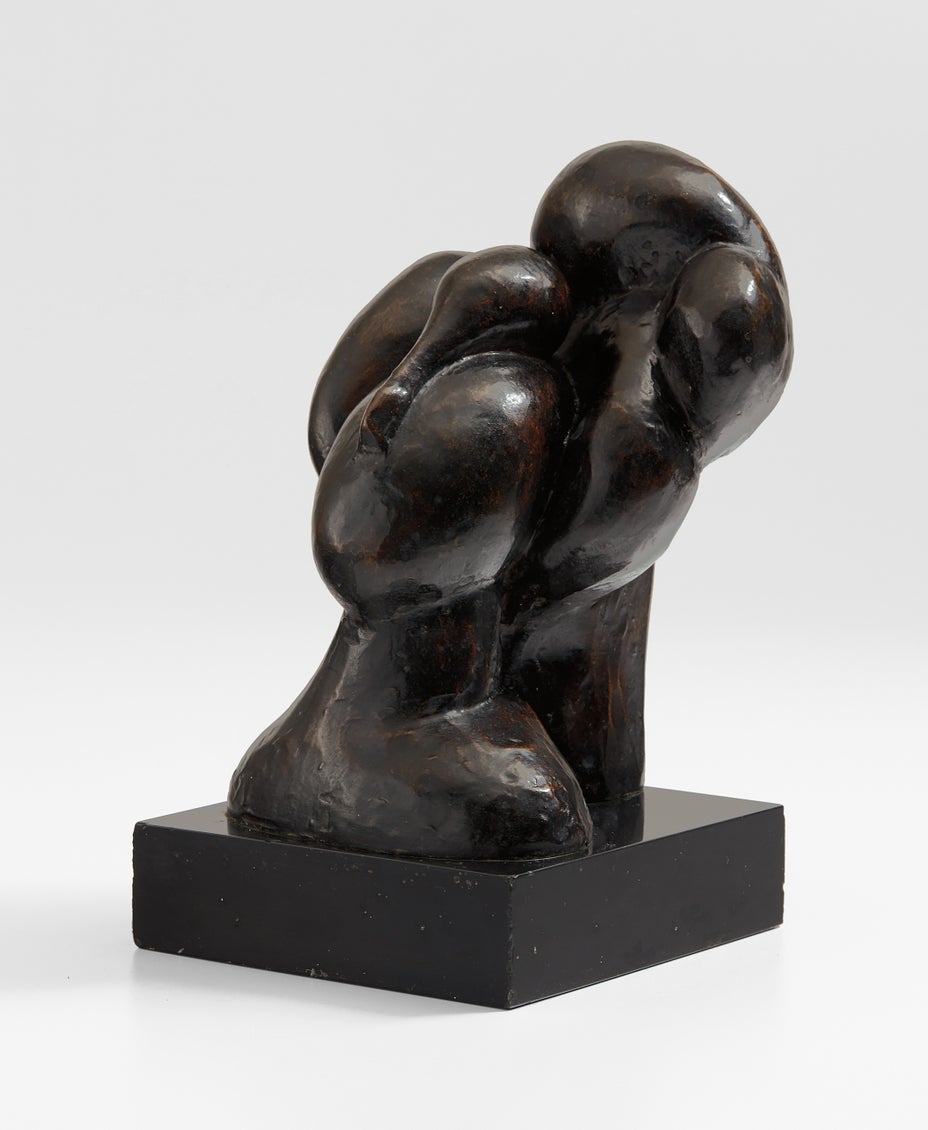
Le Tiaré
- Estimate
- $500,000 - 700,000
$1,455,000
Lot Details
bronze with dark brown patina
incised with the artist's initials and number "H.M. 4" on the left side; stamped with the foundry mark "C.VALSUANI CIRE PERDUE" on the right side
sculpture 8 x 5 1/2 x 7 1/2 in. (20.3 x 14 x 19.1 cm.)
base 1 1/2 x 5 1/2 x 7 1/2 in. (3.8 x 14 x 19.1 cm.)
overall 9 1/2 x 5 1/2 x 7 1/2 in. (24.1 x 14 x 19.1 cm.)
base 1 1/2 x 5 1/2 x 7 1/2 in. (3.8 x 14 x 19.1 cm.)
overall 9 1/2 x 5 1/2 x 7 1/2 in. (24.1 x 14 x 19.1 cm.)
Conceived in Nice in 1930 and cast in 1954, this work is number 4 from an edition of 10 plus 1 artist's proof.
Other casts of this work are in the permanent collection of the Museum of Modern Art, New York, The Baltimore Museum of Art, the Nasher Sculpture Center, Dallas and the Musée Matisse, Nice.
Specialist
Full-Cataloguing
Catalogue Essay
A remarkable example of Henri Matisse’s mature sculptural oeuvre, Le Tiaré is widely celebrated as the apex in his pursuit of organic simplicity. Conceived in Nice in 1930 and cast in the months before his passing in November 1954, the present bronze was purchased by Los Angeles collector Betty Sheinbaum from famed art dealer Eric Estorick in 1960. Inspired by the tiari flower worn by Tahitian women in their hair that Matisse had admired during his visit to the South Sea in early 1930, this exquisite bust presents the modulated features of a female head with a cluster of rounded forms – its simplified profile surmounted by a sensuous conglomeration of petal and leaf-like bulbous shapes akin to an elaborate hairstyle. It is not only this deliberate and punning ambiguity of the plant metaphor that makes Le Tiaré unique within Matisse’s sculptural oeuvre, it is notably also, as Alfred H. Barr Jr. highlighted, “perhaps his only work done during the ensuing decades to be a characteristically Tahitian form” (Alfred H. Barr Jr., Matisse: His Art and His Public, New York, 1951, p. 218). As the only sculpture in Matisse’s oeuvre to be transferred into stone, the white-marble version of Le Tiaré resides in the Musée Matisse in Nice-Cimiez.
Le Tiaré marks the radical turning point in Matisse’s mature career prompted by his trip to Tahiti. In fact, it represents the first major work he created after having reached a creative impasse at age 60 in the late 1920s. Like his artistic forebear Paul Gauguin, Matisse embarked upon a five-month journey to Tahiti in February 1930 in search of new inspiration. The trip utterly revitalized Matisse, who profusely sketched and drew the island’s lush tropical vegetation – ushering in a wholly new formulation of his art. "The voyage to the other side of the world appears, in retrospect, a major turning point…a hinge between the two major phases of his oeuvre" (Pierre Schneider, Matisse, Paris, 1984, p. 605). Upon his return to France, Matisse reengaged with the highly experimental streak that had characterized his practice prior to 1918.
Though Matisse’s memories of his Tahiti trip would surface in his paper cut-outs in the mid-1940s, their most crystalline reference came in the present work. Le Tiaré would go on to serve as a crucial foundation for the pictorial innovations in Matisse’s late oeuvre. As Matisse explained in 1941, “I took up clay in order to rest from painting, in which I had done absolutely everything I could for the moment. It was to order my sensations, to seek a method that completely suited me. When I had found it in sculpture, I used it in painting” (Henri Matisse, quoted in Serge Guilbaut, Chatting with Henri Matisse: The Lost 1941 Interview, Los Angeles, 2013, pp. 84-85). The formal perfection that Matisse achieved with Le Tiaré provided him with the necessary confidence to capture similarly shaped volumes with an unprecedented economy of line in his late drawings and paintings, such as in the illustrated Poésies book and his masterpiece La Danse, 1930-1933. Situated at the crucial crossroads between Matisse’s Nice period and the more abstract style of his late practice, Le Tiaré is a truly exceptional masterpiece that exemplifies Matisse’s relentless innovation and radical inventiveness.
Le Tiaré marks the radical turning point in Matisse’s mature career prompted by his trip to Tahiti. In fact, it represents the first major work he created after having reached a creative impasse at age 60 in the late 1920s. Like his artistic forebear Paul Gauguin, Matisse embarked upon a five-month journey to Tahiti in February 1930 in search of new inspiration. The trip utterly revitalized Matisse, who profusely sketched and drew the island’s lush tropical vegetation – ushering in a wholly new formulation of his art. "The voyage to the other side of the world appears, in retrospect, a major turning point…a hinge between the two major phases of his oeuvre" (Pierre Schneider, Matisse, Paris, 1984, p. 605). Upon his return to France, Matisse reengaged with the highly experimental streak that had characterized his practice prior to 1918.
Though Matisse’s memories of his Tahiti trip would surface in his paper cut-outs in the mid-1940s, their most crystalline reference came in the present work. Le Tiaré would go on to serve as a crucial foundation for the pictorial innovations in Matisse’s late oeuvre. As Matisse explained in 1941, “I took up clay in order to rest from painting, in which I had done absolutely everything I could for the moment. It was to order my sensations, to seek a method that completely suited me. When I had found it in sculpture, I used it in painting” (Henri Matisse, quoted in Serge Guilbaut, Chatting with Henri Matisse: The Lost 1941 Interview, Los Angeles, 2013, pp. 84-85). The formal perfection that Matisse achieved with Le Tiaré provided him with the necessary confidence to capture similarly shaped volumes with an unprecedented economy of line in his late drawings and paintings, such as in the illustrated Poésies book and his masterpiece La Danse, 1930-1933. Situated at the crucial crossroads between Matisse’s Nice period and the more abstract style of his late practice, Le Tiaré is a truly exceptional masterpiece that exemplifies Matisse’s relentless innovation and radical inventiveness.
Provenance
Exhibited
Literature
Henri Matisse
French | B. 1869 D. 1954The leading figure of the Fauvist movement at the turn of the 20th century, Henri Matisse is widely regarded as the giant of modern art alongside friend and rival Pablo Picasso. Working as a painter, draughtsman, printmaker and sculptor for over five decades, he radically challenged traditional conventions in art by experimenting with vivid colors, flat shapes and distilled line. Rather than modeling or shading to lend volume to his pictures, the French artist employed contrasting areas of unmodulated color. Heavily influenced by the art and visual culture of non-Western cultures, his subjects ranged from nudes, dancers, odalisques, still lifes and interior scenes and later evolved into the graphic semi-abstractions of his cut-outs of his late career.
Browse Artist