Priority Bidding is here! Secure a lower Buyer’s Premium today (excludes Online Auctions and Watches). Learn More
Property from a Private Collection, the Netherlands

47

Gerrit Thomas Rietveld

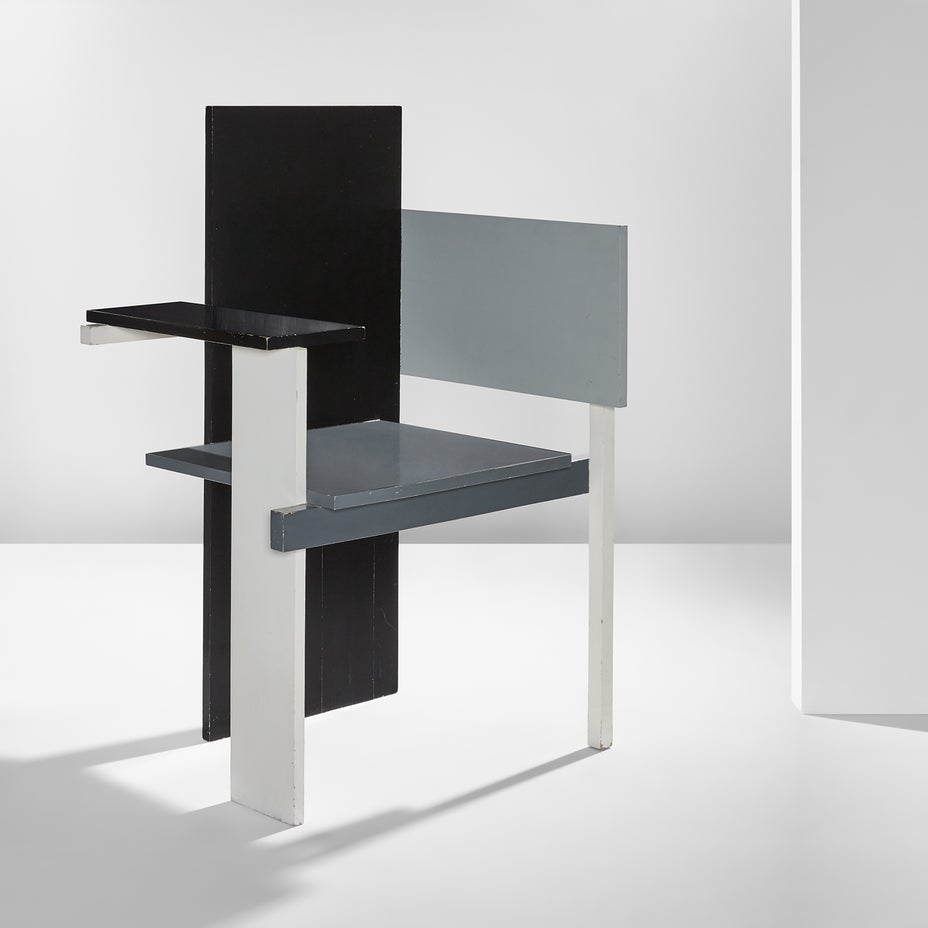
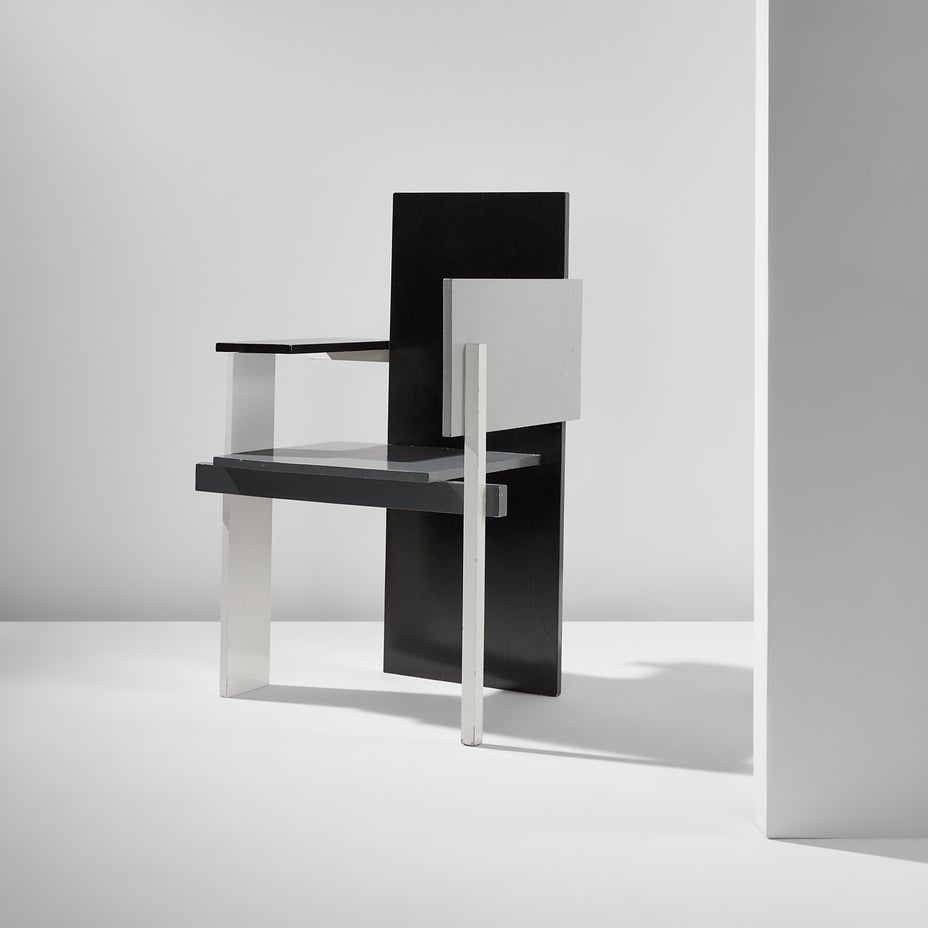
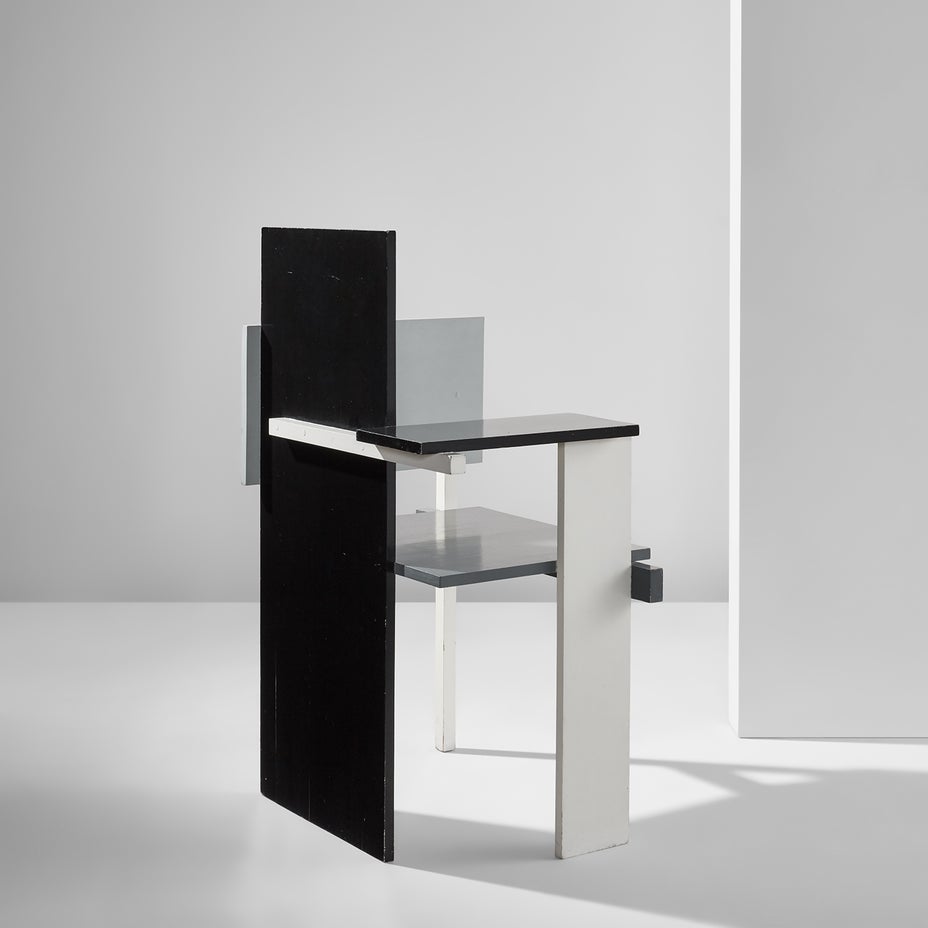
"Berlin" armchair

Estimate
$18,000 - 24,000
$22,680
Lot Details
Painted elm, painted beechwood.
designed 1923, executed circa 1957
42 x 29 x 21 1/2 in. (106.7 x 73.7 x 54.6 cm)
Executed by Gerard van de Groenekan, De Bilt, the Netherlands. Underside with paper label printed G. A. v. d. GROENEKAN/Utrechtseweg 315, DE BILT and inscribed in pen NEDERLAND.
Catalogue Essay
Gerrit Rietveld’s Berlin chair is among his most iconic furniture designs, and his first asymmetrical chair, predating the Steltman chair by four decades. This asymmetry was radical for the time and is the materialization of ideas Rietveld had begun to explore with the design of the Red-Blue chair. In 1959, in reference to his 1919 design for a sideboard, he recalled “You see I would have very much liked to make this sideboard asymmetrical, because I felt that even this symmetry was actually too closely tied to the mass and I would have preferred to set it freely in space, but that was still too difficult at the time.” A chair presented less of a challenge in engineering, and in 1923 he was able to realize this ambition when he collaborated with De Stijl artist Vilmos Huszár on the Space-Color-Composition for the Juryfreie Kunstschau in Berlin. This was a scale model of an interior that gained visibility and influence through publication. Of the various furniture designs employed in this interior, the Berlin chair was the only one to be produced as a full-scale functional model, in both left and right-handed versions. There is one known extant period example of the Berlin chair in the permanent collection of the Stedelijk Museum in Amsterdam, and Gerard van de Groenekan produced a only a very limited number of Berlin chairs in the 1950s.

Gerrit Thomas Rietveld

Dutch | B. 1888 D. 1964
Gerrit Thomas Rietveld began as an apprentice in his father's cabinetmaking workshop, going on to train and work as a draftsman. In 1917 he started his own furniture-making workshop in Utrecht. Positive critical review by Theo van Doesburg in his journal De Stijl resulted in near-instantaneous influence on broader developments in European modernism. This connection to the De Stijl movement also inspired him to introduce color to the posts, rails and terminals of his furniture. His resulting "Red-blue" armchair is among the most iconic chair designs of the twentieth century.

From the beginning, Rietveld embraced modernist principles of functionalism, simplicity of form and mass-production, and eventually moved away from De Stijl to become a member of the Congrès Internationaux d'Architecture Moderne (CIAM). Rietveld worked through the post-war years, completing a number of private residences, housing developments and institutions. He continued to design furniture for these commissions as well as for retailers like Metz & Co.
Browse Artist