176
Gerrit Thomas Rietveld
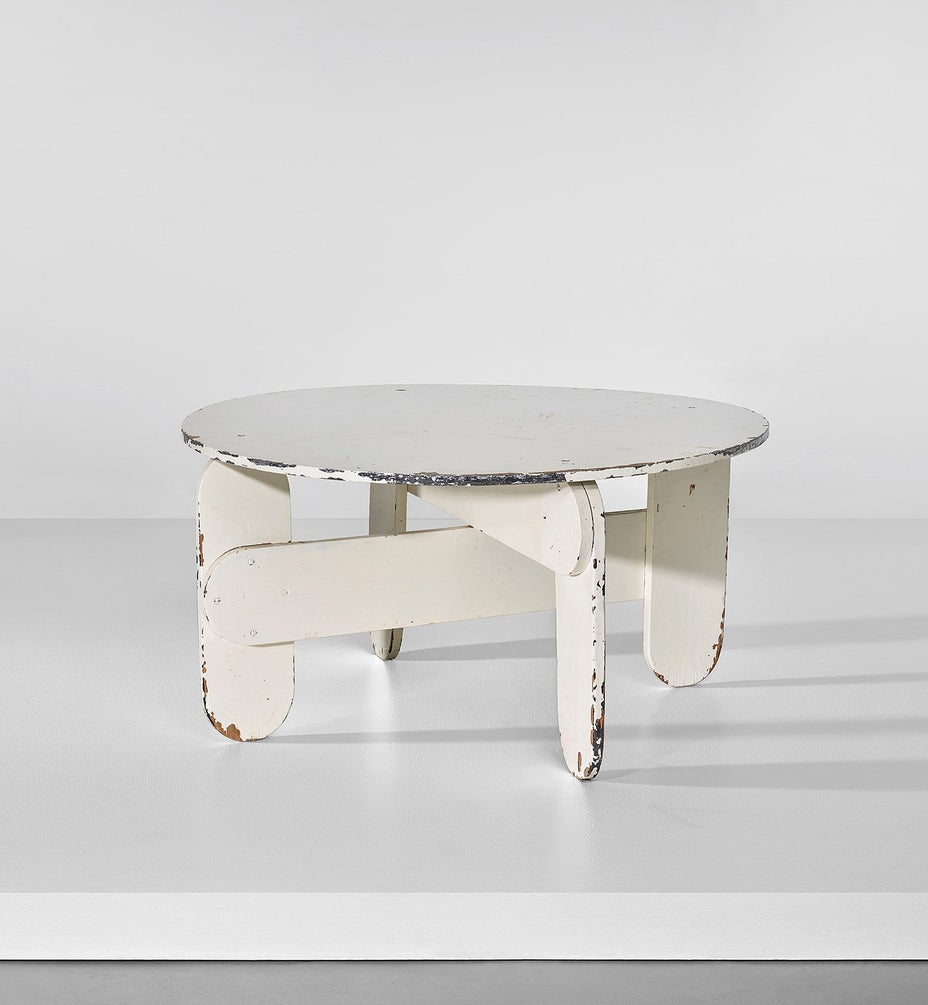
Unique low table
Full-Cataloguing
Gerrit Thomas Rietveld’s pragmatic approach towards furniture is apparent in his chairs, but even more so in his table designs. While the famous De Stijl asymmetric end table is an exception to the rule, most of his tables are rudimentary archetypes of their function: a horizontal plane supported by a simple base, preferably made out of ready-made or easily accessible material such as door panels and standard iron gas pipes. For Truus Schröder, Rietveld made a dining table top out of four raw planks with irregular edges, and he regarded his austere crate series as one of his most satisfactory furniture concepts.
Given his approach, the present table is sophisticated despite its relatively basic form. Although the base of crossed boards echoes the crate designs, the rounded edges give it a playful twist. Rietveld first applied this idea in a series of low chairs similar to the “Beugel” chair design, with wooden bases instead of the customary tubular steel frames, the rounded edges of the planks fitting neatly into the curves of the undulating plywood seats. One of these low wooden “Beugel” chairs is recorded in Rietveld’s private apartment and a set of these chairs with a matching small high table, similar to the present larger low table, is in the collection of the Stedelijk Museum. Although Rietveld never designed a specific table for his "Beugel" chairs, it is not surprising that these two tables became known as “Beugeltafels.”
Rietveld designed the table for his youngest daughter Vrouwgien Rietveld (1918-1995) as a gift for her wedding in January 1940, together with a pair of crate chairs. It is possible that the table originally was unpainted with a clear finish, which would have matched with the pair of crate chairs. The top was later painted an aluminum color, much like the paint found on the frames of “Beugel” chairs, with black finish on the edges of the top and the legs. In later years, the table top and the frame were overpainted in white, covering the curved heads of the screws which originally must have been a visible and decorative part of the construction of the base.
-Rob Driessen
Gerrit Thomas Rietveld
Dutch | B. 1888 D. 1964Gerrit Thomas Rietveld began as an apprentice in his father's cabinetmaking workshop, going on to train and work as a draftsman. In 1917 he started his own furniture-making workshop in Utrecht. Positive critical review by Theo van Doesburg in his journal De Stijl resulted in near-instantaneous influence on broader developments in European modernism. This connection to the De Stijl movement also inspired him to introduce color to the posts, rails and terminals of his furniture. His resulting "Red-blue" armchair is among the most iconic chair designs of the twentieth century.
From the beginning, Rietveld embraced modernist principles of functionalism, simplicity of form and mass-production, and eventually moved away from De Stijl to become a member of the Congrès Internationaux d'Architecture Moderne (CIAM). Rietveld worked through the post-war years, completing a number of private residences, housing developments and institutions. He continued to design furniture for these commissions as well as for retailers like Metz & Co.