1009
Georges Rémond & Compagnie
An extremely well-preserved, possibly unique and important early 19th century three-colour gold singing-bird box with miniature enamel, engine-turned panels, center seconds watch and musical mechanism attributed to Frères Rochat
Estimate
HK$400,000–800,000
€44,300–88,500
$51,300–103,000
Sold For
HK$1,333,500
Manufacturer
Georges Rémond & Compagnie
Year
Circa 1810
Material
Three-colour gold, enamel
Calibre
Manual, Singing bird movement: fusée-and-chain; Watch movement: cylinder escapement
Dimensions
95mm width x 60mm length x 24mm height
Signed
Case signed
Accessories
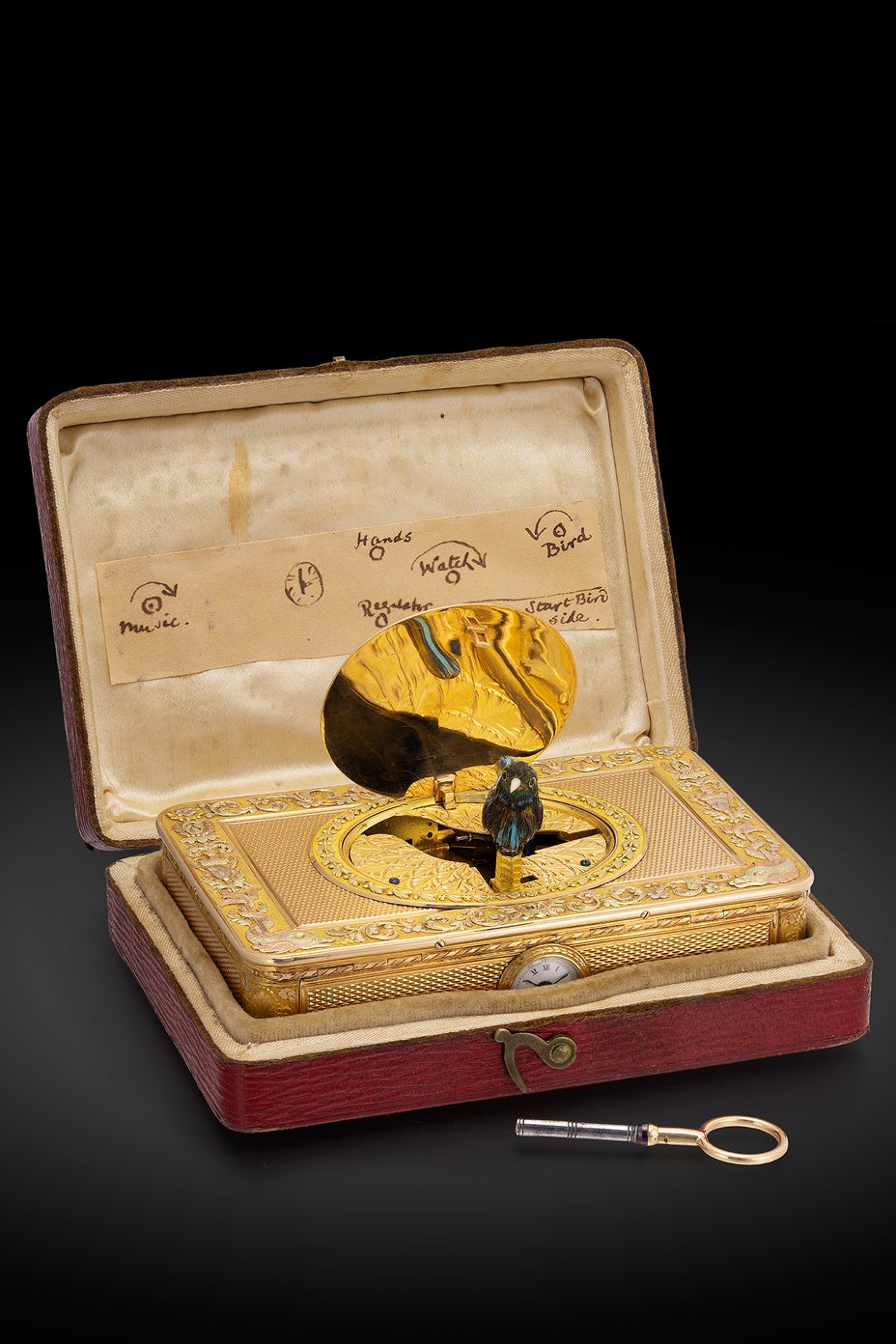
Accompanied by fitted winding key and red leather presentation box.
Full-Cataloguing
Singing bird boxes date back to as early as 1750, serving decorative, sensory and entertainment purposes. These intricate antiques were often complex, wind-up automata used by the aristocracy as status symbols. Regardless of whether the mechanism was housed in a birdcage or a small scent bottle, the principle remained the same: a source of compressed air generated by bellows, activated by levers, cranks and handles to bring the singing bird to life.
Jean-Georges Rémond (1752-1830), who was born in Germany and moved to Geneva in 1783, established the firm “Jean-Georges Rémond & Company”. During his golden years, his creations were highly sought after, placing him among an elite group of European artisans who produced jewelry, clocks and singing bird boxes along with musical automata. This group included renowned names such as Rochat Frères, Frederick Leschot and Jaquet-Droz.
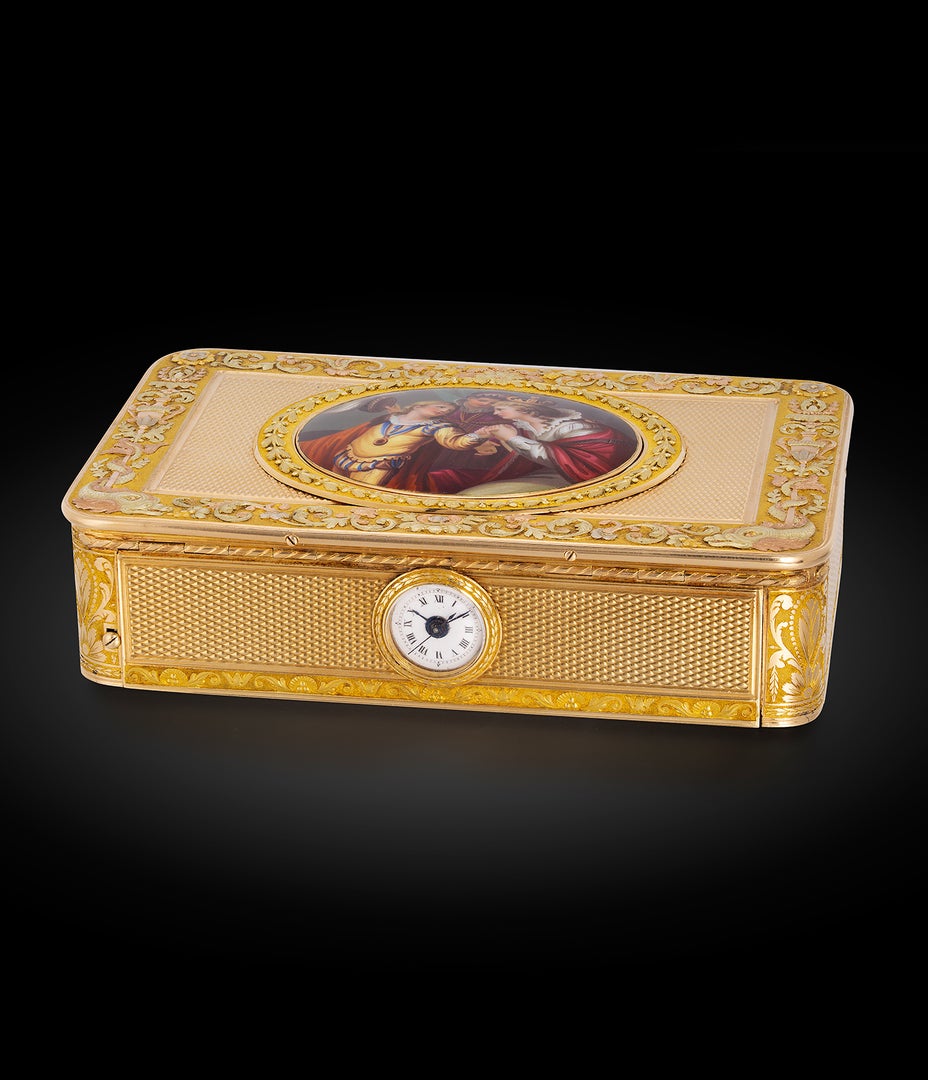
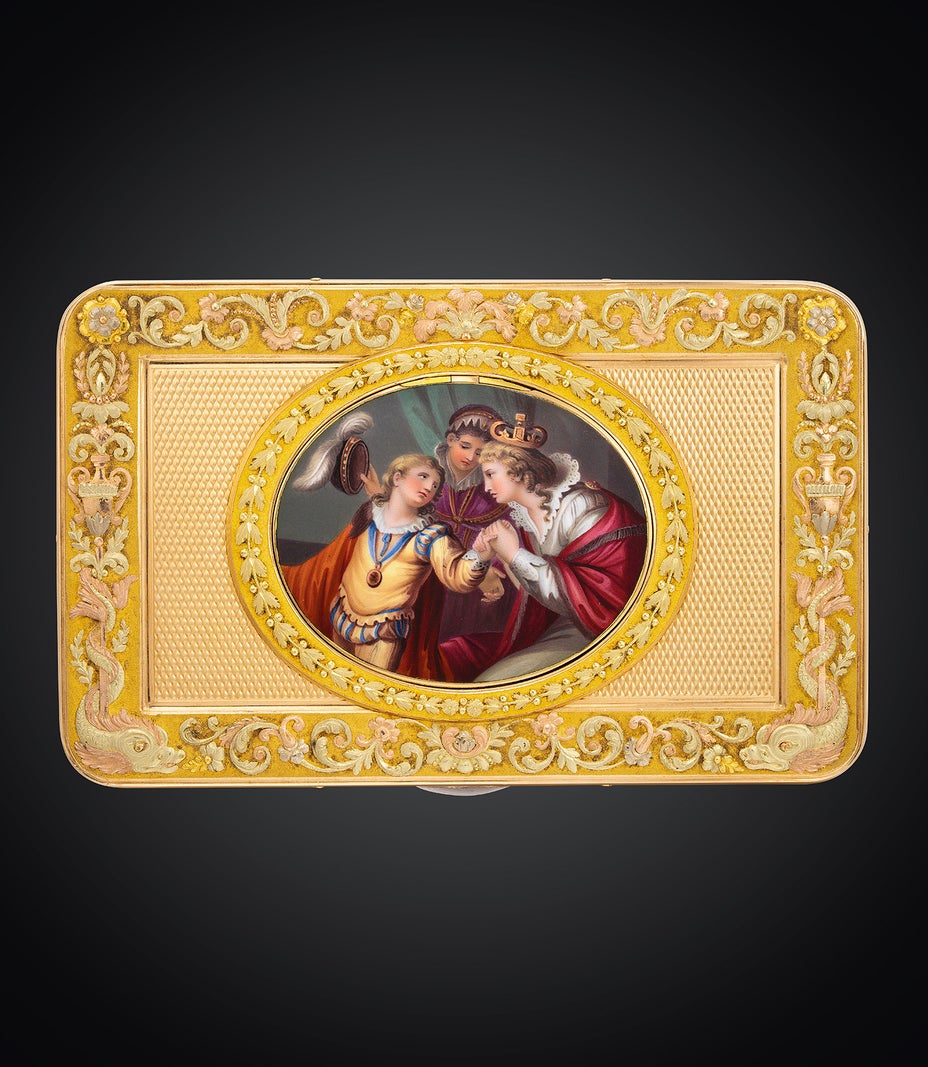
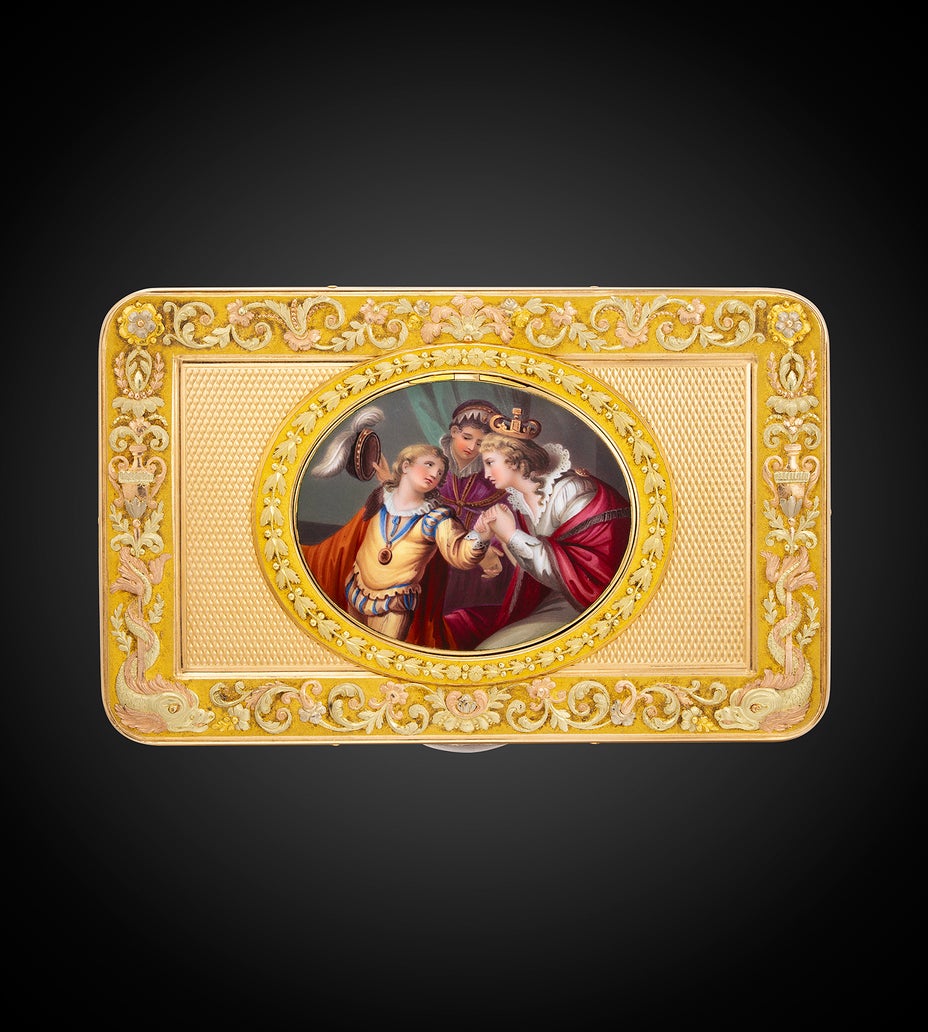
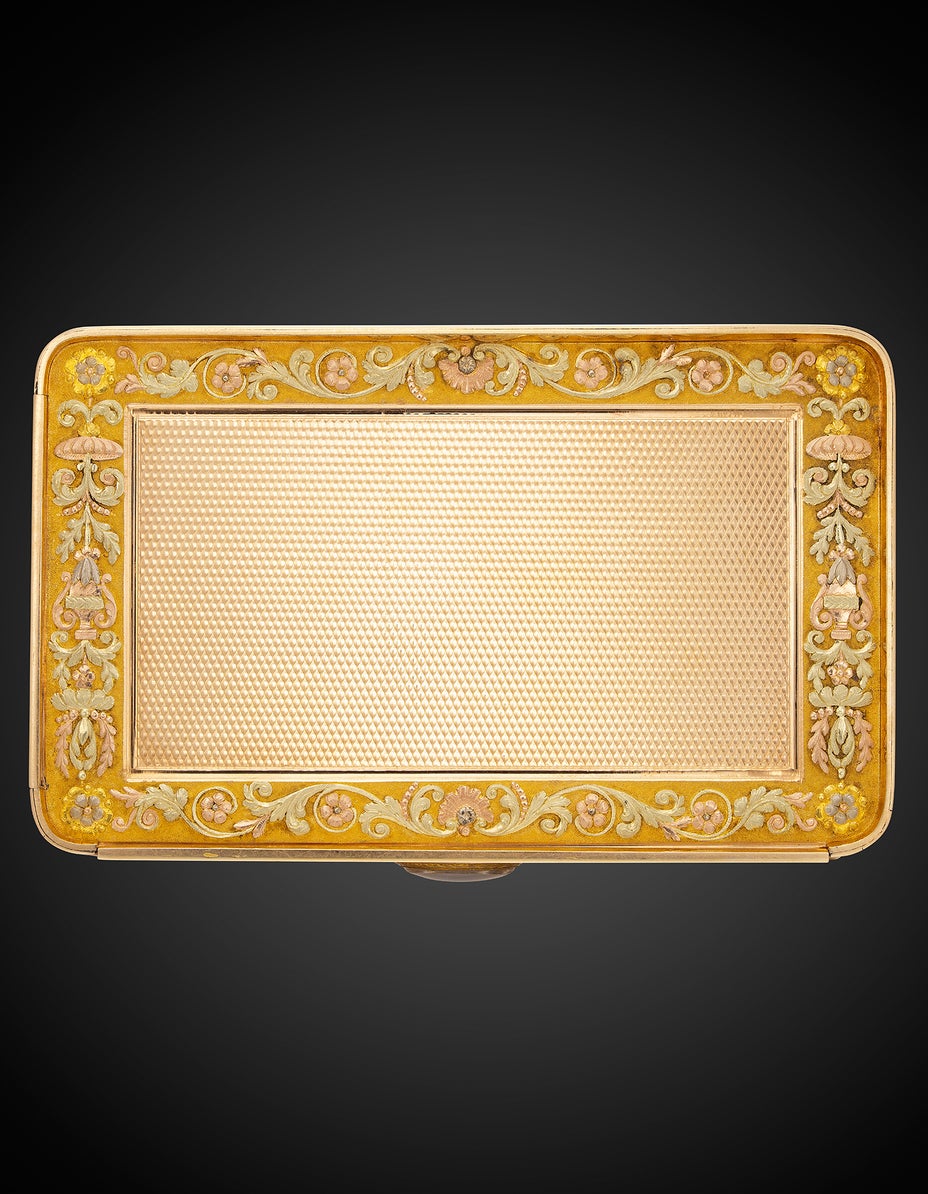
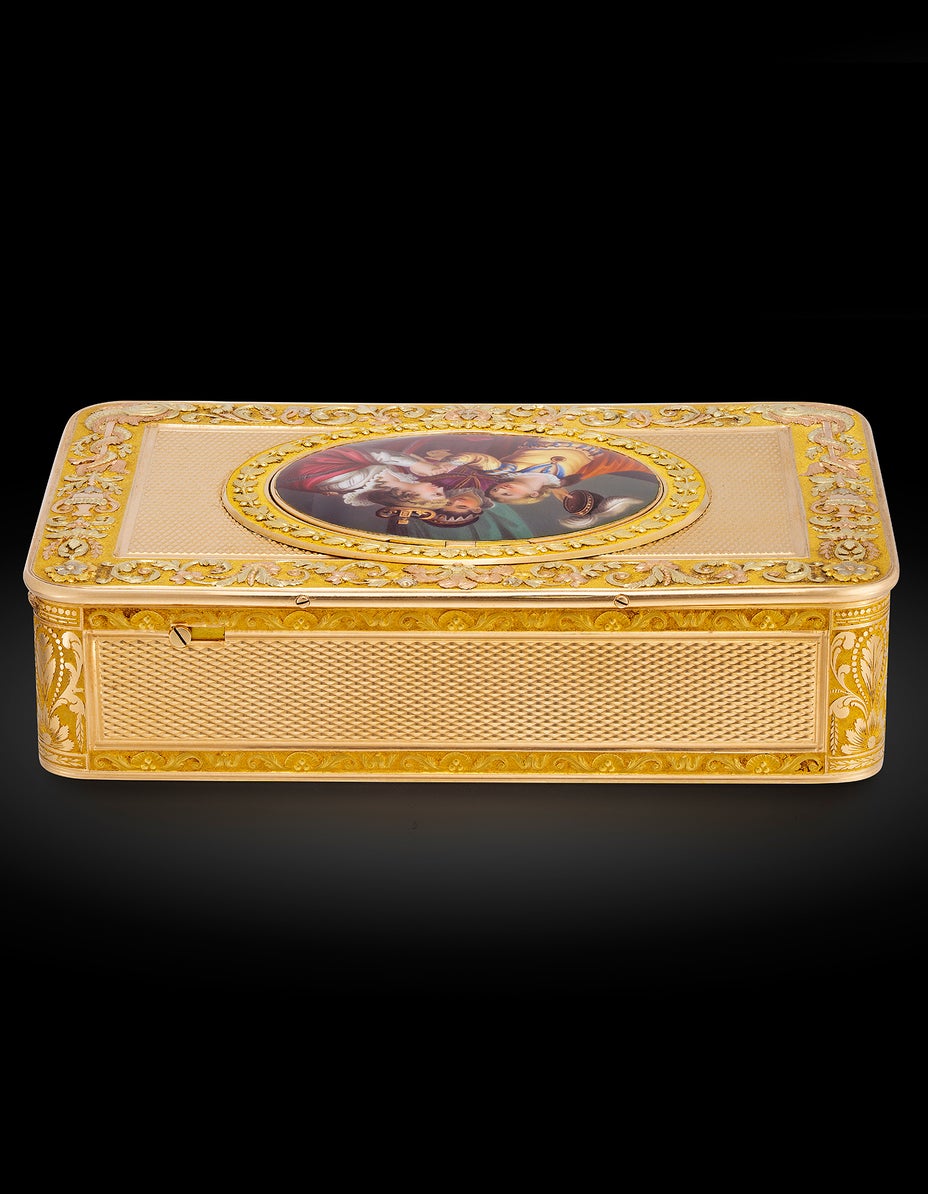
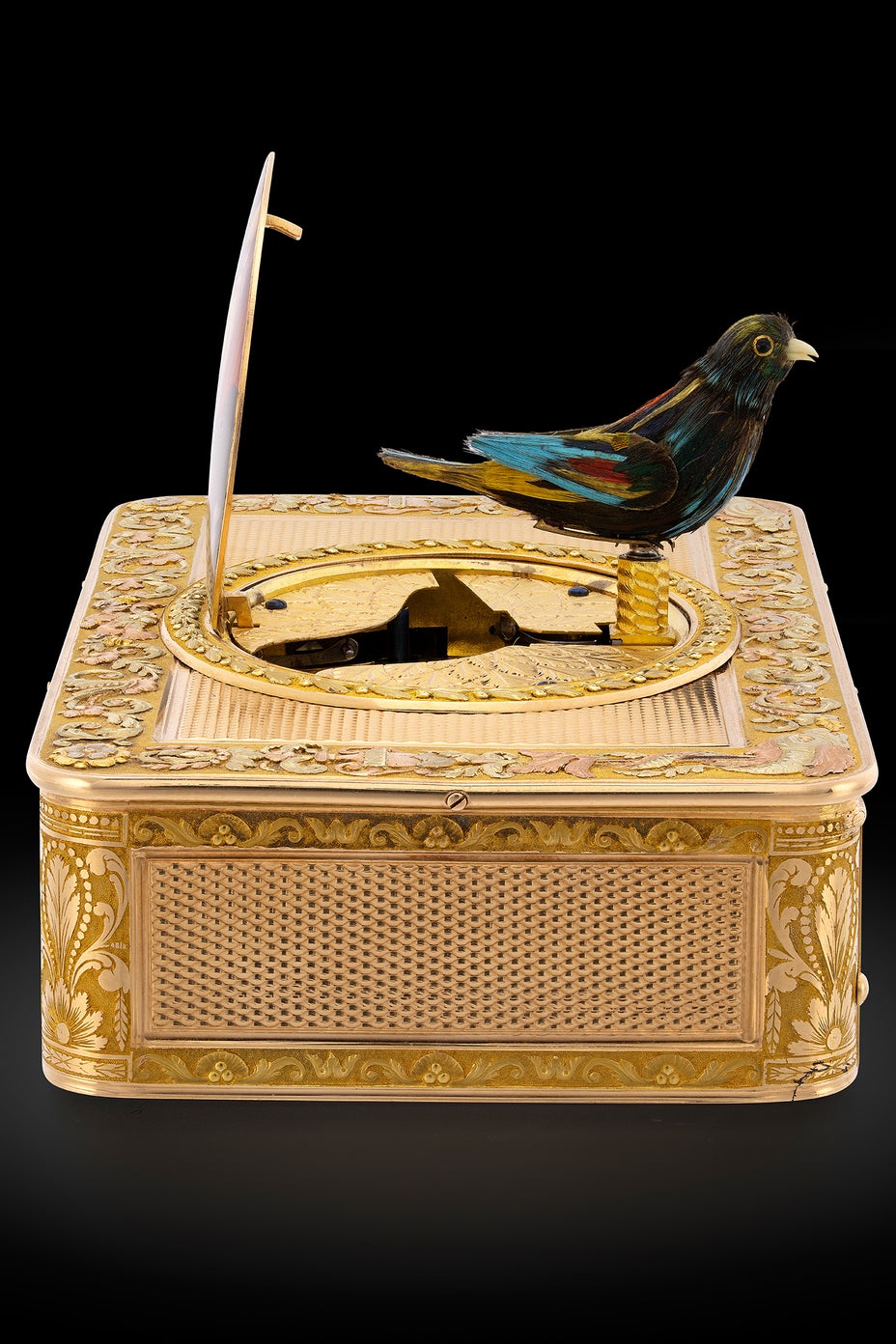
These singing bird boxes exemplify exceptional craftsmanship and meticulous attention to detail. The present box features beautifully fitted pink gold engine-turned panels, with the top panel hand-engraved in multiple colors of gold, creating striking visual depth. The decorations include urns, dolphins, roses and floral scrolls against a matte yellow background, with the sides and corners adorned with chased and engraved floral motifs.
At the center of the top panel is a remarkably preserved miniature enamel attributed to Jean-Abraham Lissignol (1749-1819), known for his exquisite depictions of human figures and for decorating enamelled snuff boxes and watch cases for Rémond. This beautifully painted oval enamel lid portrays a poignant scene of a young nobleman bidding farewell to what appears to be his sister, showcasing exquisite detail and vibrant colors that remain captivating by today's standards. The panel is further enhanced by raised floral decorations set against a matte yellow bezel.
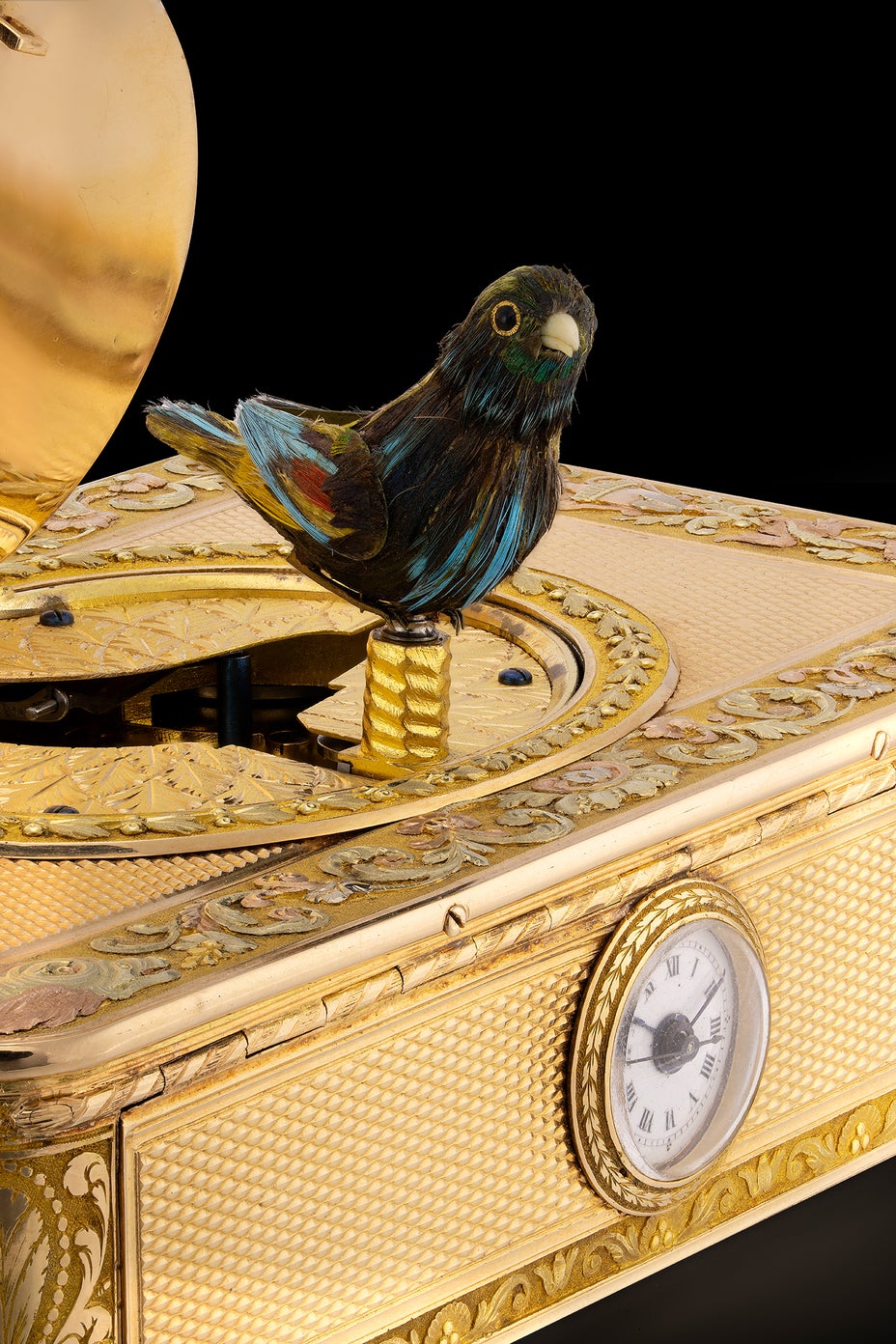
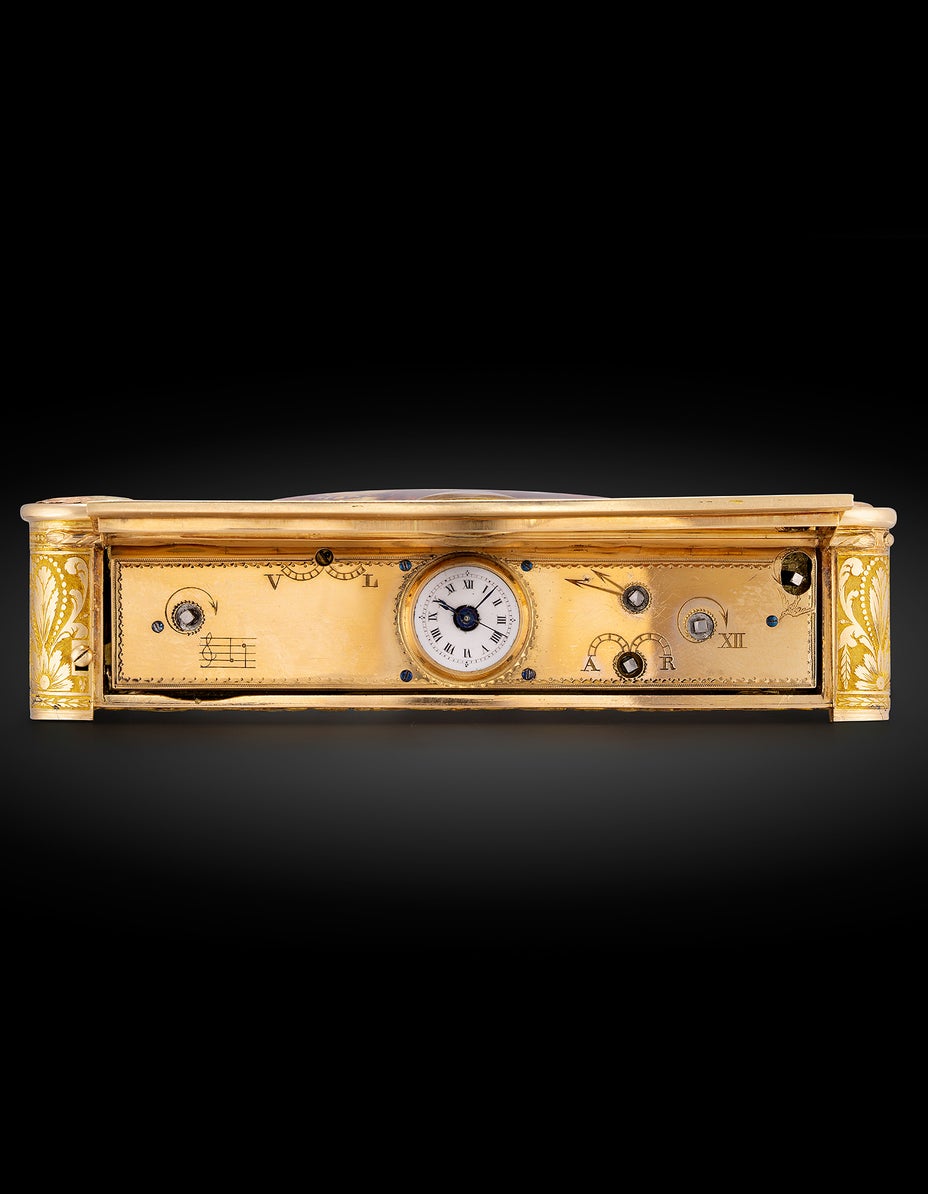
The front panel houses a watch with highlighted wheat leaf engraving on the bezel, featuring a white enamel dial with Roman numerals and a sweep seconds hand. It is hinged to reveal the winding arbors for the bird, watch, and musical movements, with another hinged side panel containing the winding key.
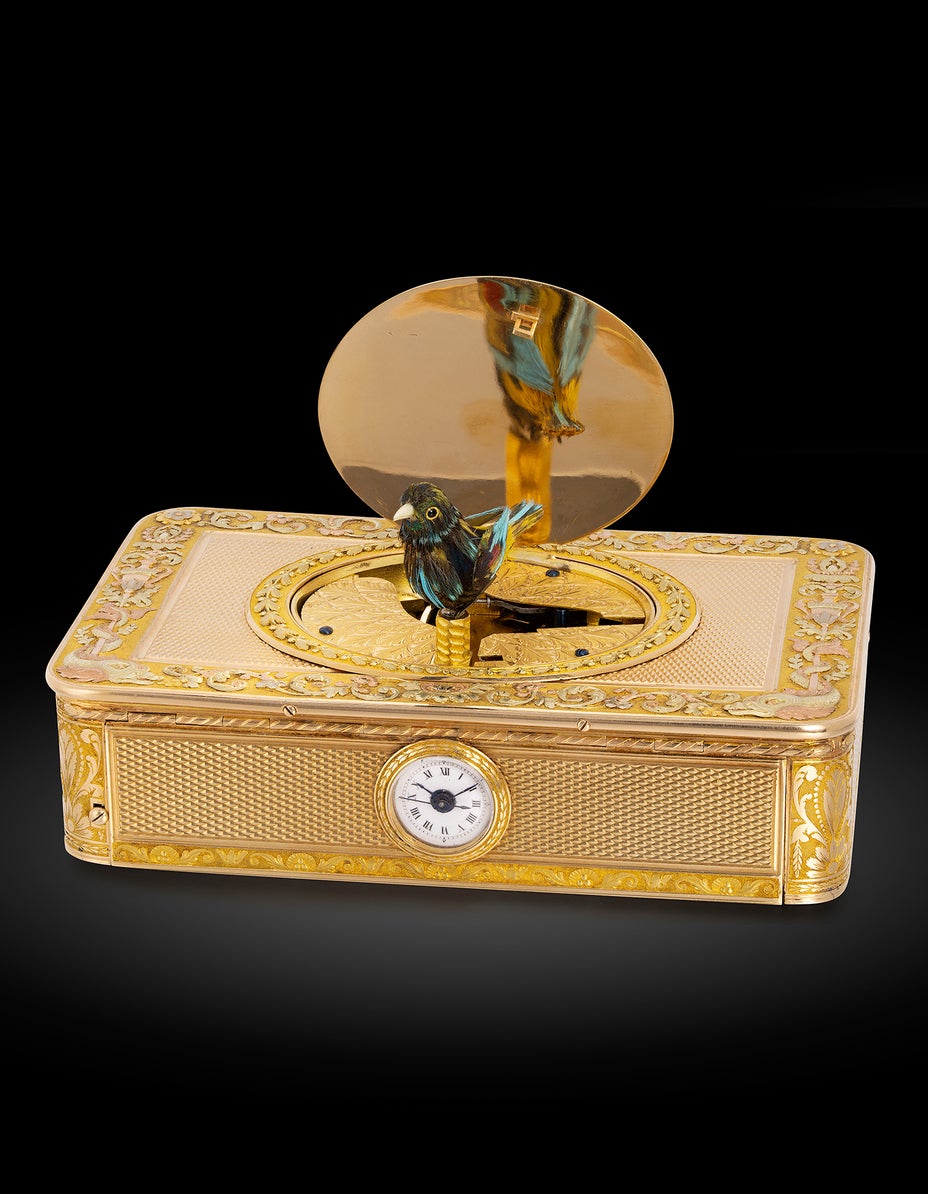
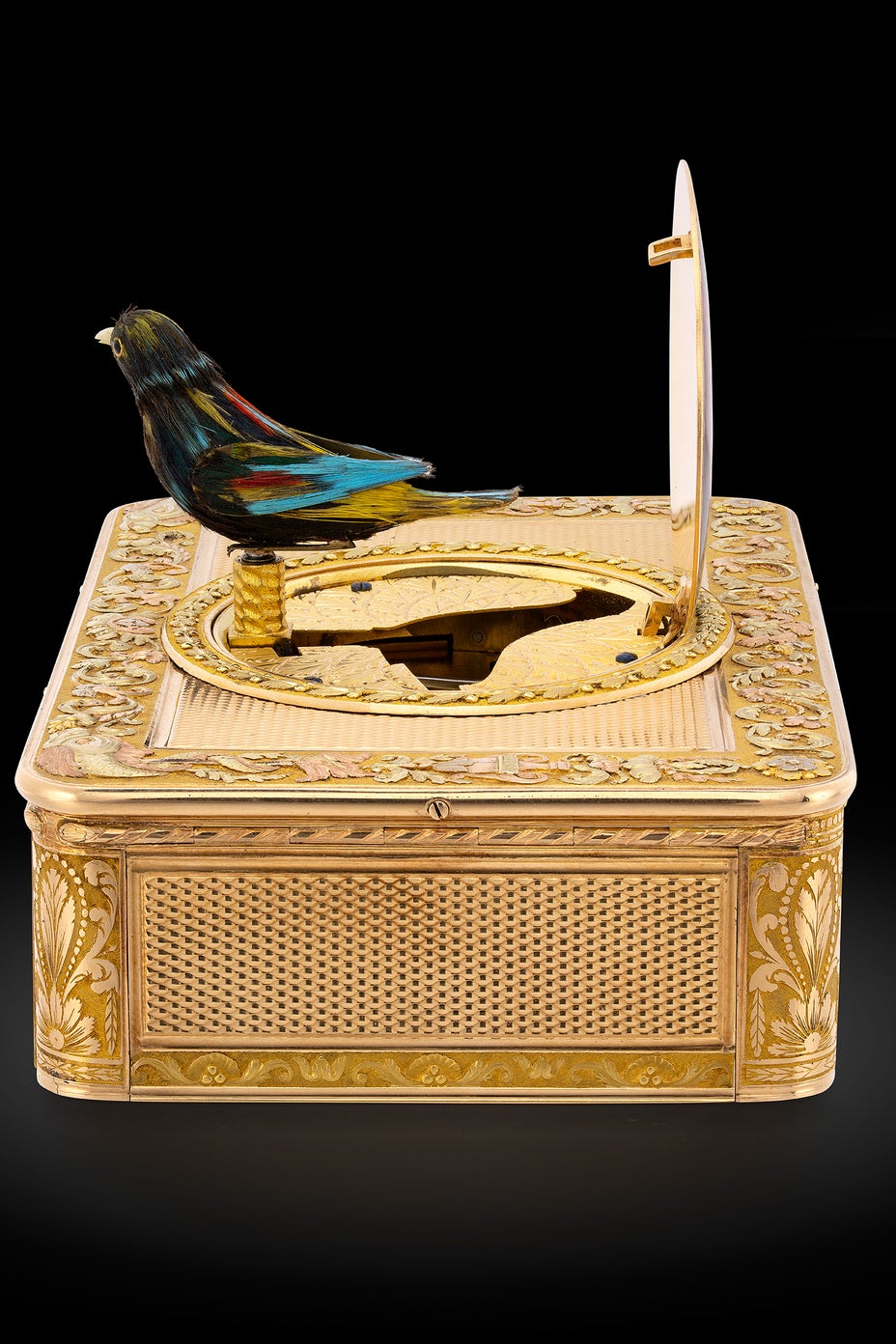
When the musical mechanism is wound, a slide on the rear panel reveals the singing bird, which operates by turning on its axis, flapping its wings, wagging its tail, and turning its head, all while producing a delightful chirping sound. This bird is one of the most vibrant and lively examples found in a singing bird box, with movements that include swiveling its body and flapping its wings. The lid will close once the power reserve is depleted, returning the bird to its resting position.
This particular example features a movement attributed to Frères Rochat. The Rochat brothers—François-Elisée, Frédéric, and Samuel-Henri—were active in Geneva from around 1800 to 1835. Trained by their father Pierre Rochat in Brassus, they quickly established themselves among the elite makers of complex singing bird mechanisms and automaton watches, supplying their creations to other esteemed manufacturers, including Jaquet-Droz and Leschot. The Rochats were renowned for perfecting the singing bird mechanism, enhancing the naturalness of the bird's movements by incorporating additional cams, and improving sound quality through the use of piston rods.
The present singing bird movement comprises a high-quality gilt brass fusée-and-chain mechanism with polished steel levers and blued steel screws, featuring eight operating cams and circular bellows. The musical movement includes a brass plate mounted behind the hinged front panel, with a spring contained in the pin-barrel and two banks of eight separate tuned teeth. The watch movement, mounted on the same plate as the musical mechanism, employs a going-barrel and cylinder escapement to drive the hands at the center, along with a center seconds hand.
Extremely well-preserved, this singing bird box has a notable provenance, having belonged to Caroline Lady Clonbrock (1805-1864), the granddaughter of the 4th Duke of Marlborough. It was gifted to her by her uncle, the 5th Duke of Marlborough, and has remained in the family until the first auction appearance in 1993, and the box has not undergone any intervention ever since. The casemaker’s mark from Georges Rémond & Compagnie is visible in the key compartment and inside the case, still legible to the naked eye. It also includes the original fitted red leather presentation box and key.
Objects by Rémond can be found in Beijing's Imperial Palace, as well as in the world’s most prestigious museums and private collections, notably the Musée de l'Horlogerie et de l'Emaillerie and the Patek Philippe Museum in Geneva. This piece is an important mechanical artwork and stands as one of the best-preserved, museum-quality examples of a singing bird box.
Jean-Georges Rémond (1752-1830), who was born in Germany and moved to Geneva in 1783, established the firm “Jean-Georges Rémond & Company”. During his golden years, his creations were highly sought after, placing him among an elite group of European artisans who produced jewelry, clocks and singing bird boxes along with musical automata. This group included renowned names such as Rochat Frères, Frederick Leschot and Jaquet-Droz.
These singing bird boxes exemplify exceptional craftsmanship and meticulous attention to detail. The present box features beautifully fitted pink gold engine-turned panels, with the top panel hand-engraved in multiple colors of gold, creating striking visual depth. The decorations include urns, dolphins, roses and floral scrolls against a matte yellow background, with the sides and corners adorned with chased and engraved floral motifs.
At the center of the top panel is a remarkably preserved miniature enamel attributed to Jean-Abraham Lissignol (1749-1819), known for his exquisite depictions of human figures and for decorating enamelled snuff boxes and watch cases for Rémond. This beautifully painted oval enamel lid portrays a poignant scene of a young nobleman bidding farewell to what appears to be his sister, showcasing exquisite detail and vibrant colors that remain captivating by today's standards. The panel is further enhanced by raised floral decorations set against a matte yellow bezel.
The front panel houses a watch with highlighted wheat leaf engraving on the bezel, featuring a white enamel dial with Roman numerals and a sweep seconds hand. It is hinged to reveal the winding arbors for the bird, watch, and musical movements, with another hinged side panel containing the winding key.
When the musical mechanism is wound, a slide on the rear panel reveals the singing bird, which operates by turning on its axis, flapping its wings, wagging its tail, and turning its head, all while producing a delightful chirping sound. This bird is one of the most vibrant and lively examples found in a singing bird box, with movements that include swiveling its body and flapping its wings. The lid will close once the power reserve is depleted, returning the bird to its resting position.
This particular example features a movement attributed to Frères Rochat. The Rochat brothers—François-Elisée, Frédéric, and Samuel-Henri—were active in Geneva from around 1800 to 1835. Trained by their father Pierre Rochat in Brassus, they quickly established themselves among the elite makers of complex singing bird mechanisms and automaton watches, supplying their creations to other esteemed manufacturers, including Jaquet-Droz and Leschot. The Rochats were renowned for perfecting the singing bird mechanism, enhancing the naturalness of the bird's movements by incorporating additional cams, and improving sound quality through the use of piston rods.
The present singing bird movement comprises a high-quality gilt brass fusée-and-chain mechanism with polished steel levers and blued steel screws, featuring eight operating cams and circular bellows. The musical movement includes a brass plate mounted behind the hinged front panel, with a spring contained in the pin-barrel and two banks of eight separate tuned teeth. The watch movement, mounted on the same plate as the musical mechanism, employs a going-barrel and cylinder escapement to drive the hands at the center, along with a center seconds hand.
Extremely well-preserved, this singing bird box has a notable provenance, having belonged to Caroline Lady Clonbrock (1805-1864), the granddaughter of the 4th Duke of Marlborough. It was gifted to her by her uncle, the 5th Duke of Marlborough, and has remained in the family until the first auction appearance in 1993, and the box has not undergone any intervention ever since. The casemaker’s mark from Georges Rémond & Compagnie is visible in the key compartment and inside the case, still legible to the naked eye. It also includes the original fitted red leather presentation box and key.
Objects by Rémond can be found in Beijing's Imperial Palace, as well as in the world’s most prestigious museums and private collections, notably the Musée de l'Horlogerie et de l'Emaillerie and the Patek Philippe Museum in Geneva. This piece is an important mechanical artwork and stands as one of the best-preserved, museum-quality examples of a singing bird box.