18
Gabriel Orozco
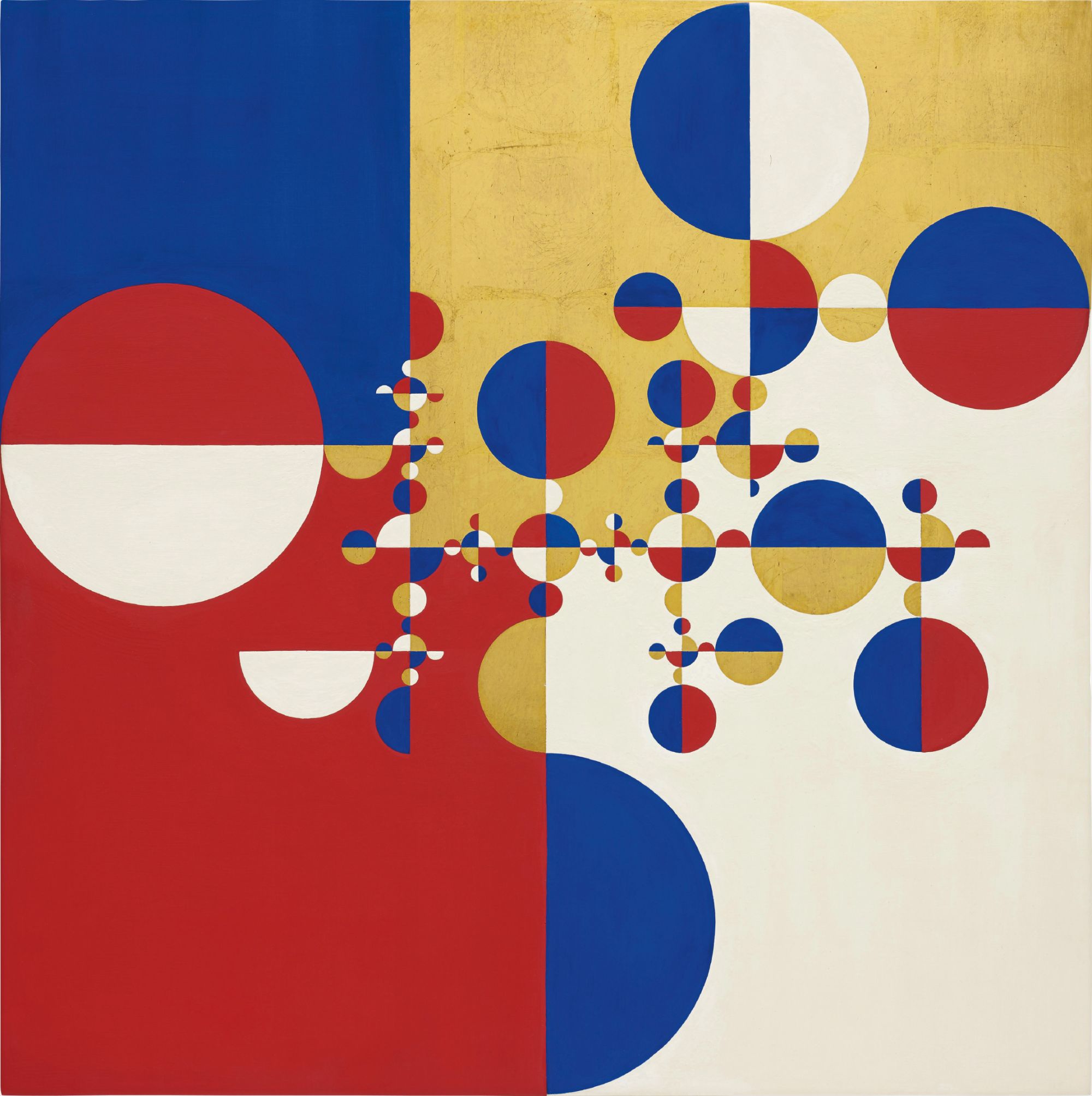
Samurai Tree 6C
Full-Cataloguing
From there, Orozco would go on to travel and exhibit around the world, renouncing the sanctified space of the traditional artist’s studio, and instead utilizing the everyday streets as his canvas. The present work, Samurai Tree 6C (2006), comes from one of the artist’s best known series, one that disrupts the viewer’s traditional notions of art by utilizing the medium of painting yet removing the artist’s hand completely, as well as his creative impulses. Rather, the series of Samurai Tree Invariants—begun in 2004 and each executed by either Philippe Piccoli or Christian Macia—has over 600 computer generated permutations designed by Orozco and based on a composition drawn into four quadrants, following a systematic series of circles bisected by dividing lines with rotating colors of red, blue, white and gold.
Gabriel Orozco
Mexican | 1954Gabriel Orozco's diverse practice, which includes sculpture, photography, painting and video, is centered on the rejection of the concept of a traditional studio. Alternatively, Orozco's conceptual process involves using quotidian objects as commentary on urban society. In the widely exhibited La DS (1993), Orozco cut a Citroën DS car into thirds, eliminating the central section and reconfiguring the remaining parts.
Another important motif in Orozco's lexicon is that of the colored ellipses. In his seminal series, Samurai Tree Invariants, the artist employs fragmented colored circles as the basis for geometric compositions, exploring the movements made by a knight on a chessboard. These not only represent Orozco's conceptual practices but illustrate his interest in both the geometric and organic world.