

19
Cartier
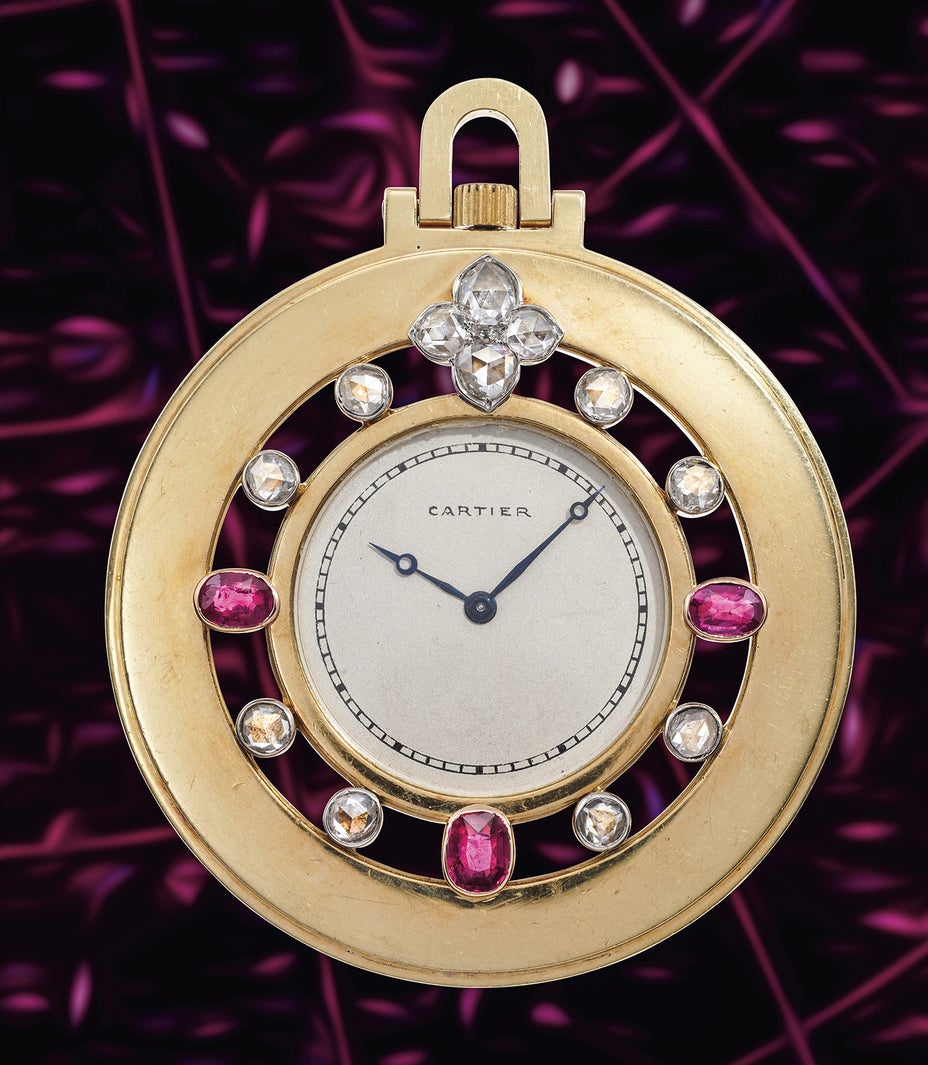
A highly rare and attractive ruby and diamond-set open face "helm style" pocket watch
- Estimate
- CHF6,000 - 12,000€6,500 - 13,000$7,400 - 14,700
CHF20,320
Lot Details
- Manufacturer
- Cartier
- Year
- Circa 1940
- Case No
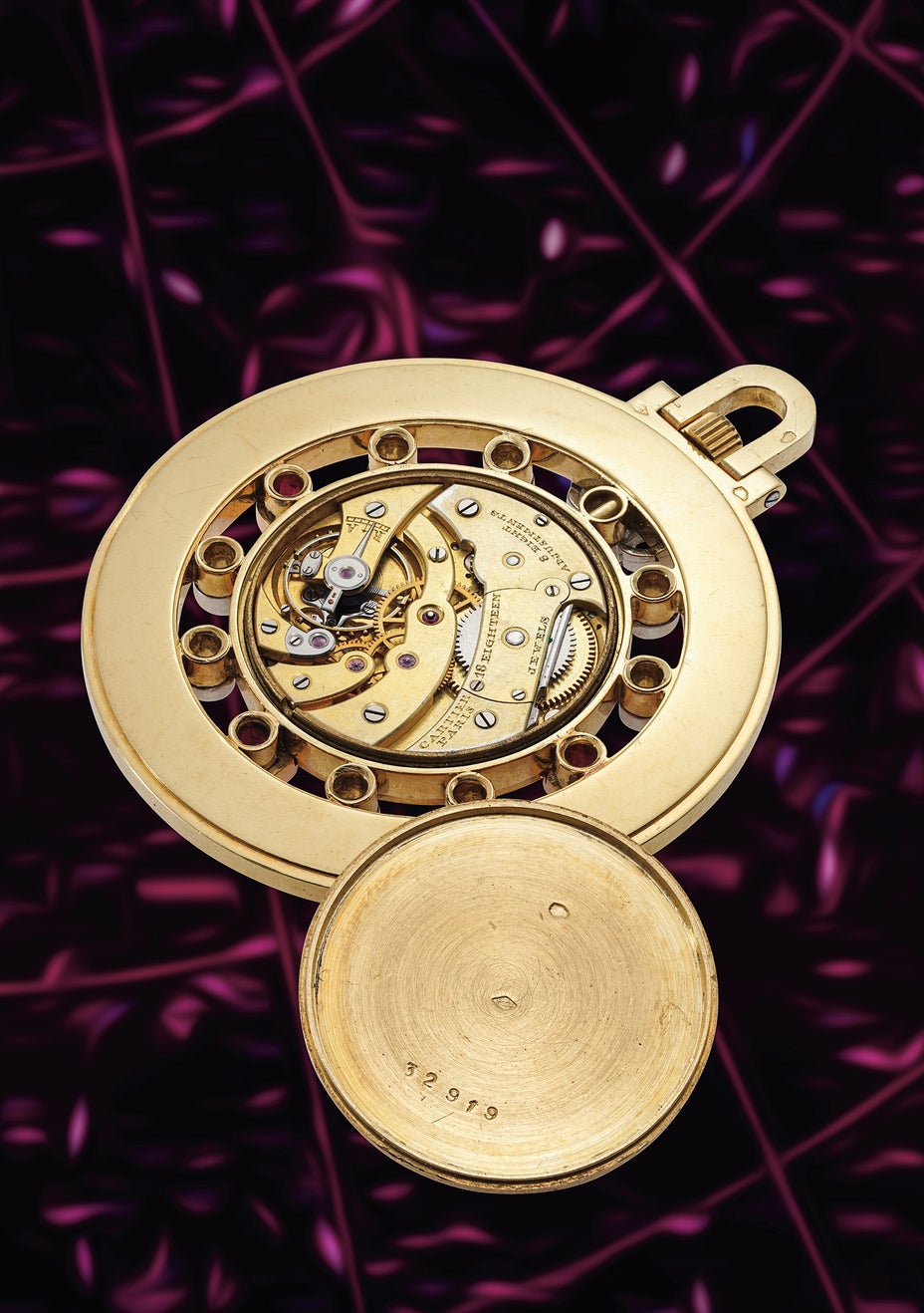
- 32'919
- Material
- 18k yellow gold, diamonds and rubies
- Calibre
- Manual, 18 jewels
- Dimensions
- 44.5mm diameter
- Signed
- Dial and movement signed, case furthermore signed with Cartier hand stamped numbers and EJ maker's mark
Specialist
Full-Cataloguing
Catalogue Essay
The advent of the 1940s brought forward the return of gold watches and gold cases - a stylistic departure from the ornate and flamboyant designs of the Art Deco era. During this time, round watches surpassed the Art Deco inspired form watches of the previous decades in terms of popularity. Cartier took the notion of a round watch one step further by creating one with another circular bezel attached by circular fixtures. This design gave way to the name "Helm Watch", or "Gouvernail" in French, named such because of its design resembling a ship's wheel. The timepieces during this period were usually plain yellow gold or platinum, however the most lavish examples were set with stones.
The present open-face watch is a symbolic bridge of sorts, linking the Art Deco era and the 1940s. While it is round in shape, with a helm-like outer bezel, it still retains the codes of the Art Deco era with its Indian-inspired floral motifs and use of rose-cut diamonds and rubies. The floral Hindu motif would notably be reused again by Cartier in the modern era in its catalogue, making reference to the past.
Preserved in excellent condition, this timepiece is a testament to how Cartier forever reinvented itself throughout history and constantly pushed the boundaries of what was considered the status quo.
The present open-face watch is a symbolic bridge of sorts, linking the Art Deco era and the 1940s. While it is round in shape, with a helm-like outer bezel, it still retains the codes of the Art Deco era with its Indian-inspired floral motifs and use of rose-cut diamonds and rubies. The floral Hindu motif would notably be reused again by Cartier in the modern era in its catalogue, making reference to the past.
Preserved in excellent condition, this timepiece is a testament to how Cartier forever reinvented itself throughout history and constantly pushed the boundaries of what was considered the status quo.
Cartier
FrenchWith the Constitution of 1848 came a new standard for luxury in France. Founded one year prior by Louis-Francois Cartier, the house of Cartier was one of the first to use platinum in jewelry making. This incredibly expensive material became the stepping-stone for Cartier to experiment in form, mechanisms and attitude. It helped men move from pocket watches to wristwatches, effectively making the watch much more functional and prominent in a man's overall wardrobe.Cartier did not only touch on functionality. Inspired by a commissioned painting by George Barbier featuring a black panther at the feet of an elegantly bejeweled woman, Cartier began incorporating wild animals in his designs—most notably, Cartier Panthère rings, bangle bracelets and watches. Yet it wasn't until the late 1960s that the house of Cartier debuted their iconic yellow and rose gold LOVE collection, which includes the famous bracelet that only a special screwdriver can open.
Browse Maker