36
Alexander Archipenko
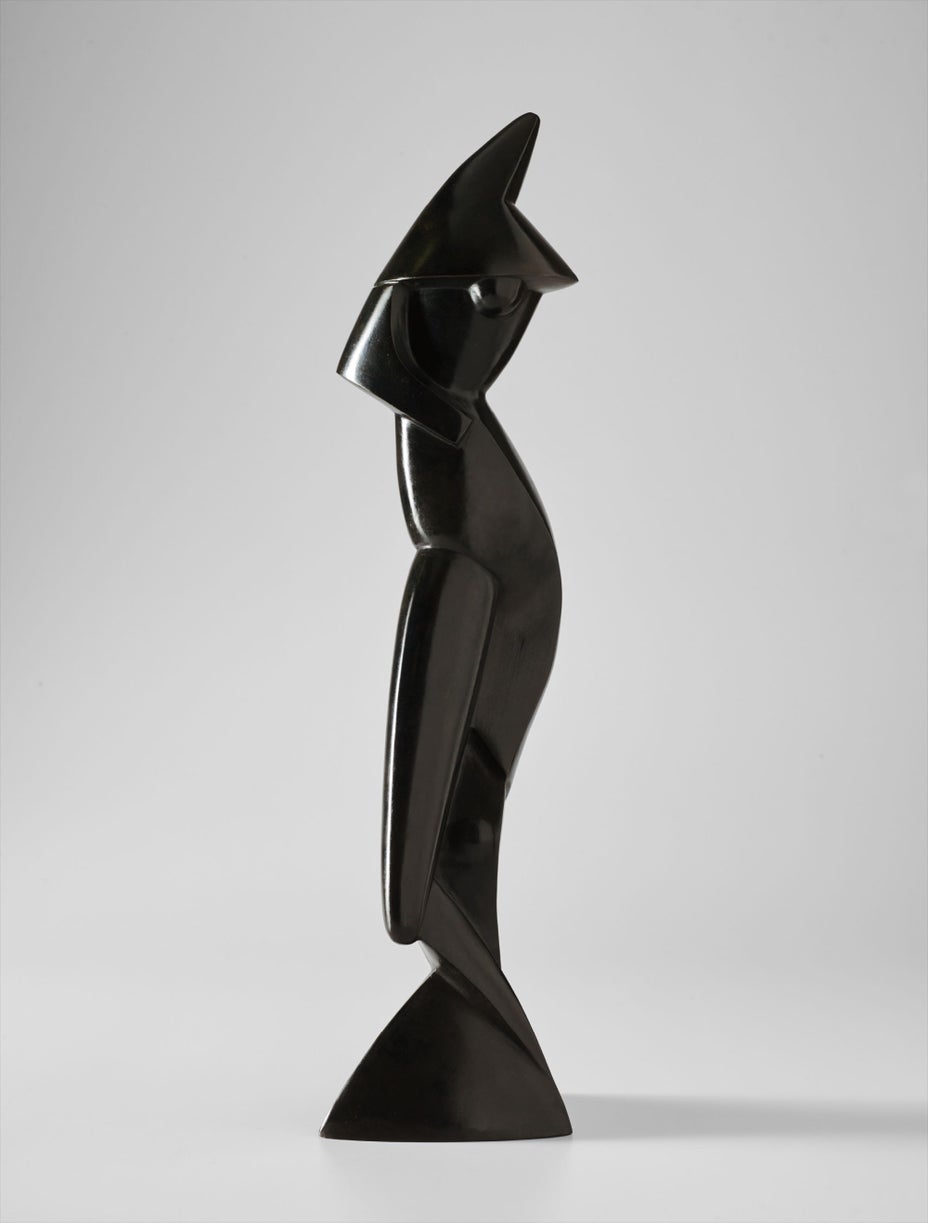
Statue on Triangular Base
Estimate
$350,000–450,000
Sold For
$394,000
incised with the artist's name, number and date "Archipenko 1914 3/6" on the base
patinated bronze
30 x 7 1/2 x 6 in. (76.2 x 19.1 x 15.2 cm.)
Conceived in 1914 and cast in 1960, this work is number 3 from an edition of 6. The authenticity of this work has kindly been confirmed by Frances Archipenko Gray.
Full-Cataloguing
Alexander Archipenko’s innovative integration of synthetic cubism’s simple geometric shapes and interlocking planes with natural cadences is exemplified in Statue on a Triangular Base. Created at the height of his Parisian period, the sculpture highlights Archipenko’s use of concave and convex forms and his refinement of the plastic arts. From the front, the sculpture disappears into flat connecting planes flowing through opposing diagonals from the triangle base to the cone-like head and angular arm. As you look closer, the two-dimensionality gives way to voluminous forms. It is this tension between two opposing forces that provides the sculpture’s energy, movement and spirit.
As the artist himself observed, “In order to explain the spiritual value of my concave, we must consider the psychological side of this new sculptural element. It is evident that in sculpture each point of the surface should have meaning and be related to millions of other points of the surface. Likewise, relief and concave are reciprocally integrated…So in my sculpture, all concaves have optical and psychological significance.” (Archipenko, Fifty Creative Years, p. 21)
Archipenko’s Parisian years (1908-1921) are often cited as his most productive and “heroic” period. During this time, he established himself as an innovator of cubist sculpture and sculptural form, developing a new method of “controlling space.” (Archipenko, Fifty Creative Years, p. 28) His experimentations with space, such as the use of concave and convex forms to abstract a human figure, coupled with his use of negative space, are among his lasting contributions to modern sculpture.
When he arrived in Paris from his native Kiev, Cubism was on the rise. The visual language developed by Picasso and Braque had a concentrated group of followers who were keen to push the stylistic boundaries. Archipenko met and exhibited with this group of pioneering artists, such as Sonia Delaunay, Marcel Duchamp, Raymond Duchamp-Villon, Albert Gleizes, Jean Metzinger and Fernand Léger, both at “La Ruche,” the artist’s colony in Montmartre where he first lived, as well as in the Salon des Indépendants where he exhibited from 1910-1914.
Archipenko’s unique style was not only a product of his association with the Parisian avant-garde. While the Cubist paintings and papier collés of Picasso and Braque had a profound impact on his work, Archipenko’s oeuvre was also deeply affected by his study of Egyptian, Greek and Gothic works, as well as the Byzantine mosaics of his homeland. As Katherine Kuh wrote in her essay to the Museum of Modern Art’s seminal exhibition Archipenko: The Parisian Years:
"Long applauded as a pioneer Cubist sculptor, he was far more than that. He never merely transferred Cubist theories from painting to sculpture; he virtually invented his own kind of three-dimensional Cubism. Relying on the human body, preferably the female nude, as his point of departure, Archipenko constructed his figures with architectural precision, yet rarely sacrificed the rhythms of nature. His idealized women have the elongated elegance we sometimes associate with undulating plants, sometimes with those Gothic saints which echo the soaring churches they decorate."
As the artist himself observed, “In order to explain the spiritual value of my concave, we must consider the psychological side of this new sculptural element. It is evident that in sculpture each point of the surface should have meaning and be related to millions of other points of the surface. Likewise, relief and concave are reciprocally integrated…So in my sculpture, all concaves have optical and psychological significance.” (Archipenko, Fifty Creative Years, p. 21)
Archipenko’s Parisian years (1908-1921) are often cited as his most productive and “heroic” period. During this time, he established himself as an innovator of cubist sculpture and sculptural form, developing a new method of “controlling space.” (Archipenko, Fifty Creative Years, p. 28) His experimentations with space, such as the use of concave and convex forms to abstract a human figure, coupled with his use of negative space, are among his lasting contributions to modern sculpture.
When he arrived in Paris from his native Kiev, Cubism was on the rise. The visual language developed by Picasso and Braque had a concentrated group of followers who were keen to push the stylistic boundaries. Archipenko met and exhibited with this group of pioneering artists, such as Sonia Delaunay, Marcel Duchamp, Raymond Duchamp-Villon, Albert Gleizes, Jean Metzinger and Fernand Léger, both at “La Ruche,” the artist’s colony in Montmartre where he first lived, as well as in the Salon des Indépendants where he exhibited from 1910-1914.
Archipenko’s unique style was not only a product of his association with the Parisian avant-garde. While the Cubist paintings and papier collés of Picasso and Braque had a profound impact on his work, Archipenko’s oeuvre was also deeply affected by his study of Egyptian, Greek and Gothic works, as well as the Byzantine mosaics of his homeland. As Katherine Kuh wrote in her essay to the Museum of Modern Art’s seminal exhibition Archipenko: The Parisian Years:
"Long applauded as a pioneer Cubist sculptor, he was far more than that. He never merely transferred Cubist theories from painting to sculpture; he virtually invented his own kind of three-dimensional Cubism. Relying on the human body, preferably the female nude, as his point of departure, Archipenko constructed his figures with architectural precision, yet rarely sacrificed the rhythms of nature. His idealized women have the elongated elegance we sometimes associate with undulating plants, sometimes with those Gothic saints which echo the soaring churches they decorate."