
23
Alejandro Otero
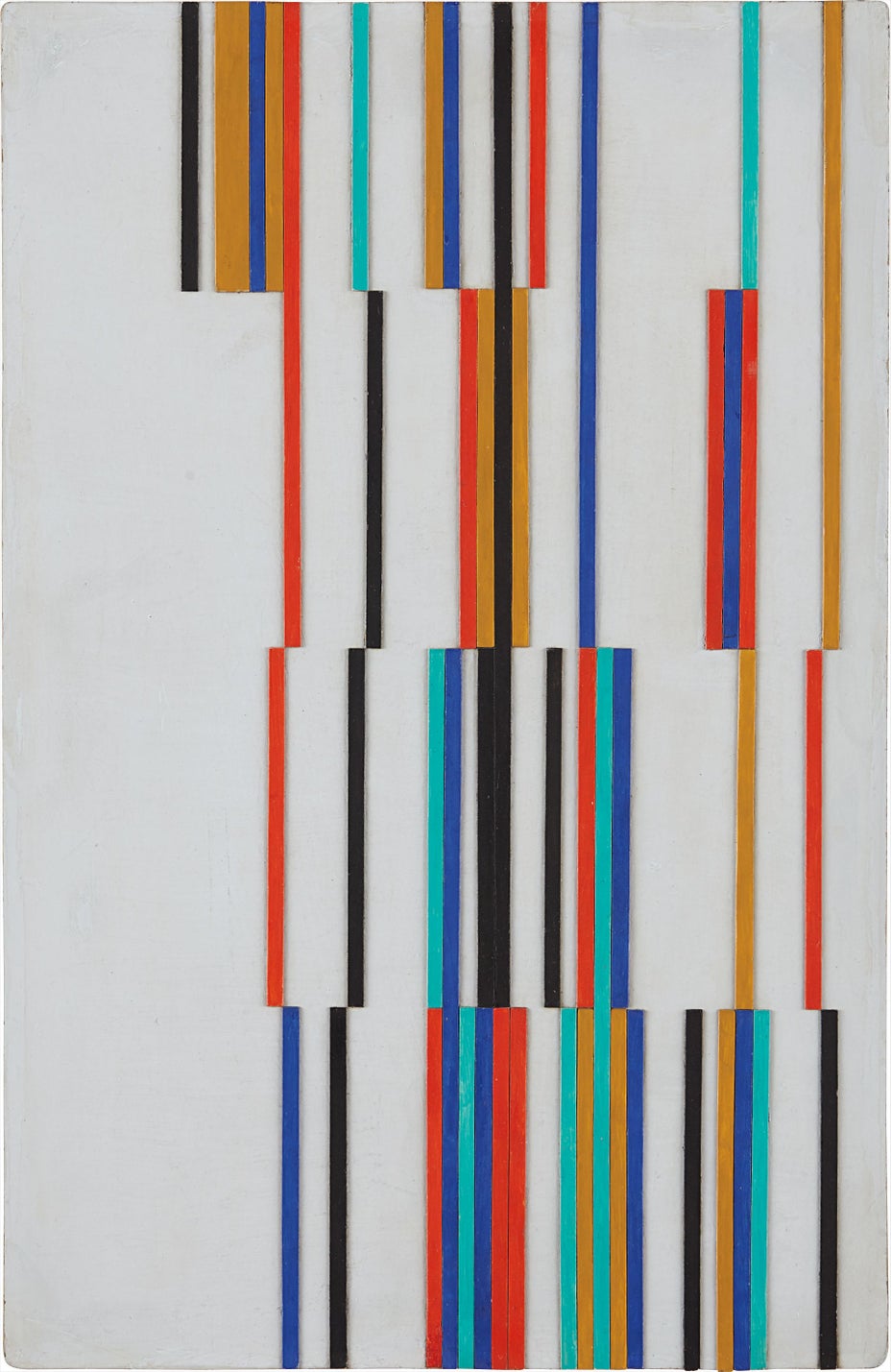
Untitled
- Estimate
- $40,000 - 60,000
$161,000
Lot Details
duco on formica, mounted on wood
circa 1965-1970
16 3/4 x 11 in. (42.5 x 27.9 cm.)
Signed and dated "Alejandro Otero 1984" and dedicated on the reverse.
Specialist
Full-Cataloguing
Catalogue Essay
After graduating from the Escuela de Artes Plásticas y Artes Aplicadas in Caracas, Alejandro Otero went on to become a prolific painter and sculptor, having won the very first Venezuela Official Art Salon prize as a young man. His extensive travels in New York and Europe enabled him to become intimately familiar with the artistic movements of the time. His earliest creative period was marked by a transition from realistic representation to abstraction, which, despite initially causing uproar in Venezuela, helped spearhead avant-garde abstraction in the country and initiated a new era of art-making. Fundamentally influenced by the work of Piet Mondrian, Otero dedicated most of his career to experimenting with the spatial and optical effects of line and color, ultimately becoming one of the greatest Venezuelan op-art and abstract artists of the Post-War period.
After living in Europe for several years, Otero returned to Venezuela and was soon invited to participate in the famous public art project of the University City of Caracas, directed by architect Carlos Raúl Villanueva, which helped integrate Venezuelan visual arts within the country’s urban development. During this time Otero produced a stunning series of Colorhythms, which form one of the major stages of his oeuvre. An emblematic example of this series, in the present lot the viewer readily experiences Otero’s application of rhythm to color over form, suggesting a subtle spatial ambiguity that insinuates movement. Throughout his Colorhythms, Otero proposed the notion of the picture plane as a spatial field that is constantly expanding, simultaneously combining painting and volume into an intricate visual dance.
Provenance
Alejandro Otero
Venezuelan | B. 1921 D. 1990Alejandro Otero is an important figure in Venezuelan abstract and kinetic art. He studied and lived in France and returned to Venezuela during a significant moment when his country was undergoing modernization. During this time he participated in a large scale architectural project with renowned Venezuelan architect Raúl Villanueva that significantly informed his works. Primarily influenced by Piet Mondrian, his art denotes the notions of integration and architecture, as well as the continual experimentation with spatial and optical effects of line and color. His most important contribution to the field of painting is his series of Coloritmos (Colorythms), where he applies rhythm to color form, suggesting a subtle spatial ambiguity and insinuating a complex visual dance.
Browse Artist