133
Ettore Sottsass, Jr.
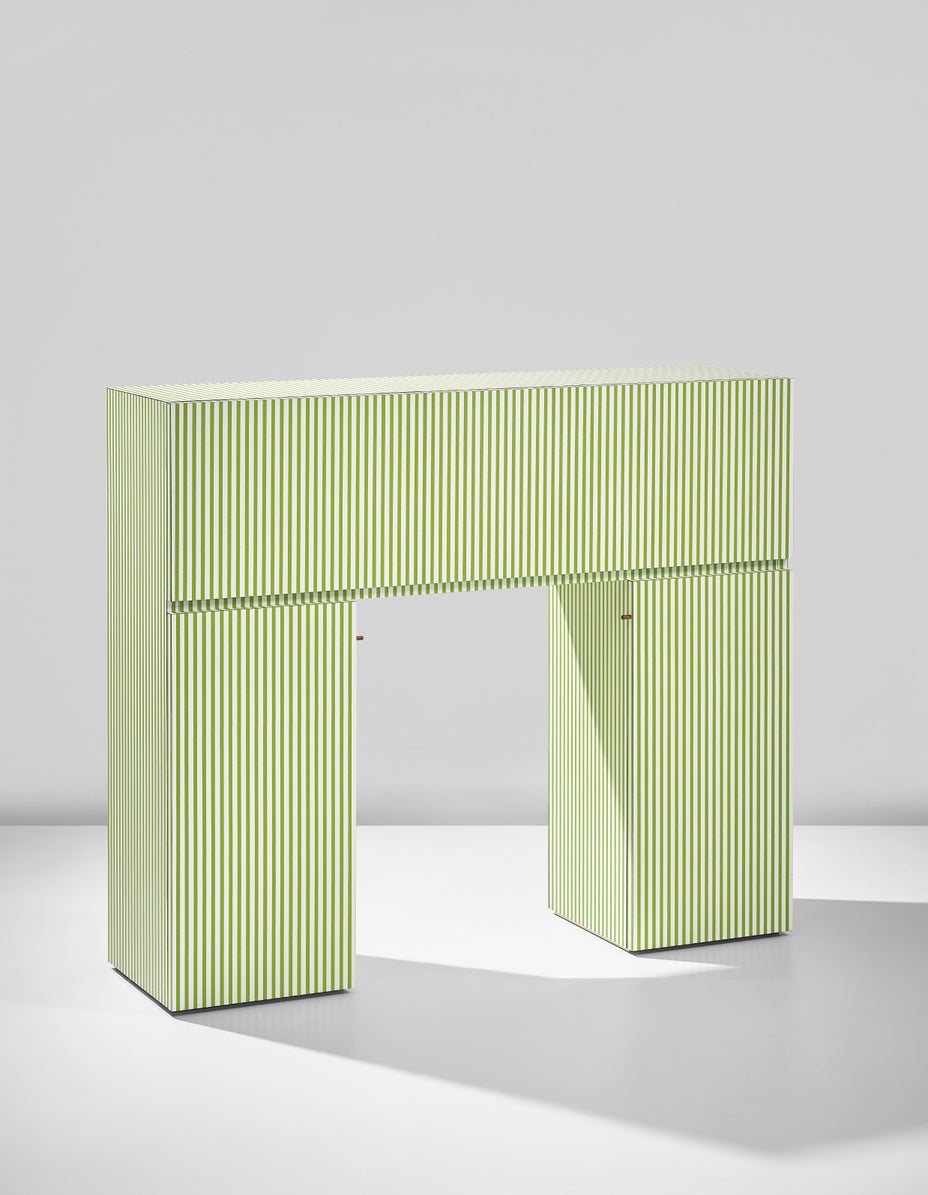
'Nefertiti' writing desk
Estimate
£40,000–60,000
Sold For
£65,000
1968-1969
Plastic-laminated wood, steel.
110.2 x 126.9 x 35.2 cm (43 3/8 x 49 7/8 x 13 7/8 in.)
Manufactured by Poltronova, Agliana, Italy.
Full-Cataloguing
The ‘Nefertiti’ writing desk is amongst the first furniture pieces to be executed with decorative plastic laminate in the history of design. It is the result of the collaboration between Ettore Sottsass and the Italian manufacturer Abet Laminati, the first to introduce new techniques for screen-printing of plastic laminates following Sottsass’ vision.
Designed in 1967, stylistically, the design follows from the series of ‘Superbox’ wardrobes, which Sottsass also conceived for Poltronova. Importantly, with these designs, Sottsass sought to demonstrate to Abet Laminati the economic potential of this innovative process. The large series of enigmatic column-shaped units which, freed from clear function and endowed with a strong figurative value, impose a new way of domestic living and interacting. Large remaining a conceptual project for Sottsass, and with only a few prototypes ever produced, the project initiated a laminate screen-printing workshop at Abet Laminati.
Equally colourful and enigmatic, the ‘Nefertiti’ writing desk was introduced to the Poltronova catalogue shortly thereafter, where it was offered until the mid-1970s. Exclusively by order, only a few examples of the desk were ever executed. The original design was conceived by Sottsass in white and green vertical laminate stripes on the exterior, with a white interior, such as the present lot. Colour variations included pink and white stripes, with white interior; green and white stripes applied only on the front and back elevation, with all other sides in white; or entirely white monochrome. It is probable that other variations also exist.
The green and white striped writing desk was included in the principal exhibitions on Ettore Sottsass’ work of this period, notably the ‘Miljo for en ny Planet’ exhibition at the National Museum of Stockholm in 1969, and ‘Italy: The New Domestic Landscape’ at MoMA, New York in 1972, the latter acquiring the writing desk for their permanent collection the same year.
Architetto Milco Carboni
Designed in 1967, stylistically, the design follows from the series of ‘Superbox’ wardrobes, which Sottsass also conceived for Poltronova. Importantly, with these designs, Sottsass sought to demonstrate to Abet Laminati the economic potential of this innovative process. The large series of enigmatic column-shaped units which, freed from clear function and endowed with a strong figurative value, impose a new way of domestic living and interacting. Large remaining a conceptual project for Sottsass, and with only a few prototypes ever produced, the project initiated a laminate screen-printing workshop at Abet Laminati.
Equally colourful and enigmatic, the ‘Nefertiti’ writing desk was introduced to the Poltronova catalogue shortly thereafter, where it was offered until the mid-1970s. Exclusively by order, only a few examples of the desk were ever executed. The original design was conceived by Sottsass in white and green vertical laminate stripes on the exterior, with a white interior, such as the present lot. Colour variations included pink and white stripes, with white interior; green and white stripes applied only on the front and back elevation, with all other sides in white; or entirely white monochrome. It is probable that other variations also exist.
The green and white striped writing desk was included in the principal exhibitions on Ettore Sottsass’ work of this period, notably the ‘Miljo for en ny Planet’ exhibition at the National Museum of Stockholm in 1969, and ‘Italy: The New Domestic Landscape’ at MoMA, New York in 1972, the latter acquiring the writing desk for their permanent collection the same year.
Architetto Milco Carboni