228
Alfred Stieglitz
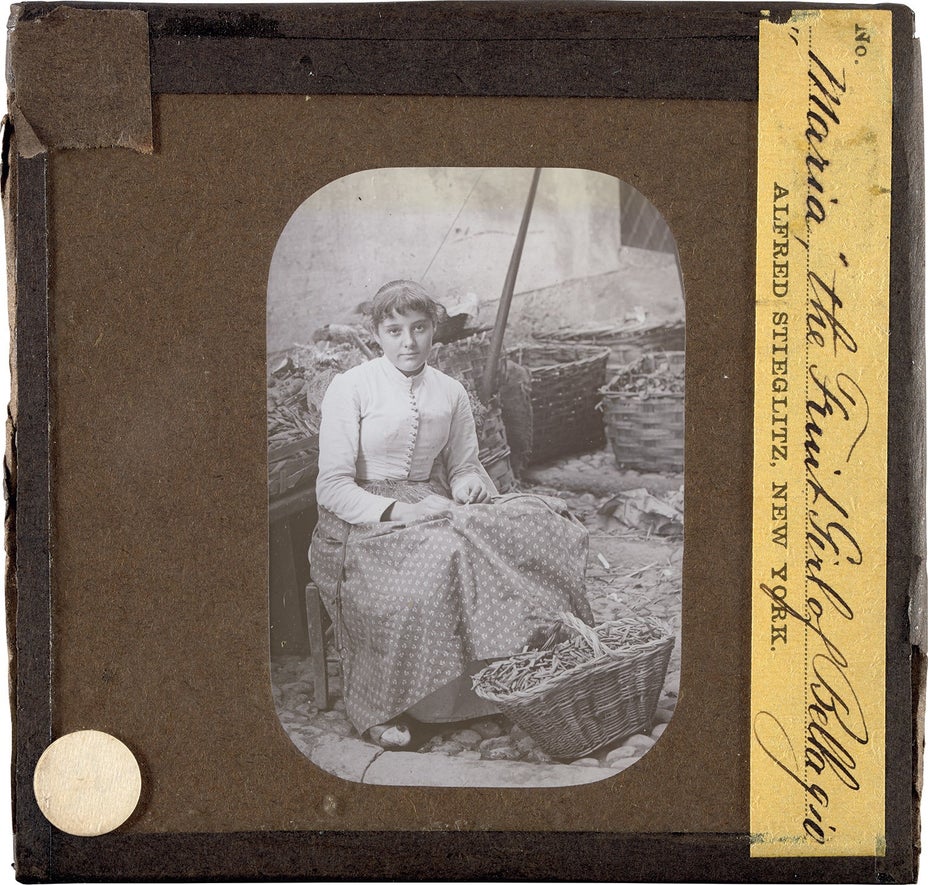
Maria, the Fruit Girl of Bellagio
Estimate
$7,000–9,000
1887
Gelatin dry-plate lantern slide.
2 3/8 x 1 1/2 in. (6 x 3.8 cm)
Overall 3 1/4 x 3 3/8 in. (8.3 x 8.6 cm)
Overall 3 1/4 x 3 3/8 in. (8.3 x 8.6 cm)
Titled in ink and printed credit on paper label affixed to the glass housing.
Full-Cataloguing
Alfred Stieglitz experimented broadly with photographic techniques and printing methods in his early career. His perfection of the photogravure, platinum, and palladium processes are generally known, but he was equally enthusiastic about the lantern slide and ultimately created a series of finely-realized slides that met his high standards for tonal precision and detail, such as the example offered here. A lantern slide is a transparency on glass designed to be viewed with a projector, popularly known as a magic lantern. Projected onto a wall or screen, a properly made lantern slide produced a luminous image much larger than could be attained through the printing methods of the day. Stieglitz’s belief in the process as a vehicle for his images was such that he made slides of many of his best photographs and included them in several prominent exhibitions.
Maria, The Fruit Girl of Bellagio was an important image for Stieglitz early in his career. It was reproduced in the photographic literature of the day, and Stieglitz included it in many European and American exhibitions through 1899. A print of this image was shown in Stieglitz’s 1934 retrospective exhibition at An American Place. The lantern slide offered here was originally given by Stieglitz to Emilie V. Clarkson, a young photographer who exhibited her work widely in the late 19th and early 20th centuries. Working in New York, Clarkson was befriended by Stieglitz, becoming one of the few women photographers within his orbit. Like Stieglitz, Clarkson was a great believer in lantern slides as a photographic medium. Her collection of lantern slides, by her and other photographers, is in the collection of St. Lawrence University.
Maria, The Fruit Girl of Bellagio was an important image for Stieglitz early in his career. It was reproduced in the photographic literature of the day, and Stieglitz included it in many European and American exhibitions through 1899. A print of this image was shown in Stieglitz’s 1934 retrospective exhibition at An American Place. The lantern slide offered here was originally given by Stieglitz to Emilie V. Clarkson, a young photographer who exhibited her work widely in the late 19th and early 20th centuries. Working in New York, Clarkson was befriended by Stieglitz, becoming one of the few women photographers within his orbit. Like Stieglitz, Clarkson was a great believer in lantern slides as a photographic medium. Her collection of lantern slides, by her and other photographers, is in the collection of St. Lawrence University.