Property of an Important European Collector
28
Zeng Fanzhi
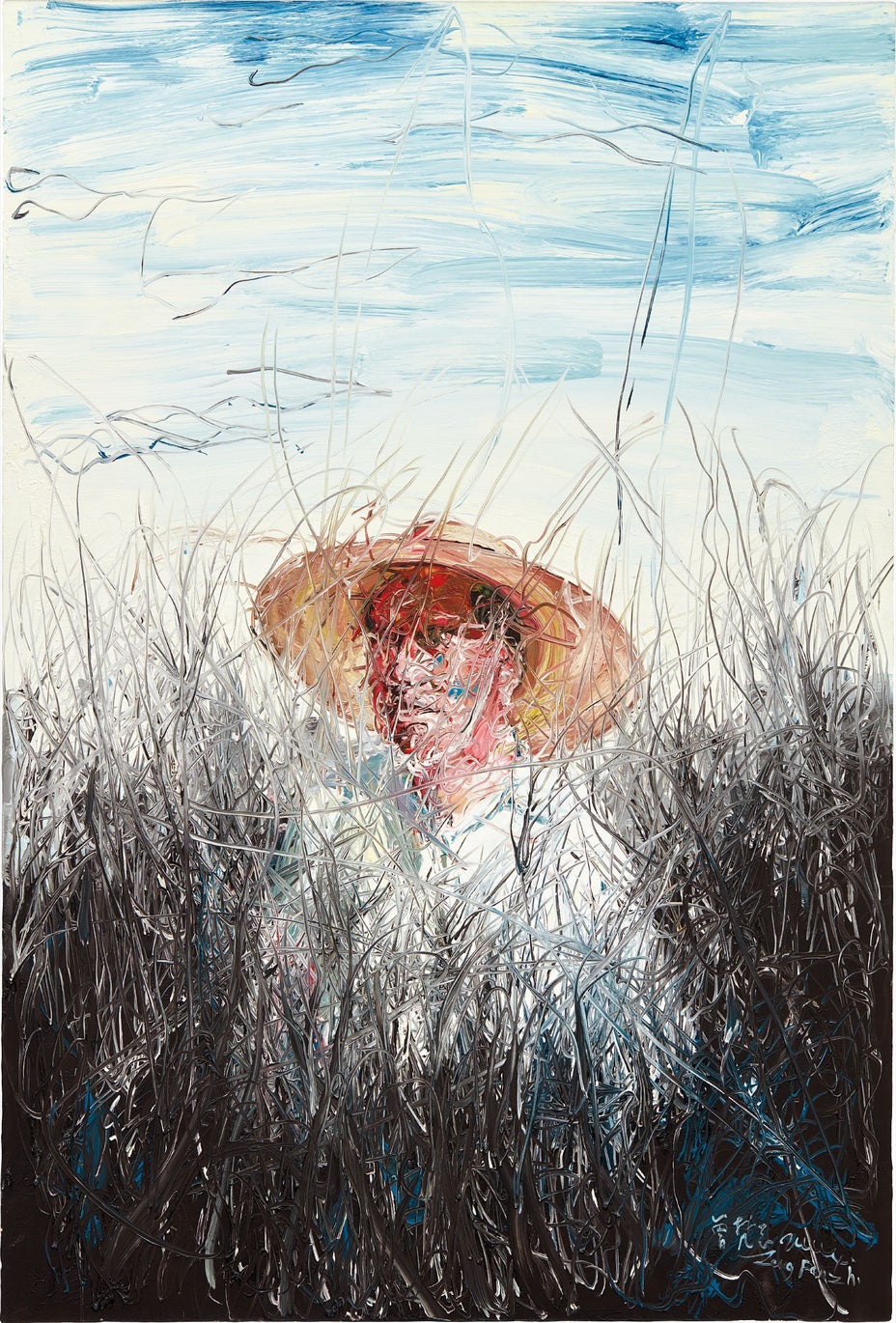
A Man with a Straw Hat
Estimate
HK$5,000,000–7,000,000
€602,000–843,000
$641,000–897,000
Sold For
HK$5,120,000
signed and dated 'Zeng Fanzhi [Chinese and Pinyin] 2004' lower right
oil on canvas
239.9 x 162 cm (94 1/2 x 63 3/4 in.)
Painted in 2004.
Full-Cataloguing
Zeng Fanzhi’s position as the famed ‘Mask Artist’ shifted at the turn of the millennium, when the artist began a new form of artistry. Developing another mode of ‘masking’ his figures, Zeng explored the act of concealment with his radical luanbi method in the early 2000s. With the use of palette knives, Zeng’s electric luanbi method is achieved by scraping away paint and dragging impasto in expressionistic gestures, guided by raw emotion. The outcome of this technique is a body of rich, dense pieces usually depicting unbridled nature and sprawling landscapes.
The central figure in A Man with a Straw Hat is an adaptation of a well-known photograph of Chairman Mao, taken by Hou Bo, one of the most well-known photographers of Mao Zedong. This piece features the rare depiction of Mao, a figure whom only sporadically appears in Zeng’s oeuvre. This bold allusion to and evocation of The Chairman is in great contrast to the artist’s other works, where specific figures are rarely rendered outright, but instead are merely hinted at through subtle symbols such as red kerchiefs of Mao jackets. Extending the artist’s exploration of the remnant imageries and collective experiences from the Cultural Revolution, A Man with a Straw Hat is a continuation of Zeng’s investigation into his Chinese heritage and childhood.
The present lot’s scale immediately evokes Mao’s immense influence and almost god-like status. Obscured by a dense wall of grass, as well as elusively referred to as the titular A Man in a Straw Hat, Mao is both concealed but also immediately recognisable. This interplay highlights the paradox in The Chairman’s ubiquity in China, but also the distance between the figure and present day. The crops in the original image are replaced by jagged branches typical of Zeng’s luanbi scenes, injecting the work with a sense of the unknown, decontextualising the work.
That such a recognisable image of Mao is used here is bold, but that it also quietly references any number of Self-Portrait[s] in a Straw Hat painted by Vincent van Gogh in 1887 is a testament to Zeng’s wide range of stimuli—an important influence which the artist himself has acknowledged. Speaking in an interview in 2015, the artist stated that “Van Gogh saw colours rather than three-dimensional objects”, a manner of painting that no doubt lends itself to the vibrancy and visceral energy in A Man with a Straw Hat (Zeng in an interview with Phong Bui, in ‘In Conversation: Zeng Fanzhi with Phong Bui', The Brooklyn Rail, 9 December 2015, reproduced online).
The central figure in A Man with a Straw Hat is an adaptation of a well-known photograph of Chairman Mao, taken by Hou Bo, one of the most well-known photographers of Mao Zedong. This piece features the rare depiction of Mao, a figure whom only sporadically appears in Zeng’s oeuvre. This bold allusion to and evocation of The Chairman is in great contrast to the artist’s other works, where specific figures are rarely rendered outright, but instead are merely hinted at through subtle symbols such as red kerchiefs of Mao jackets. Extending the artist’s exploration of the remnant imageries and collective experiences from the Cultural Revolution, A Man with a Straw Hat is a continuation of Zeng’s investigation into his Chinese heritage and childhood.
The present lot’s scale immediately evokes Mao’s immense influence and almost god-like status. Obscured by a dense wall of grass, as well as elusively referred to as the titular A Man in a Straw Hat, Mao is both concealed but also immediately recognisable. This interplay highlights the paradox in The Chairman’s ubiquity in China, but also the distance between the figure and present day. The crops in the original image are replaced by jagged branches typical of Zeng’s luanbi scenes, injecting the work with a sense of the unknown, decontextualising the work.
That such a recognisable image of Mao is used here is bold, but that it also quietly references any number of Self-Portrait[s] in a Straw Hat painted by Vincent van Gogh in 1887 is a testament to Zeng’s wide range of stimuli—an important influence which the artist himself has acknowledged. Speaking in an interview in 2015, the artist stated that “Van Gogh saw colours rather than three-dimensional objects”, a manner of painting that no doubt lends itself to the vibrancy and visceral energy in A Man with a Straw Hat (Zeng in an interview with Phong Bui, in ‘In Conversation: Zeng Fanzhi with Phong Bui', The Brooklyn Rail, 9 December 2015, reproduced online).