42
Wolfgang Tillmans
Freischwimmer 99
Full-Cataloguing
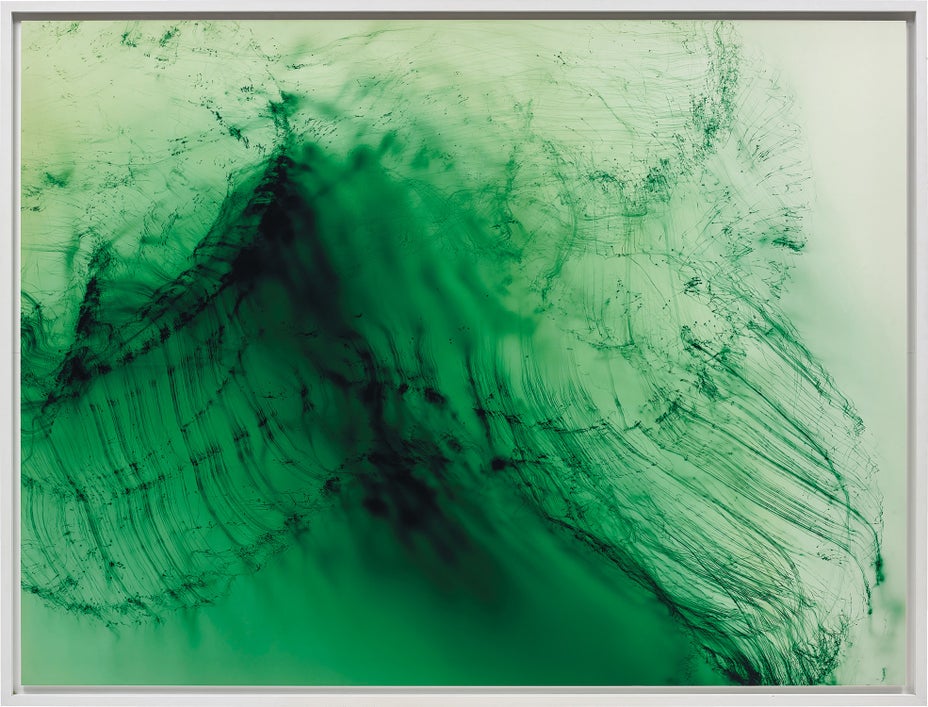
Engulfing the viewer in meandering expanses of emerald, Freischwimmer 99, 2004, marvellously exemplifies Wolfgang Tillmans titular series, which explores the visual qualities and parameters of light as a medium. Though the present image has been produced without a camera, a subject, or a negative, Tillmans asserts that it represents, along with its sister Freischwimmer works, the purest form of photography. To create these prints, the artist exposed photographic paper in a darkroom, digitised the result on a computer, and enlarged the luminographs to monumental proportions, before presenting them as unframed inkjet prints, or large framed mounted prints. Musing on the irreducibly important element of chance in this mechanical technique, Tillmans remarked, ‘what connects all my work is finding the right balance between intention and chance, doing as much as I can and knowing when to let go’ (Wolfgang Tillmans, in conversation with Dominic Eicher, Frieze, issue 118, October 2008, online). A sublime example from Tillmans’ now iconic series, Freischwimmer 99 was conceived on the heels of his major solo exhibition at Tate Britain, London, in 2003, and just a few years following his reception of the Turner Prize, in 2000.
Borne from the theoretical synthesis of water and light, Freischwimmer owes its name to the swimming certificate German children are bestowed at a beginner’s level. ’Literally, Freischwimmer means something like “swimming freely”’, explained the artist. ‘And as the title suggests, and the work intimates, a sense of fluidity is evoked in the mind of the viewer even though these pictures were essentially made “dry” – only with light and my hand’ (Wolfgang Tillmans, quoted in Jan Verwoert, Wolfgang Tillmans, London, 2002, n.p.). Boasting a regal splash of fluttering greens, the composition evokes the graceful ripples of pigment distilling in water, a sublime moment of evanescence. As such, it seems only fitting that Freischwimmer 99 would bring to mind Sigmar Polke’s Dispersion pictures, as well as the avant-garde experiments of Man Ray and György Kepes, and the fluid diffusions of colour found in Colour Field painting.
Wolfgang Tillmans
German | 1968Since the early 1990s, Wolfgang Tillmans has pushed the boundaries of the photographic medium. Challenging the indexical nature traditionally associated with photography, his abstract and representational photographic bodies of work each in their own way put forward the notion of the photograph as object—rather than as a record of reality. While achieving his breakthrough with portraits and lifestyle photographs, documenting celebrity culture as well as LGBTQ communities and club culture, since the turn of the millennium the German photographer has notably created abstract work such as the Freischwimmer series, which is made in the darkroom without a camera.
Seamlessly integrating genres, subject matters, techniques and exhibition strategies, Tillmans is known for photographs that pair playfulness and intimacy with a persistent questioning of dominant value and hierarchy structures of our image-saturated world. In 2000, Tillmans was the first photographer to receive the prestigious Turner Prize.