4
Wolfgang Tillmans
Lighter, Green I
Full-Cataloguing
Boasting an extensive photographic oeuvre spanning three decades, which has often eschewed traditional classification, Tillmans began by producing intimate, snapshot-like portraits of friends and other youth within the context of the rave and LGBT subcultures, drawing early inspiration from the works of Sigmar Polke and Andy Warhol. Having established a reputation as a distinguished purveyor of contemporary cultural and social movements, Tillmans was heralded as the “documentarian of his generation”. Although, as a result of the products of experiments with a Canon photocopier in the late 1980s, he was inspired to shift his attention to the non-representational, culminating most notably in his Freischwimmer series and Impossible Colour series, the latter of which was made from photochemical accidents and irreproducible hues.
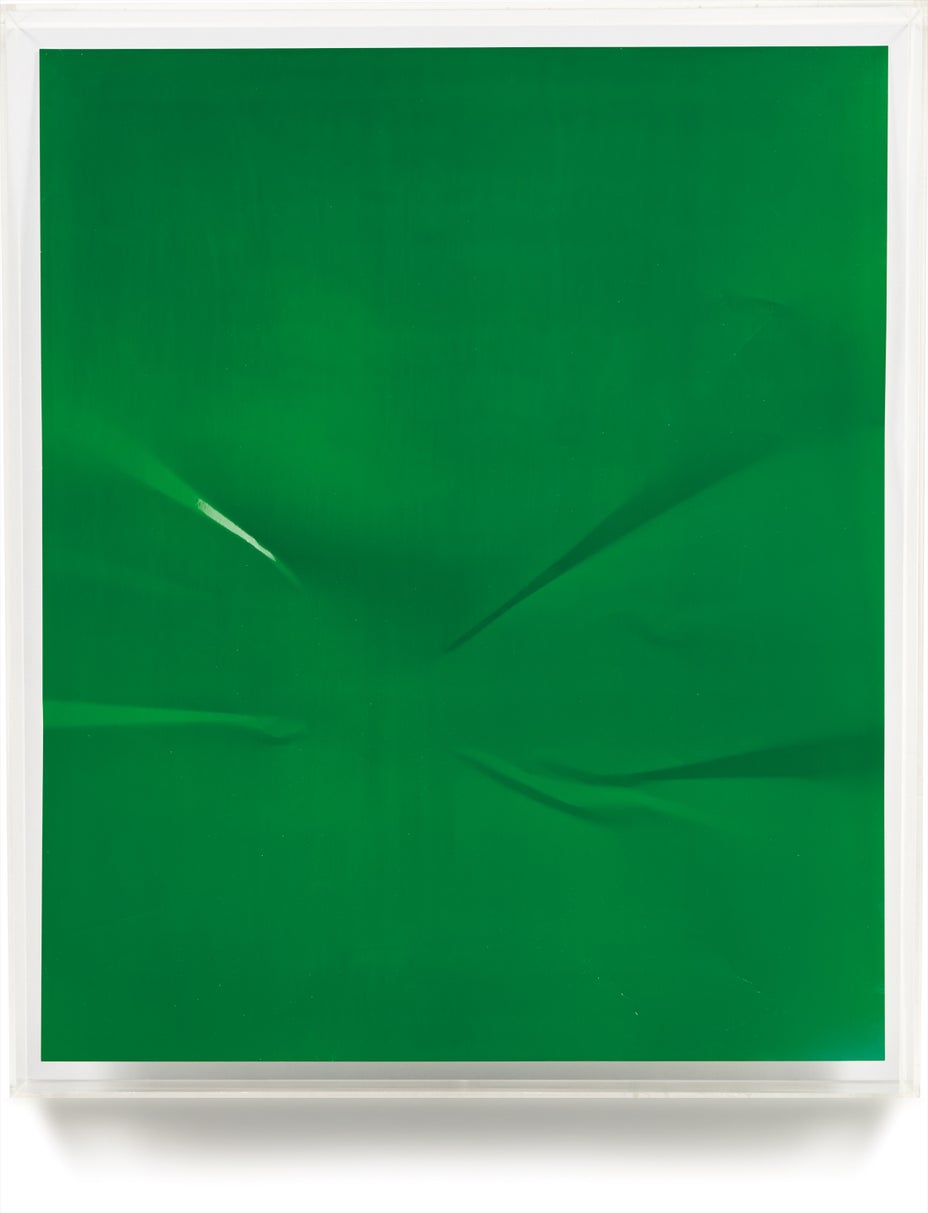
However, his Lighter series is perhaps the most groundbreaking of his developments, in which his “paper drop” photographs allow the paper itself to transcend its traditional role as a reproductive medium and instead function as an independent object. Essentially cameraless photographs, Tillmans exposes photosensitive paper directly to light, then during the subsequent developing process folds the paper, moulding the medium within a sculptural motif to render three dimensional forms.
The result of such a process is what we see in Lighter, Green I. The sheer magnitude and tactile quality of the composition allows for the viewer to be engulfed by the deep swathes of rich greens, allowing surface and scale to serve as subject matter. Sensations of ingression or submission – heightened by how the folds of the paper point in towards its centre - lie at the heart of the work, which also carries a largely ambiguous discourse between photograph and object, one that almost holds an emotional, sentient presence. Such a visceral effect is not too dissimilar from the colour fields of Mark Rothko or the monochromatic photographs of Yves Klein. Ultimately, Tillmans allows for the viewer to interact with a composition that does not coerce nor predetermine, instead assisting in a personal experience that is metaphysical, yet transcendental.
By rejecting the traditional conceptions of photographic medium and creating works which are voluminous but atmospheric, Tillmans presents to us an alternative and revolutionary form of abstraction - all the while challenging and probing the perceived boundaries of photography.
Wolfgang Tillmans
German | 1968Since the early 1990s, Wolfgang Tillmans has pushed the boundaries of the photographic medium. Challenging the indexical nature traditionally associated with photography, his abstract and representational photographic bodies of work each in their own way put forward the notion of the photograph as object—rather than as a record of reality. While achieving his breakthrough with portraits and lifestyle photographs, documenting celebrity culture as well as LGBTQ communities and club culture, since the turn of the millennium the German photographer has notably created abstract work such as the Freischwimmer series, which is made in the darkroom without a camera.
Seamlessly integrating genres, subject matters, techniques and exhibition strategies, Tillmans is known for photographs that pair playfulness and intimacy with a persistent questioning of dominant value and hierarchy structures of our image-saturated world. In 2000, Tillmans was the first photographer to receive the prestigious Turner Prize.