Property from an Important Private Collector
153Ο︎
William Baziotes
Untitled
Estimate
$300,000–400,000
Sold For
$350,000
oil on canvas
48 1/4 x 61 7/8 in. (122.4 x 157.2 cm.)
Painted in 1962, this work will be included in the forthcoming catalogue raisonné being prepared by Michael Preble in cooperation with the Ethel Baziotes Estate.
This work is accompanied by a letter from Ethel Baziotes confirming that this is the last painting the artist ever painted.
This work is accompanied by a letter from Ethel Baziotes confirming that this is the last painting the artist ever painted.
Full-Cataloguing
“It is the mysterious that I love in painting. It is the stillness and the silence. I want my pictures to take effect very slowly, to obsess and to haunt.” William Baziotes
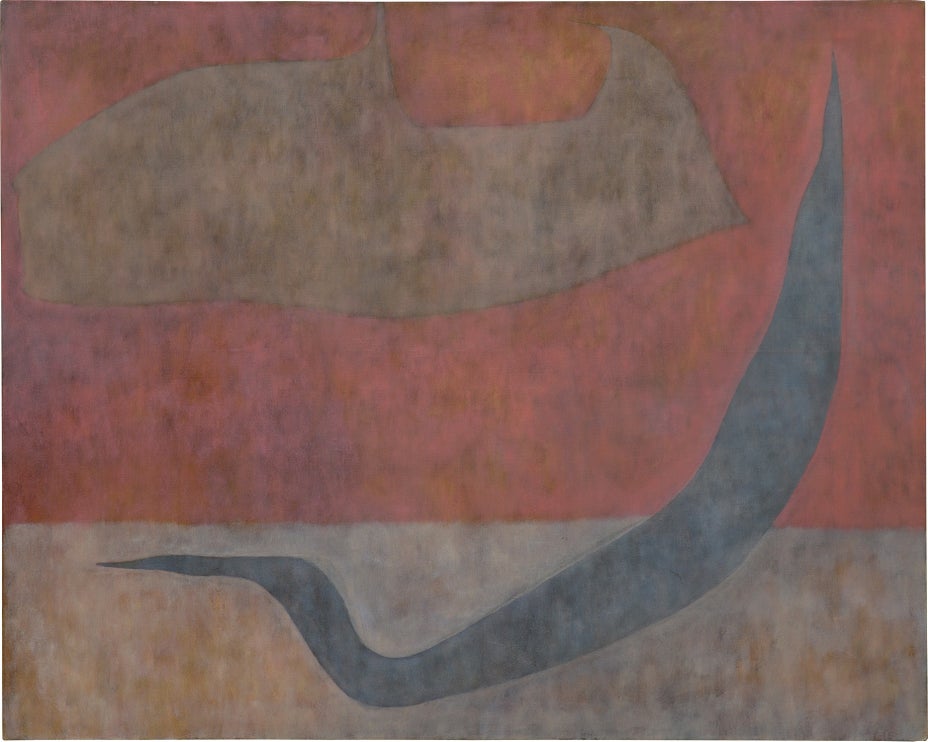
Drawing the viewer into William Baziotes’ poetic realm of pure color and form, Untitled, 1962, is a beautiful example of the distinct painterly idiom of “biomorphic abstraction" the artist pursued up to the last years of his life. Suffused with references to both the knowable and unknowable world, it is paradigmatic of the atmospheric works Baziotes had begun creating since the early 1950s. The delicate, semi-translucent surface is the result of the artist’s increased elimination of brushwork, his process of repeatedly rubbing oil paint into the surface to achieve a soft, dream-like field reminiscent of Mark Rothko’s psychologically charged canvases. While sharing Rothko’s pursuit of a deeper, primordial spiritual truth through painting, Baziotes importantly retained a deep-seated commitment to the figure, as evidenced in the biomorphic shapes which are suspended across the canvas, obliquely referencing the organic realm. As with Dusk, 1958, Solomon R. Guggenheim Museum, New York, Baziotes presents us with a painterly, Baudelairian landscape where association and allusion rule, and stillness abounds with ethereal aftereffect.
Baziotes painted Untitled as the last painting before his premature passing at merely fifty years of age. At the time, Baziotes had established a reputation as one of the leading abstract painters of his generation – having emerged as one of the core members of the pioneering artist group The Ten along with Adolph Gottlieb and Mark Rothko in the mid 1930s, and exhibiting at Peggy Guggenheim’s Art of This Century in the 1940s. And yet, as artist Carroll Dunham observed, “Baziotes has been somewhat eclipsed in that story [of Abstract Expressionism], although he was a central participant in the significant organizations, events, and broadsides that gave the downtown art scene its first feelings of traction. He developed under the same basic influences as his cohort, but his sensibility was always a little off in relation to the main currents of the time, remained close both to his Surrealist roots and to prewar American modernist painting, uninterested in the large scale and transparent approach to process that now define the period in which he was most active. As he developed, he explored a different kind of transparency, with an atmospheric touch that can seem to foreshadow artists like Olitski and…‘lyrical abstractionists’ of the later ’60s” (Carroll Dunham, “Close Up”, Artforum, Summer 2011, online). Bridging Surrealist automatism with color field painting, Baziotes’ psychologically charged canvases speak of the individualistic style that the artist pursued with unwavering commitment until the end of his career.
Drawing the viewer into William Baziotes’ poetic realm of pure color and form, Untitled, 1962, is a beautiful example of the distinct painterly idiom of “biomorphic abstraction" the artist pursued up to the last years of his life. Suffused with references to both the knowable and unknowable world, it is paradigmatic of the atmospheric works Baziotes had begun creating since the early 1950s. The delicate, semi-translucent surface is the result of the artist’s increased elimination of brushwork, his process of repeatedly rubbing oil paint into the surface to achieve a soft, dream-like field reminiscent of Mark Rothko’s psychologically charged canvases. While sharing Rothko’s pursuit of a deeper, primordial spiritual truth through painting, Baziotes importantly retained a deep-seated commitment to the figure, as evidenced in the biomorphic shapes which are suspended across the canvas, obliquely referencing the organic realm. As with Dusk, 1958, Solomon R. Guggenheim Museum, New York, Baziotes presents us with a painterly, Baudelairian landscape where association and allusion rule, and stillness abounds with ethereal aftereffect.
Baziotes painted Untitled as the last painting before his premature passing at merely fifty years of age. At the time, Baziotes had established a reputation as one of the leading abstract painters of his generation – having emerged as one of the core members of the pioneering artist group The Ten along with Adolph Gottlieb and Mark Rothko in the mid 1930s, and exhibiting at Peggy Guggenheim’s Art of This Century in the 1940s. And yet, as artist Carroll Dunham observed, “Baziotes has been somewhat eclipsed in that story [of Abstract Expressionism], although he was a central participant in the significant organizations, events, and broadsides that gave the downtown art scene its first feelings of traction. He developed under the same basic influences as his cohort, but his sensibility was always a little off in relation to the main currents of the time, remained close both to his Surrealist roots and to prewar American modernist painting, uninterested in the large scale and transparent approach to process that now define the period in which he was most active. As he developed, he explored a different kind of transparency, with an atmospheric touch that can seem to foreshadow artists like Olitski and…‘lyrical abstractionists’ of the later ’60s” (Carroll Dunham, “Close Up”, Artforum, Summer 2011, online). Bridging Surrealist automatism with color field painting, Baziotes’ psychologically charged canvases speak of the individualistic style that the artist pursued with unwavering commitment until the end of his career.