PROPERTY OF A PROMINENT NEW YORK COLLECTOR
170
Willem de Kooning
Women
Estimate
$200,000–300,000
pencil on paper
8 3/4 x 11 5/8 in. (22.2 x 29.5 cm.)
Signed "de Kooning" lower right; further inscribed and encircled "26" upper left.
Full-Cataloguing
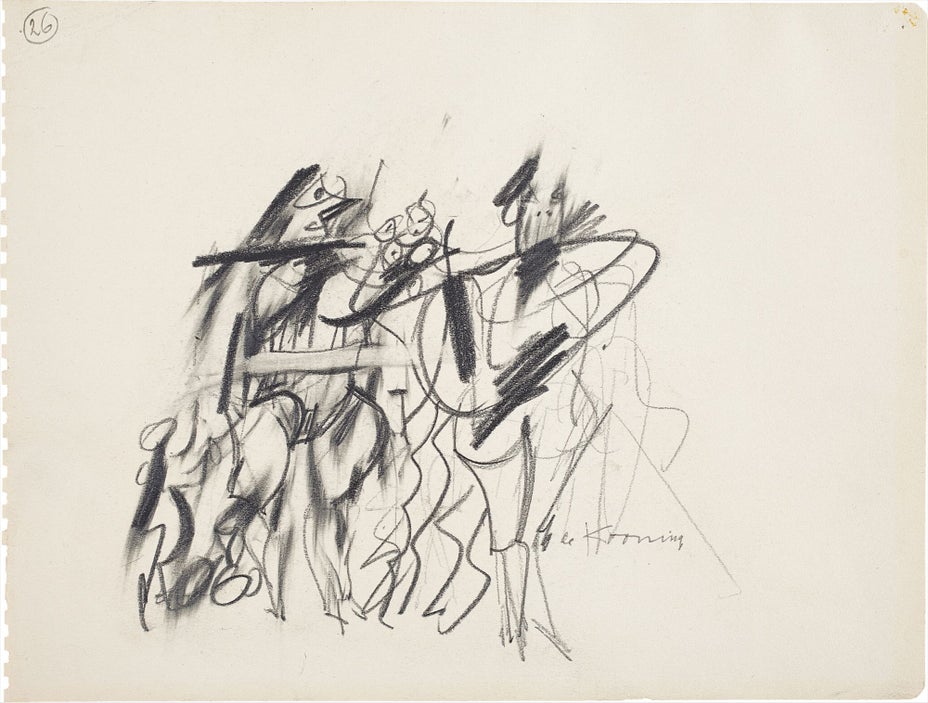
Constructed sometime between 1949 and 1953, Willem de Kooning’s Women is a wonderful glimpse into the turning gears of his artistic mind. Alive with a mix of figure and shape, limb and facial features, the present lot comes at de Kooning’s greatest and most productive artistic period. It was during this time that de Kooning’s single figure of the Woman came to define his artistic styling; it was an Abstract Expressionist’s interpretation of the beauty of the female body. Centered on the paper, de Kooning’s drawing is not a series of delineated characters, but rather a confuence of figures, each dependent upon the other for their existence. At the far right, we can make out the womanly curves of a front-facing subject, along with de Kooning’s nods to his Cubist past contained in her multiple vantage points. Centrally, a pastiche of eyes and disembodied limbs comprises our central female figure, the most abstracted of the bunch. And, at the far left, we find a Woman in profile, giving the illusion of the figures’ communal interaction.
De Kooning’s Women, 1949-53 is unique in that its title refers specifcally to multiple characters, as opposed to multiple incarnations of the same character. Indeed, his inclination to endow his abstracted fgures with lives of their own gives them much more power than, say, a simple sketch of a model for artistic study. De Kooning’s Women were never simply fgures in a piece of art—his fgures were the art themselves
De Kooning’s Women, 1949-53 is unique in that its title refers specifcally to multiple characters, as opposed to multiple incarnations of the same character. Indeed, his inclination to endow his abstracted fgures with lives of their own gives them much more power than, say, a simple sketch of a model for artistic study. De Kooning’s Women were never simply fgures in a piece of art—his fgures were the art themselves