56
Ulysse Nardin
Ref. 831-22
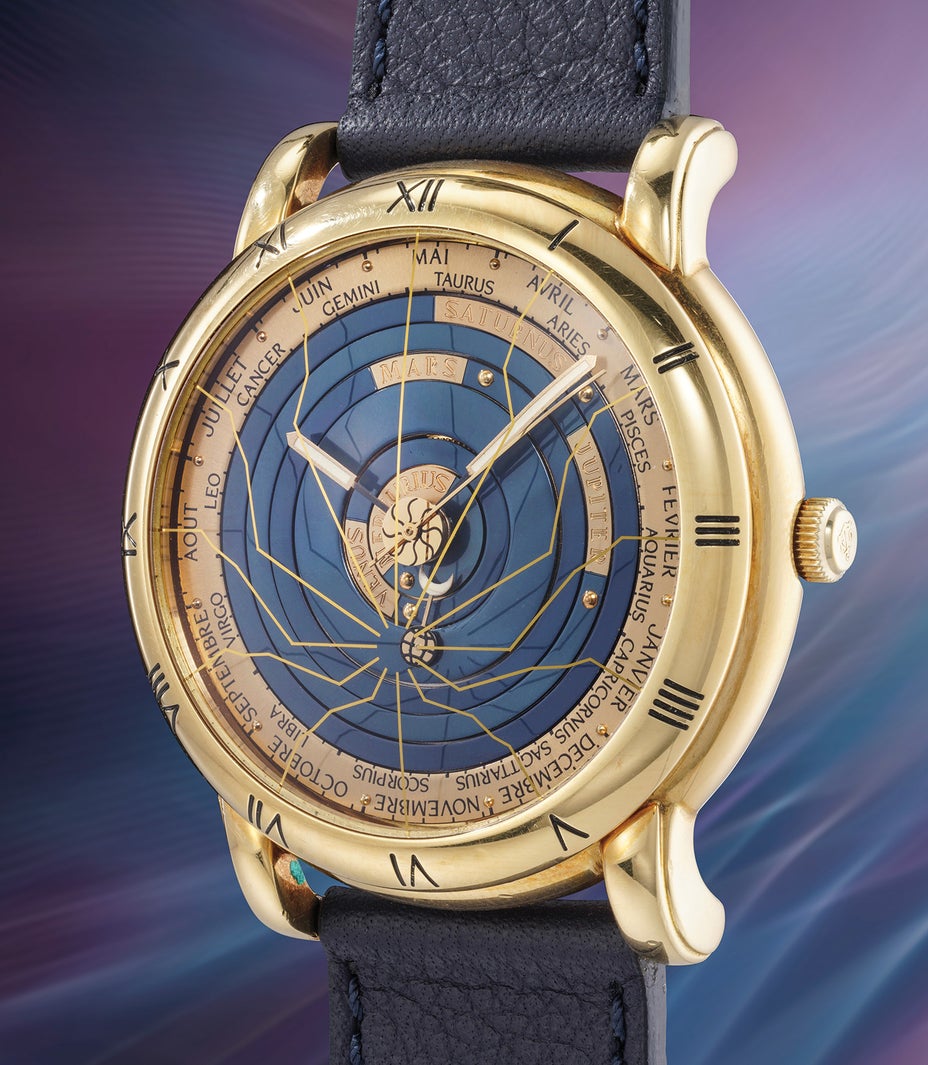
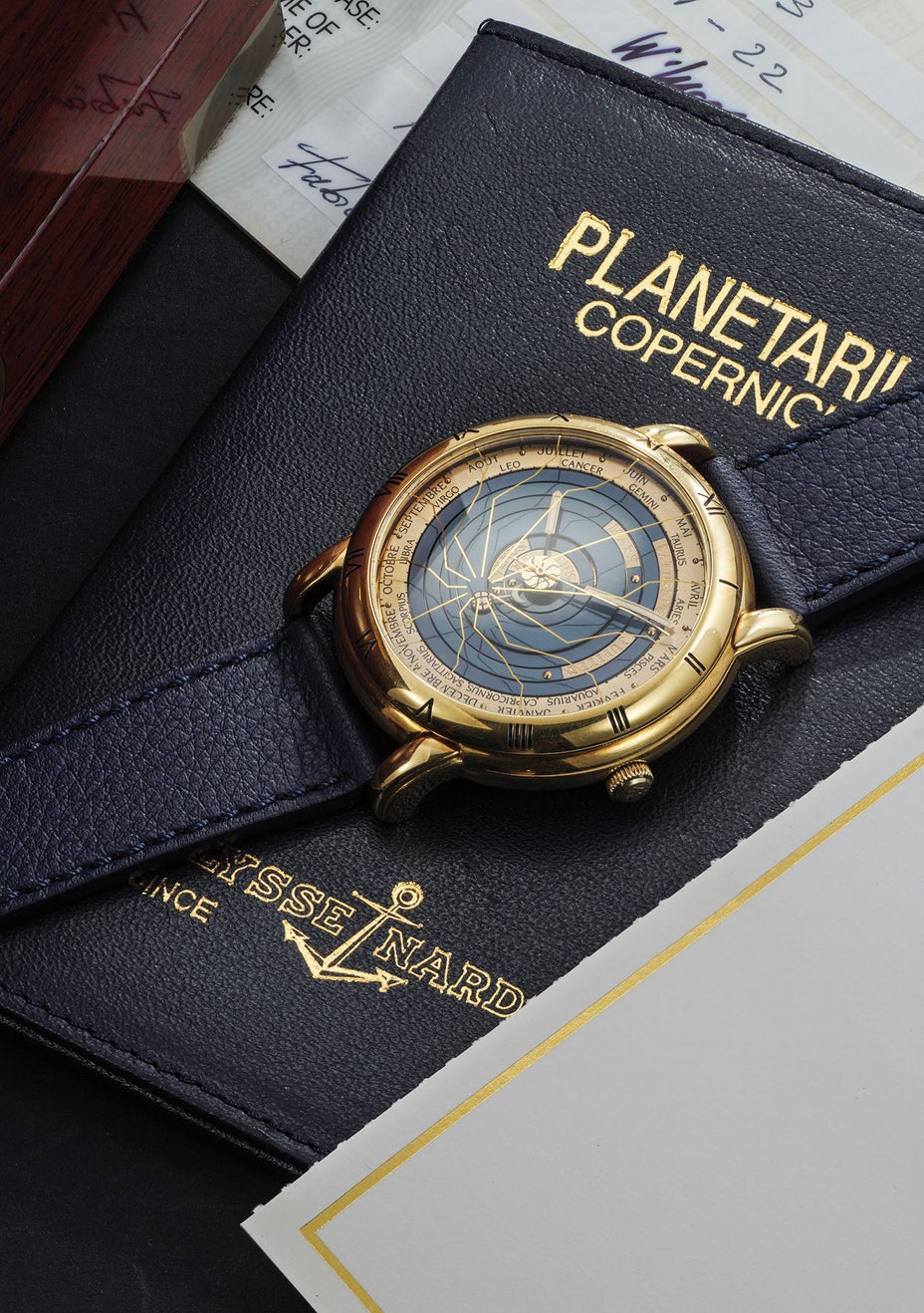
Planetarium Copernicus
An incredibly innovative and impressive yellow gold planetarium wristwatch with guarantee and presentation box
Estimate
CHF20,000–40,000
€21,300–42,700
$23,300–46,700
Sold For
CHF27,940
Manufacturer
Ulysse Nardin
Year
1997
Movement No
80.7.153
Reference No
831-22
Case No
153
Model Name
Planetarium Copernicus
Material
18K yellow gold
Calibre
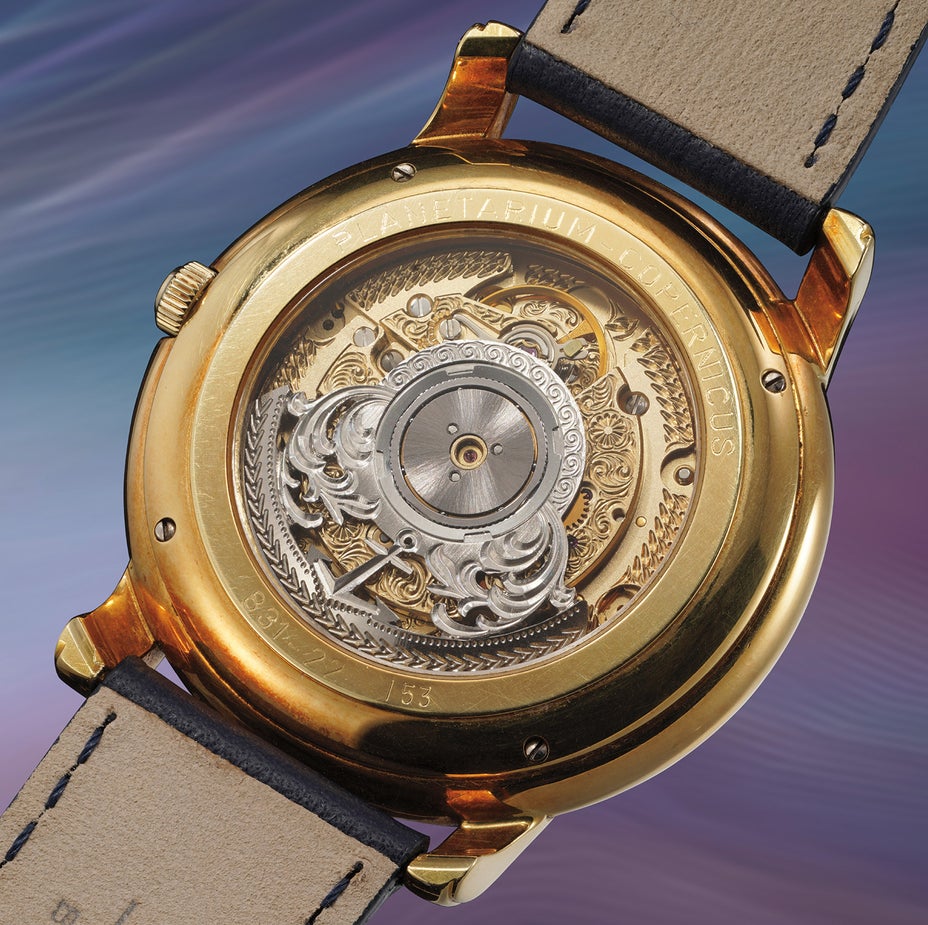
Automatic, cal. UN-80, 33 jewels
Bracelet/Strap
Leather
Clasp/Buckle
18K yellow gold Ulysse Nardin pin buckle
Dimensions
40mm Diameter
Signed
Case, movement and clasp signed
Accessories
Accompanied by Ulysse Nardin fitted box, Certificate, catalogue and product literature.
Full-Cataloguing
The present Planetarium Copernicus is part of Ulysse Nardin’s Trilogy of Time that was originally launched in 1985. The idea came following the meeting between Rolf Schnyder who had just recently bought Ulysse Nardin and Ludwig Oechslin the genius who is more than a watchmaker but a mathematician, philosopher and astronomer.
It was during a visit to watchmaker Jörg Spöring – for whom Oechslin was working at the time, that Schnyder saw an astrolabium and asked Oechslin if he could miniaturize an astrolabe clock into wristwatch size. Legend has it that Oechslin asked Schnyder who would buy such a watch to which Schnyder replied “I would”. The rest - as one would say - is history. The Trilogy of Time paid homage to the great astronomers. The first watch was the Astrolabium Galileo Galilei launched in 1985 and directly inspired by the astrolabe clock. The second model was introduced in 1988, the Planetarium Copernicus – the present model, which displays the movement of the planets Mercury, Venus, the Earth, Mars, Jupiter and Saturn around the sun. The position of the moon to the Earth is also displayed.
The last watch of the Trilogy was launched in 1992, the Tellerium Johannes Kepler, the dial represents the earth from the vantage point above the North Pole, as well as a variety of astronomical complications including the eclipses of both the sun and moon. The Trilogy of Time models are a living proof of the incredible innovative and forward thinking minds of Schnyder and Oeschlin who made the impossible possible pushing further the boundaries of watchmaking and creating a whole new genre of astronomical wristwatches.
The present Planetarium Copernicus is fresh to the market and offered by its original owner.
It was during a visit to watchmaker Jörg Spöring – for whom Oechslin was working at the time, that Schnyder saw an astrolabium and asked Oechslin if he could miniaturize an astrolabe clock into wristwatch size. Legend has it that Oechslin asked Schnyder who would buy such a watch to which Schnyder replied “I would”. The rest - as one would say - is history. The Trilogy of Time paid homage to the great astronomers. The first watch was the Astrolabium Galileo Galilei launched in 1985 and directly inspired by the astrolabe clock. The second model was introduced in 1988, the Planetarium Copernicus – the present model, which displays the movement of the planets Mercury, Venus, the Earth, Mars, Jupiter and Saturn around the sun. The position of the moon to the Earth is also displayed.
The last watch of the Trilogy was launched in 1992, the Tellerium Johannes Kepler, the dial represents the earth from the vantage point above the North Pole, as well as a variety of astronomical complications including the eclipses of both the sun and moon. The Trilogy of Time models are a living proof of the incredible innovative and forward thinking minds of Schnyder and Oeschlin who made the impossible possible pushing further the boundaries of watchmaking and creating a whole new genre of astronomical wristwatches.
The present Planetarium Copernicus is fresh to the market and offered by its original owner.
Ulysse Nardin
Swiss | 1846Founded in 1846 in Le Locle, Switzerland, Ulysse Nardin is a widely acclaimed Swiss watch manufacturer that earned recognition for its precision chronometers during the early to mid-twentieth century. Ulysse Nardin himself was a trained watchmaker under the guidance of his father, Leonard-Frederic Nardin, as well as master watchmakers Frederic William Dubois and Louis Jean Richard-dit-Bressel. Collectors in particular seek this brand's oversized vintage chronograph wristwatches, including the reference 7536-2.