343
Tunga
Revolution
dimensions variable
Full-Cataloguing
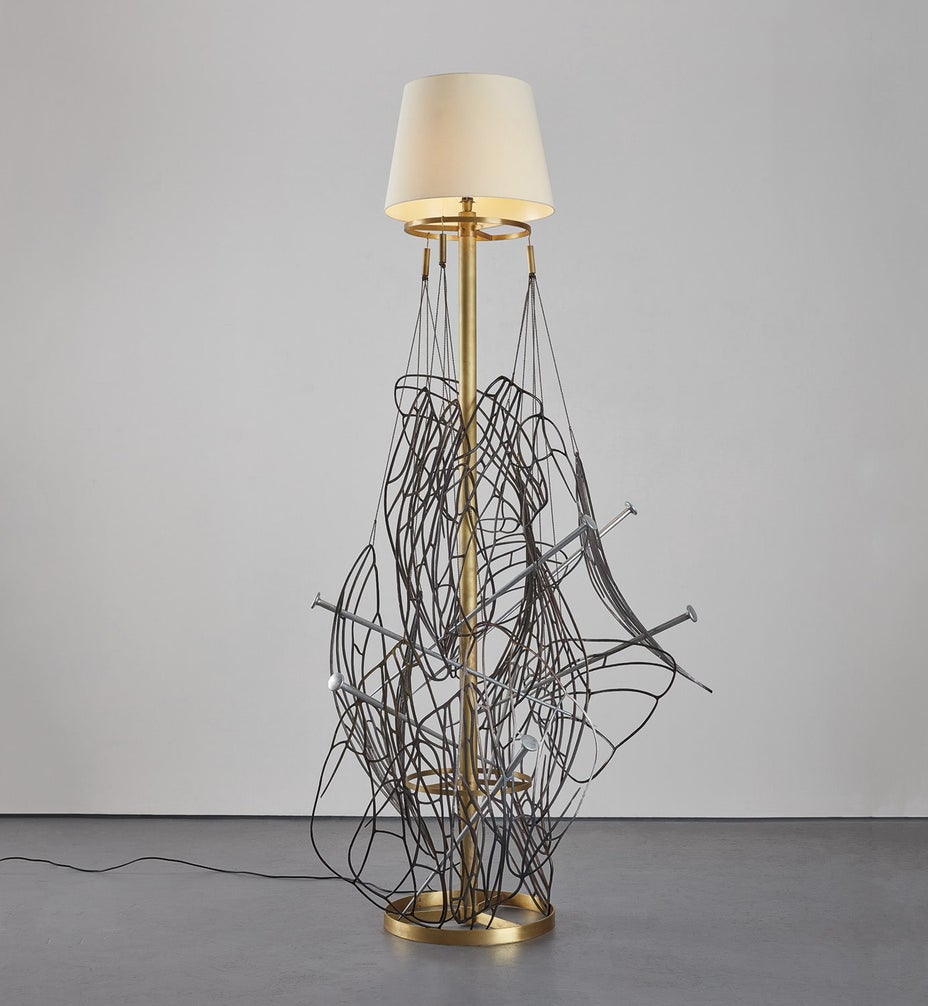
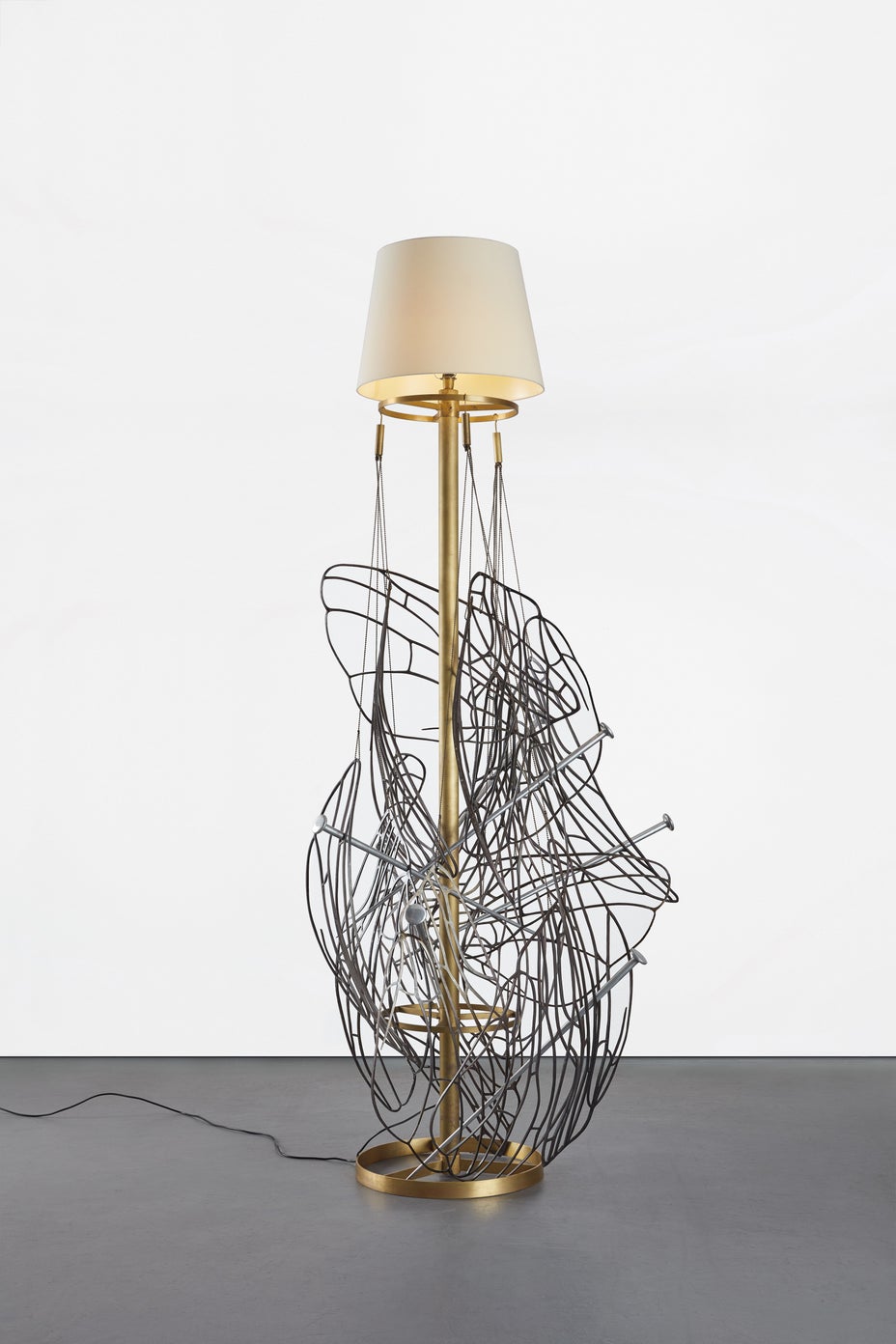
Since the 1970s, Brazilian artist Tunga worked primarily with sculpture, installation, and performance art, inviting viewers into a continuous dialogue with his practice. His artworks are intentionally enigmatic, meant to confound viewers and, in turn, probe new meanings and ideas, which for the artist become embedded within the pieces themselves. In his sculptures, Tunga draws upon Surrealism as a primary influence, juxtaposing familiar objects in mysterious, often unsettling ways. Revolution, executed in 2007, reveals such influences and, in doing so, engages the viewer at the delicate border between the real and the imaginary. A tall, standing lamp exists at the core of the sculpture, swathed in a tangled web of seemingly unidentifiable forms. Upon closer examination, this web reveals itself as larger-than-life insect wings, oversized pins, and hanging chains, arranged in a frenzy of opposing elements.
In an interview with Beverly Adams in 2007, the same year in which the present lot was created, Tunga discusses the process by which sculptures such as Revolution evolve with continued viewership. He notes, “the work is nothing more than the sum of the living experiences around it, like a depository…And in a way, this is evoked by flies flying around a lamp. You see the flies here with fragments reflecting light like small particles that are magnetized and maintained by the heat of this light. The lamp is not unadulterated clarity but the combination of clarity and the fragments of opacity that oscillate around it at all times” (Tunga, quoted in Beverly Adams, “Interview with Tunga”, Laminated Souls, p. 101). The lamp thus serves as a mirror, reflecting not only the surface of the flies’ wings, but also the ever-changing shadows produced by passersby. In Revolution, Tunga dismantles the formal boundaries between sculpture, artist and viewer, as the work ultimately becomes – in the artist’s own words – “the sum of the living experiences around it.”
Tunga
Brazilian | B. 1952 D. 2016Tunga was born in Palmares, Brazil and trained as an architect. He chose to pursue a visual arts career, through which he is best known for his subversive sculpture, installations and performances. At only 22, Tunga held his first solo exhibition at the Museum of Modern Art in Rio de Janeiro, drawing the attention of the art world with the title Museu da Masturbação Infantil (Museum of Childhood Masturbation).
Like this first exhibition, Tunga's works are psychologically charged and influenced by Surrealism and Constructivism. His art is highly conceptual and conveys spatial concerns, often dealing with bodily organs and functions, desires and rituals that he depicted in enigmatic environments, employing non-traditional mediums such as teeth, hair, nets and skulls.