202
Toshimitsu Imai
Chimère 幻想 [Gensou] (Fantasy)
Estimate
$80,000–120,000
Sold For
$112,500
mixed media and oil on canvas
51 1/3 x 63 1/2 in. (130.4 x 161.3 cm)
Signed in Japanese and English, and titled in French and Japanese "今井俊満 [Imai Toshimitsu] CHIÈRE シメール 幻想" on the reverse.
Full-Cataloguing
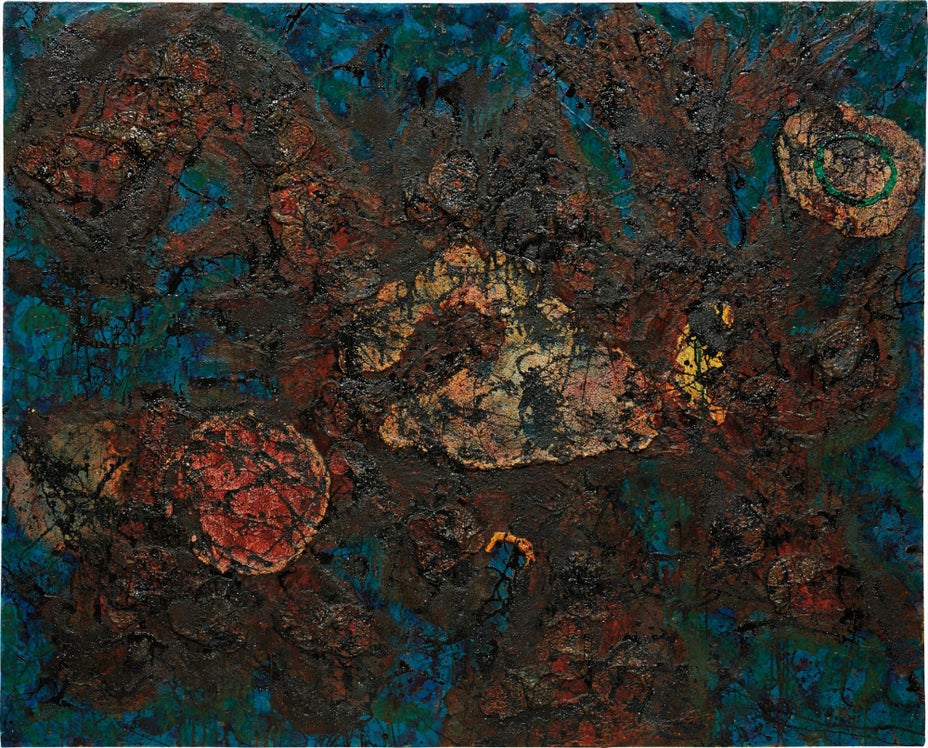
"Despite all the violence, or even the brutality of the shock produced by lmai's painting, one must recognize in this thick, floating material mixed with rock fragments and varnish, a power which surpasses that power which the material alone is incapable of engendering. There is a savage, almost cruel joy in the boldness of these harmonies." (R.B., Aujourd'hui, May, 1961 as quoted in IMAÏ Toshimitsu, Kyuryudo Art Publishing Co., Tokyo, 1975, p. 88)
The genius of Imai’s work is his groundbreaking embrace of Art Informal and renegade denial of the dominant conventions of 1950s Japanese art. Imai’s forceful style of unbounded, yet evocative, gesture, paint application, and use of mixed media is well represented in Chimère / 幻想 (Fantasy) [GENSOU], a tour de force painting that is unequivocally characteristic of Imai's finest mature works.
Having left Japan for Paris 1952, he found his place alongside artists such as Georges Matthieu and Sam Francis and the French critic Michel Tapié. His debut solo exhibition at Galerie Stadler in 1957 solidified his position as a veritable Informal artist of international repute. Imai soon began bringing the leading luminaries of the group to Japan by arranging exhibitions of their work in various cities and introducing them to fellow contemporary artists of the day, such as Jiro Yoshihara, leader of the avant-garde Gutai group based in Osaka, and the Tokyo-based critics Shuzo Takiguchi and Taro Okamoto.
Chimère / 幻想 (Fantasy) [GENSOU], exemplifies Imai’s signature palate of muted earth-bound hues, characteristic of prehistoric Japanese pottery (Jomon), mixed with explosions of bright color. The composition is expressive of his fundamental interest in classical mythology, depicting an apocalyptic fire-spitting creature surrounded in a reverence for nature, created through feeling and evocation rather than any representation bound by conventional style.
The genius of Imai’s work is his groundbreaking embrace of Art Informal and renegade denial of the dominant conventions of 1950s Japanese art. Imai’s forceful style of unbounded, yet evocative, gesture, paint application, and use of mixed media is well represented in Chimère / 幻想 (Fantasy) [GENSOU], a tour de force painting that is unequivocally characteristic of Imai's finest mature works.
Having left Japan for Paris 1952, he found his place alongside artists such as Georges Matthieu and Sam Francis and the French critic Michel Tapié. His debut solo exhibition at Galerie Stadler in 1957 solidified his position as a veritable Informal artist of international repute. Imai soon began bringing the leading luminaries of the group to Japan by arranging exhibitions of their work in various cities and introducing them to fellow contemporary artists of the day, such as Jiro Yoshihara, leader of the avant-garde Gutai group based in Osaka, and the Tokyo-based critics Shuzo Takiguchi and Taro Okamoto.
Chimère / 幻想 (Fantasy) [GENSOU], exemplifies Imai’s signature palate of muted earth-bound hues, characteristic of prehistoric Japanese pottery (Jomon), mixed with explosions of bright color. The composition is expressive of his fundamental interest in classical mythology, depicting an apocalyptic fire-spitting creature surrounded in a reverence for nature, created through feeling and evocation rather than any representation bound by conventional style.