268
Sol LeWitt
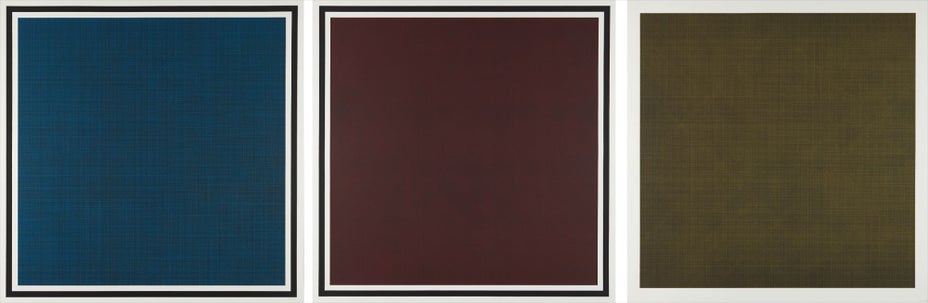
Colors with Lines in Four Directions, Within a Black Border (Blue); Colors with Lines in Four Directions, Within a Black Border (Red); and Colors with Lines in Four Directions: one plate
two S. 47 3/4 x 47 3/4 in. (121.3 x 121.3 cm)
one I. 42 x 42 in. (106.7 x 106.7 cm)
one S. 46 3/4 x 46 3/4 in. (118.7 x 118.7 cm)
Full-Cataloguing
Sol LeWitt
American | B. 1928 D. 2007Connected to the Conceptual and Minimalist art movements of the 1960s and '70s, the artist and theorist Sol LeWitt was a pivotal figure in driving 'idea' art into the mainstream art discourse. Redefining what constituted a work of art and its genesis, LeWitt explored these ideas through wall drawings, paintings, sculptures, works on paper and prints.
Using a prescription to direct the creation of a work, the artist’s hand subordinated to the artist's thoughts, in direct contrast to the Abstract Expressionist movement earlier in the century. Actions, forms and adjectives were broken down into terms, serially repeated and reconfigured: grids, lines, shapes, color, directions and starting points are several examples. These directives and constructs fueled an influential career of vast variety, subtlety and progression.