Priority Bidding is here! Secure a lower Buyer’s Premium today (excludes Online Auctions and Watches). Learn More
No Reserve

151

Shiro Kuramata

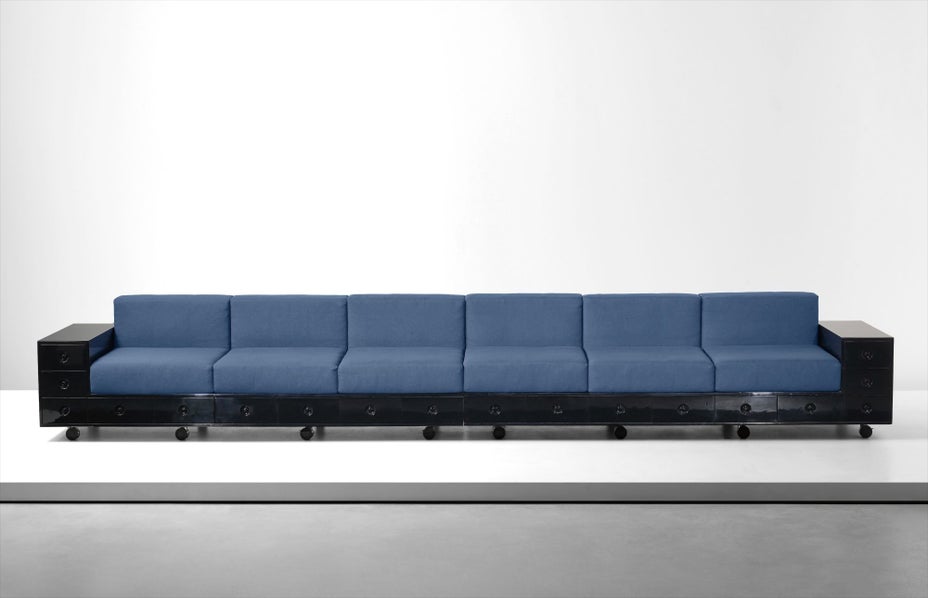
Important and unique sofa, designed for the Bub Yoshino beauty salon, Tokyo, from the ‘Furniture with Drawers, Vol. 1' series

Estimate
£60,000 - 80,000Ω
£37,500
Lot Details
Painted beech, fabric.
1976
Overall: 66 x 411 x 73 cm (25 7/8 x 161 3/4 x 28 3/4 in.)
Each section: 66 x 205.5 x 73 cm (25 7/8 x 80 7/8 x 28 3/4 in.)
Produced by Aoshima Shoten Co. Ltd., Tokyo, Japan.
Catalogue Essay
The present lot is a dyadic design and elegantly separates into two individual sofas. The sofa was part of Shiro Kuramata’s important 1976 commission for the interior of the Bub Yoshino beauty parlour, which was housed on the third and fourth floors of a building near Minami-aoyama in Tokyo. The interior construction was undertaken by Ishimaru Co., Ltd, and the furniture was produced by Aoshima Shoten Co., Ltd, and Mihoya Glass Co., Ltd. The first floor plan illustrated in the magazine Japan Interior Design depicts the present lot occupying almost the entirety of the back wall. During the same year Kuramata completed the ‘House with Stairs Project’, where he continued his investigation further by incorporating functioning drawers within a structure. Always fascinated by drawers Kuramata remarked “I believe that a chest of drawers is the kind of furniture that most strongly communicates with man, even psychologically” (Shitsunai, January, 1972). Indeed communication and psychological effects appear to be far more intriguing concepts to the designer, as he wishes to evoke the object and only leave a vestige of its existence; either by the immolation of the ‘Homage to Josef Hoffman’ chair, the diaphanous ‘Miss Blanche’, or the dichotomy of ‘Furniture with Drawers’ series.

Phillips wishes to thank the Kuramata Design Office for their confirmation that the present lot is from the Bub Yoshino commission.

Shiro Kuramata

Japanese | B. 1934 D. 1991
Shiro Kuramata is widely admired for his ability to free his designs from gravity and use materials in ways that defied convention. After a restless childhood, his ideas of being an illustrator having been discouraged, Kuramata discovered design during his time at the Teikoku Kizai Furniture Factory in Arakawa-ku in 1954. The next year he started formal training at the Department of Interior Design at the Kuwasawa Design Institute. His early work centered on commercial interiors and window displays. In 1965, at the age of 31, he opened his own firm: Kuramata Design Office.

Throughout his career he found inspiration in many places, including the work of Italian designers (particularly those embodying the Memphis style) and American conceptual artists like Donald Judd, and combined such inspirations with his own ingenuity and creativity. His dynamic use of materials, particularly those that were transparent, combination of surfaces and awareness of the potential of light in design led him to create objects that stretched structural boundaries and were also visually captivating. These qualities are embodied in his famous Glass Chair (1976).
Browse Artist