14
Rudolf Stingel
Untitled
Full-Cataloguing
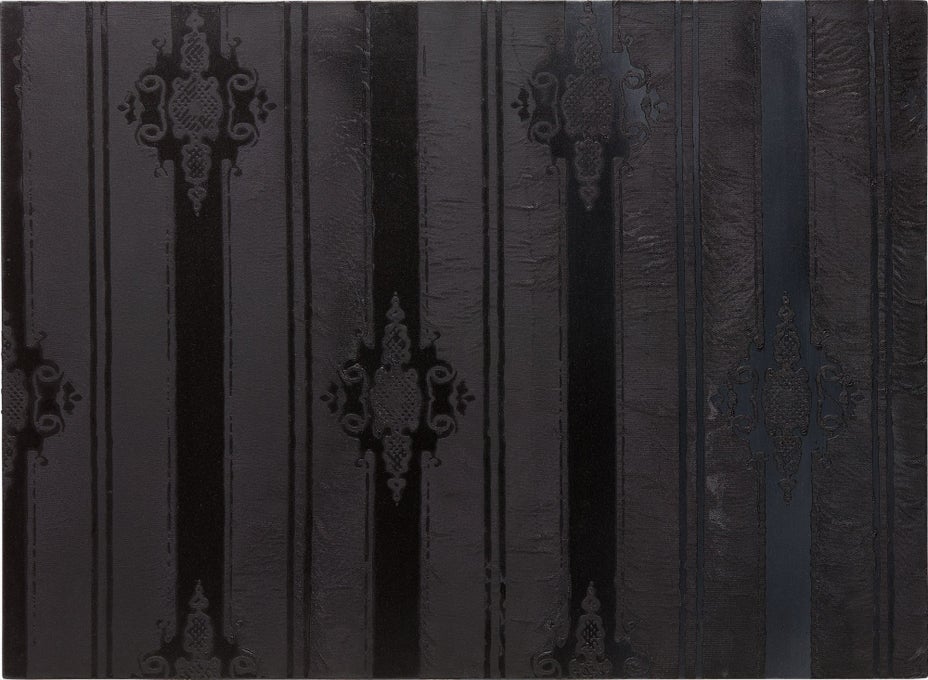
Stingel hails from the Alto Adige region in the North of Italy, where large swathes of the population are German-speaking. He was partly educated in Vienna, eventually moving to the United States. The baroque style that was so highly developed in Austria and Italy is evident in the patterns in Untitled. Yet its reincarnation here as a painted monochrome performs several functions. Stingel uses this baroque motif both to underscore and undermine the decorative language of painting. Where in some of his stencilled paintings Stingel has used gold, emphasising the connection to the Baroque, the inscrutable monochrome of Untitled recalls instead the black paintings of Ad Reinhardt. However, the grandeur of the older American painter’s vision is playfully punctured by its association with decoration under Stingel’s guidance. The monochrome traditions of Stingel’s contemporaries, Lucio Fontana and Piero Manzoni, are also parodied, be it in the vertical lines recalling the former artist’s slashes, or the notion of the self-creating artwork of the latter’s Achromes. The entire notion of authorship, of the cult of the artist, is challenged by Untitled. Stingel is deliberately colliding the worlds of high and low art, and cunningly avoids letting either have the upper hand. This is confirmed by the disrupted patterns, in particular to the right of the composition, which reaffirm Stingel’s own direct involvement in its creation.
Stingel has long sought to deflate the heightened rhetoric of modern art, not least with his publication and exhibition of Instructions in 1989. These were multilingual, illustrated guides that showed how Stingel made his paintings, inviting others to participate. Stingel has long used unusual devices and materials, such as gauze, stencils and insulation panels, developing strategies for creating works that circumvent the modernist emphasis on the brushstroke. For instance, in some works, he walked on Styrofoam panels wearing boots soaked in chemicals that eroded the surface, making a wry comment on Action Painting. His vast photorealist ‘self-portraits’ were painted by hand, yet based on images taken by someone else, while in his Celotex murals, visitors to his exhibitions have been invited to make their own marks in the surface. Untitled echoes these unconventional approaches to painting in both its inscrutable palette and in the manner of its creation, simultaneously throwing into question the role of the artist—and validating it.
Rudolf Stingel
Italian | 1956Rudolf Stingel came to prominence in the late 1980s for his insistence on the conceptual act of painting in a context in which it had been famously declared dead. Despite the prevailing minimalist and conceptual narrative of the time, the Italian-born artist sought to confront the fundamental aspirations and failures of Modernist painting through the very medium of painting itself. While his works do not always conform to the traditional definitions of painting, their attention to surface, space, color and image provide new and expanded ways of thinking about the process and "idea" of painting. Central to his multifarious and prolific oeuvre is an examination of the passage of time and the probing of the fundamental questions of authenticity, meaning, hierarchy, authorship and context by dislocating painting both internally and in time and space. Stingel is best known for his wall-to-wall installations, constructed of fabric or malleable Celotex sheets, as well as his seemingly more traditional oil-on-canvas paintings.