Property from the Miles and Shirley Fiterman Collection
126Ο︎
Roy Lichtenstein
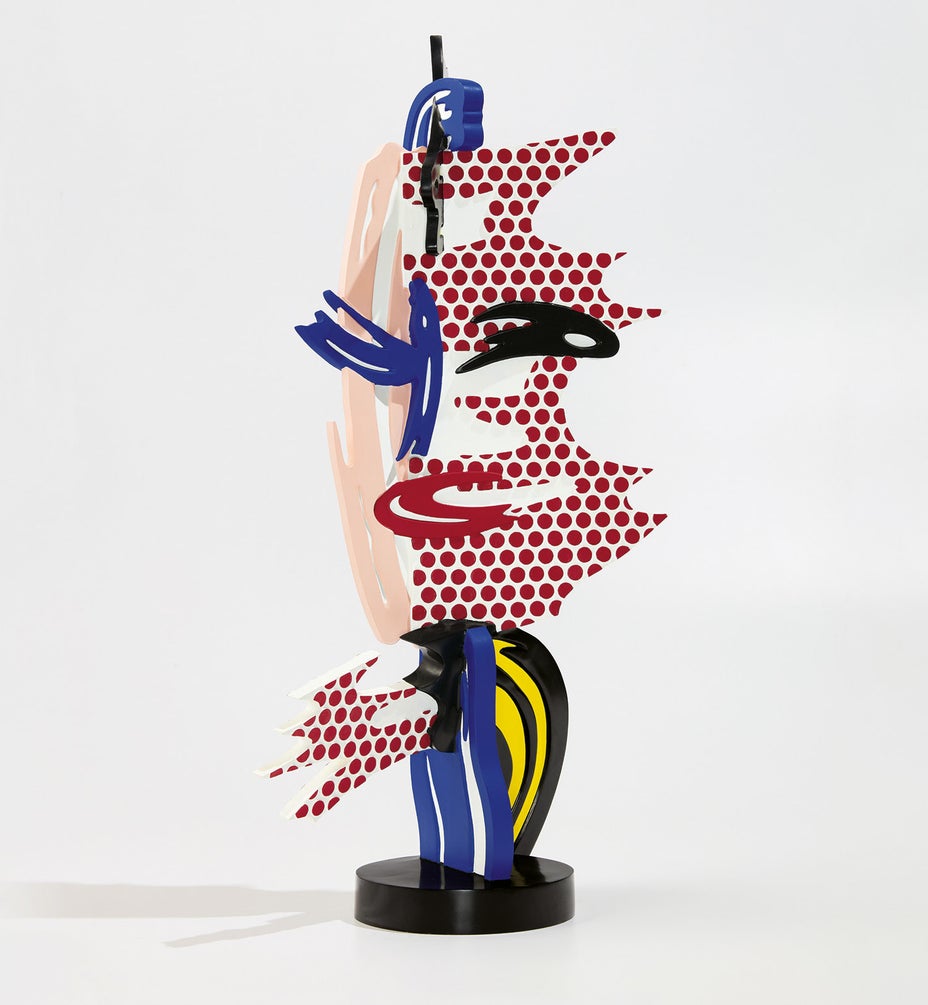
Brushstroke Head IV (Barcelona Head)
Estimate
$600,000–800,000
Sold For
$800,000
incised with the artist's signature, number and date "© 3/6 rf Lichtenstein '87" and stamped with the Tallix foundry mark on the base
painted and patinated bronze
44 x 20 x 10 in. (111.8 x 50.8 x 25.4 cm.)
Executed in 1987, this work is number 3 from an edition of 6.
Full-Cataloguing
Remaining in the Miles and Shirley Fiterman Collection for over four decades, Roy Lichtenstein’s Brushstroke Head IV (Barcelona Head), 1987, presents the striking precursor to the large-scale public sculpture Barcelona Head, which the artist created as a commission for the 1992 Olympic Games in Barcelona. Towering over 45 feet tall to this day in the center of Barcelona, it is among the most iconic of Lichtenstein’s sculptures and epitomizes the triumphal return of the female figure in the last decade of the Pop artist's life. With a sly nod to Abstract Expressionism, his own 1960s Pop art idiom and the traditional motif of the female bust, Lichtenstein here puts forth a dynamic sculpture that oscillates between abstraction and representation. A deconstructed female face emerges as the viewer walks around the sculpture, and swooshing brushstrokes and Ben-Day dots give way to forms redolent of eyelashes, an elongated nose, and pouting lips. Executed in 1987 in an edition of six, this work represents the culmination of a series of four Brushstroke Head iterations that Lichtenstein created as part of his lengthy and exacting process, and the final form for his Barcelona commission.
Brushstroke Head IV (Barcelona Head) brilliantly expands upon Lichtenstein’s three-dimensional interrogation of the brushstroke motif that he had first commenced in 1981 with Brushstroke Sculpture, an example of which also resided in the Fitermans’s revered collection. Harkening back to his early Brushstroke Paintings from the mid 1960s, Lichtenstein here too subverts the subjectivity of the gestural brushstroke with his trademark graphic line and boldly colored Ben-Day dots, the dot system used in mass-circulation commercial printing. While Lichtenstein zoomed into the very gesture of action painting in direct reaction against – and parody of – the dominating movement of Abstract Expressionism in the 1960s, he returned to the motif in 1981 in sculptural form.
The present work brilliantly furthers the artist’s early investigations by challenging the primacy of abstract painting and division between artistic media that critics such as Clement Greenberg had espoused. As Jack Cowart observed, “Lichtenstein seems busily deconstructing the language and painterly idioms of Abstract Expressionism to make its artistic medium the actual message… In these brushstroke sculptures it is as if Lichtenstein wanted us to think this is what Franz Kline, as well, might have done had he worked in three dimensions. Clearly this historic appropriation is the case with Lichtenstein's next suite of four Brushstroke Heads, 1987, in editions of six, where he takes de Kooning like face forms and casts them in painted and patinated bronze. Since we already know that de Kooning made sculpture (but not at all like this), we appreciate the conceptual and visual puns all the more" (Jack Cowart, Lichtenstein: Sculptures & Drawings, exh. cat., The Corcoran Gallery of Art, Washington, D.C., 1999, p. 19).
While Lichtenstein engaged with different artistic styles and movements throughout his career, Brushstroke Head IV (Barcelona Head) comes from a period where the artist was re-engaging with his very own practice. Embracing a post-modern meta-discourse with artistic precedents, Lichtenstein offers a masterful double loop of appropriation that explores the conventions of art historical precedents – including his own world-famous oeuvre. Indeed, beyond echoing his early Brushstroke paintings, Lichtenstein here also reprises the motif of the female figure that had lain dormant in the preceding decades and would culminate in the 1990s with such works as Woman: Sunlight, Moonlight, 1996. Whereas Lichtenstein’s early “Girl Paintings” were driven by an interest in elevating the clichés and banalities of popular culture, while also exploring notions of reproduction, his exploration of the female figure, starting in the late 1980s, reflects his movement towards the pastiche of established art historical traditions.
With Brushstroke Head IV (Barcelona Head), Lichtenstein boldly challenges traditional sculptural norms – both through his application of high gloss, vibrant paint upon the revered medium of bronze, and his deconstruction of the female bust. As Hal Foster observed, “The collision of high and low modes is the very strategy of his art, indeed of Pop in general, and here he extends it to sculpture as well: traditional bust meets abstract mannequin, Abstract Expressionist brushstroke meets cartoon sign of the same...if there is a radical edge in Lichtenstein, it lies here: less in his thematic appropriation of comics and the like, and more in his formal reconciliation of lowly contents and high forms" (Hal Foster, Roy Lichtenstein, Sculpture, exh. cat., Gagosian Gallery, New York, 2005, p. 10). Lichtenstein’s conception of this work as a precursor to the monumental public sculpture Barcelona Head expands upon this eradicating of boundaries between high and low art. Formally and conceptually complex, Brushstroke Head IV (Barcelona Head) not only demonstrates the core tenets that catapulted Lichtenstein to acclaim in the 1960s, it moreover speaks of an artist in his twilight years relentlessly re-inventing his practice.
Brushstroke Head IV (Barcelona Head) brilliantly expands upon Lichtenstein’s three-dimensional interrogation of the brushstroke motif that he had first commenced in 1981 with Brushstroke Sculpture, an example of which also resided in the Fitermans’s revered collection. Harkening back to his early Brushstroke Paintings from the mid 1960s, Lichtenstein here too subverts the subjectivity of the gestural brushstroke with his trademark graphic line and boldly colored Ben-Day dots, the dot system used in mass-circulation commercial printing. While Lichtenstein zoomed into the very gesture of action painting in direct reaction against – and parody of – the dominating movement of Abstract Expressionism in the 1960s, he returned to the motif in 1981 in sculptural form.
The present work brilliantly furthers the artist’s early investigations by challenging the primacy of abstract painting and division between artistic media that critics such as Clement Greenberg had espoused. As Jack Cowart observed, “Lichtenstein seems busily deconstructing the language and painterly idioms of Abstract Expressionism to make its artistic medium the actual message… In these brushstroke sculptures it is as if Lichtenstein wanted us to think this is what Franz Kline, as well, might have done had he worked in three dimensions. Clearly this historic appropriation is the case with Lichtenstein's next suite of four Brushstroke Heads, 1987, in editions of six, where he takes de Kooning like face forms and casts them in painted and patinated bronze. Since we already know that de Kooning made sculpture (but not at all like this), we appreciate the conceptual and visual puns all the more" (Jack Cowart, Lichtenstein: Sculptures & Drawings, exh. cat., The Corcoran Gallery of Art, Washington, D.C., 1999, p. 19).
While Lichtenstein engaged with different artistic styles and movements throughout his career, Brushstroke Head IV (Barcelona Head) comes from a period where the artist was re-engaging with his very own practice. Embracing a post-modern meta-discourse with artistic precedents, Lichtenstein offers a masterful double loop of appropriation that explores the conventions of art historical precedents – including his own world-famous oeuvre. Indeed, beyond echoing his early Brushstroke paintings, Lichtenstein here also reprises the motif of the female figure that had lain dormant in the preceding decades and would culminate in the 1990s with such works as Woman: Sunlight, Moonlight, 1996. Whereas Lichtenstein’s early “Girl Paintings” were driven by an interest in elevating the clichés and banalities of popular culture, while also exploring notions of reproduction, his exploration of the female figure, starting in the late 1980s, reflects his movement towards the pastiche of established art historical traditions.
With Brushstroke Head IV (Barcelona Head), Lichtenstein boldly challenges traditional sculptural norms – both through his application of high gloss, vibrant paint upon the revered medium of bronze, and his deconstruction of the female bust. As Hal Foster observed, “The collision of high and low modes is the very strategy of his art, indeed of Pop in general, and here he extends it to sculpture as well: traditional bust meets abstract mannequin, Abstract Expressionist brushstroke meets cartoon sign of the same...if there is a radical edge in Lichtenstein, it lies here: less in his thematic appropriation of comics and the like, and more in his formal reconciliation of lowly contents and high forms" (Hal Foster, Roy Lichtenstein, Sculpture, exh. cat., Gagosian Gallery, New York, 2005, p. 10). Lichtenstein’s conception of this work as a precursor to the monumental public sculpture Barcelona Head expands upon this eradicating of boundaries between high and low art. Formally and conceptually complex, Brushstroke Head IV (Barcelona Head) not only demonstrates the core tenets that catapulted Lichtenstein to acclaim in the 1960s, it moreover speaks of an artist in his twilight years relentlessly re-inventing his practice.