132
Rolex
Ref. 1690UF
Prince
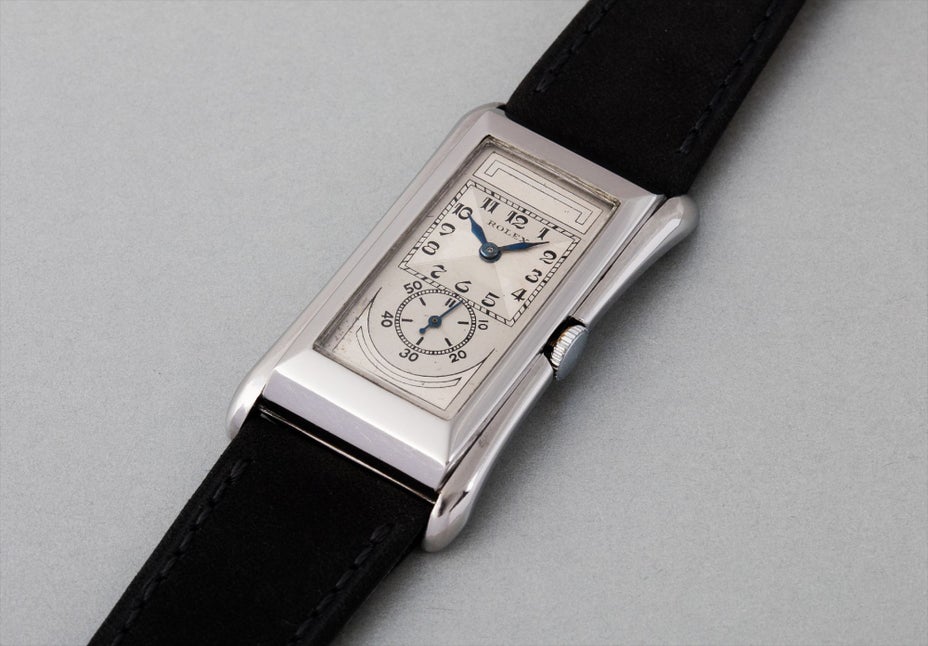
An extremely rare, highly attractive and oversized rolesium rectangular doctor's wristwatch with flared sides and two-tone dial
Full-Cataloguing
The impressively oversized reference 1690UF is one of the rarest of the Prince models. Nicknamed the “Super Prince” due to its massive size, it differentiates itself from its smaller sibling the reference 971 with its 47mm length.
The present lot comes in a “Rolesium” case (a special steel alloy used by Rolex) and is the second reference 1690UF in this metal to be offered for auction and the third to appear in public. It is believed that this superb timepiece never went above prototype stage probably due to its large size.
The superb overall condition, the playfulness of the dial with its “Art Nouveau” numerals, the elaborate oversized case, and its extreme rarity make the present lot a trophy watch for collectors of the world’s rarest timepieces.
Rolex
Swiss | 1905Founded in 1905 England by Hans Wilsdorf and Alfred Davis as Wilsdorf & Davis, it soon became known as the Rolex Watch Company in 1915, moving its headquarters to Geneva in 1919. Like no other company, the success of the wristwatch can be attributed to many of Rolex's innovations that made them one of the most respected and well-known of all luxury brands. These innovations include their famous "Oyster" case — the world's first water resistant and dustproof watch case, invented in 1926 — and their "Perpetual" — the first reliable self-winding movement for wristwatches launched in 1933. They would form the foundation for Rolex's Datejust and Day-Date, respectively introduced in 1945 and 1956, but also importantly for their sports watches, such as the Explorer, Submariner and GMT-Master launched in the mid-1950s.
One of its most famous models is the Cosmograph Daytona. Launched in 1963, these chronographs are without any doubt amongst the most iconic and coveted of all collectible wristwatches. Other key collectible models include their most complicated vintage watches, including references 8171 and 6062 with triple calendar and moon phase, "Jean Claude Killy" triple date chronograph models and the Submariner, including early "big-crown" models and military-issued variants.