


8092
Rolex
Ref. 1655
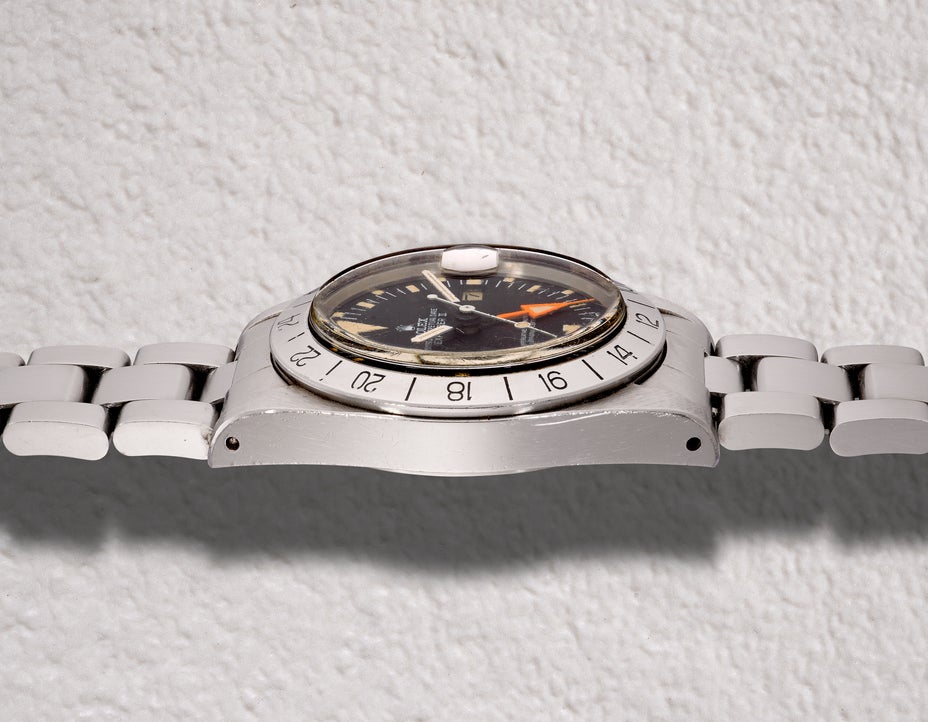
Explorer II, "Freccione"
A fine stainless steel wristwatch with bracelet, center seconds, date, 24-hour indication, “Mk 4” dial, guarantee and presentation box
Full-Cataloguing
- Orange 24-hour hand for easy time-keeping even in low-light conditions
- "Mk 4" dial in excellent overall condition
- Accompanied with its original guarantee and presentation box
- The Rolex Explorer II was first introduced in 1971 with the ref. 1655. The model provided a completely new configuration, with the absence of the traditional 3-6-9 “Explorer” dial configuration, an enlarged 39mm diameter Oyster case, date aperture, with a 24-hour bezel. Finally, a large orange 24-hour hand used with the 24-hour bezel permitted the exact hour to be read at a glance, and led to its Italian nickname “Freccione”, meaning "big arrow".
- Designed for explorers (unsurprisingly) and professionals alike, it specifically targeted speleologists as the large orange luminous hand is intended to be visible in the low light conditions of a cave allowing the wearer to track the day/night cycle in case of prolonged underground expeditions.
- The ref. 1655 was in production through the mid-1980s and released with a total of five different dial types. The present watch displays the “Mk 4” dial with “T SWISS < 25T” with serif font, which is correct for the serial number. The present watch a prominent yet uncommon model within the Rolex product line since it was first introduced.
- Adding to its collectability, the present watch is accompanied by its original guarantee and presentation box.
Rolex
Swiss | 1905Founded in 1905 England by Hans Wilsdorf and Alfred Davis as Wilsdorf & Davis, it soon became known as the Rolex Watch Company in 1915, moving its headquarters to Geneva in 1919. Like no other company, the success of the wristwatch can be attributed to many of Rolex's innovations that made them one of the most respected and well-known of all luxury brands. These innovations include their famous "Oyster" case — the world's first water resistant and dustproof watch case, invented in 1926 — and their "Perpetual" — the first reliable self-winding movement for wristwatches launched in 1933. They would form the foundation for Rolex's Datejust and Day-Date, respectively introduced in 1945 and 1956, but also importantly for their sports watches, such as the Explorer, Submariner and GMT-Master launched in the mid-1950s.
One of its most famous models is the Cosmograph Daytona. Launched in 1963, these chronographs are without any doubt amongst the most iconic and coveted of all collectible wristwatches. Other key collectible models include their most complicated vintage watches, including references 8171 and 6062 with triple calendar and moon phase, "Jean Claude Killy" triple date chronograph models and the Submariner, including early "big-crown" models and military-issued variants.