

US import tariffs: Non-US origin lots in this sale (including watches and timepieces with Swiss-made or non-US made movements) will be subject to special tariffs upon import to the USA, currently ranging from 10% to 39% on the total invoice price (hammer price plus buyer’s premium). Buyers are responsible for paying any applicable tariffs, duties, taxes and charges when importing their purchased lots. Due to the evolving nature of international trade regulations, we recommend clients consult with their local customs office or advisor for up-to-date information on the applicable tariffs.
185
Rolex
Ref. 6542
GMT-Master "Serpico y Laino"
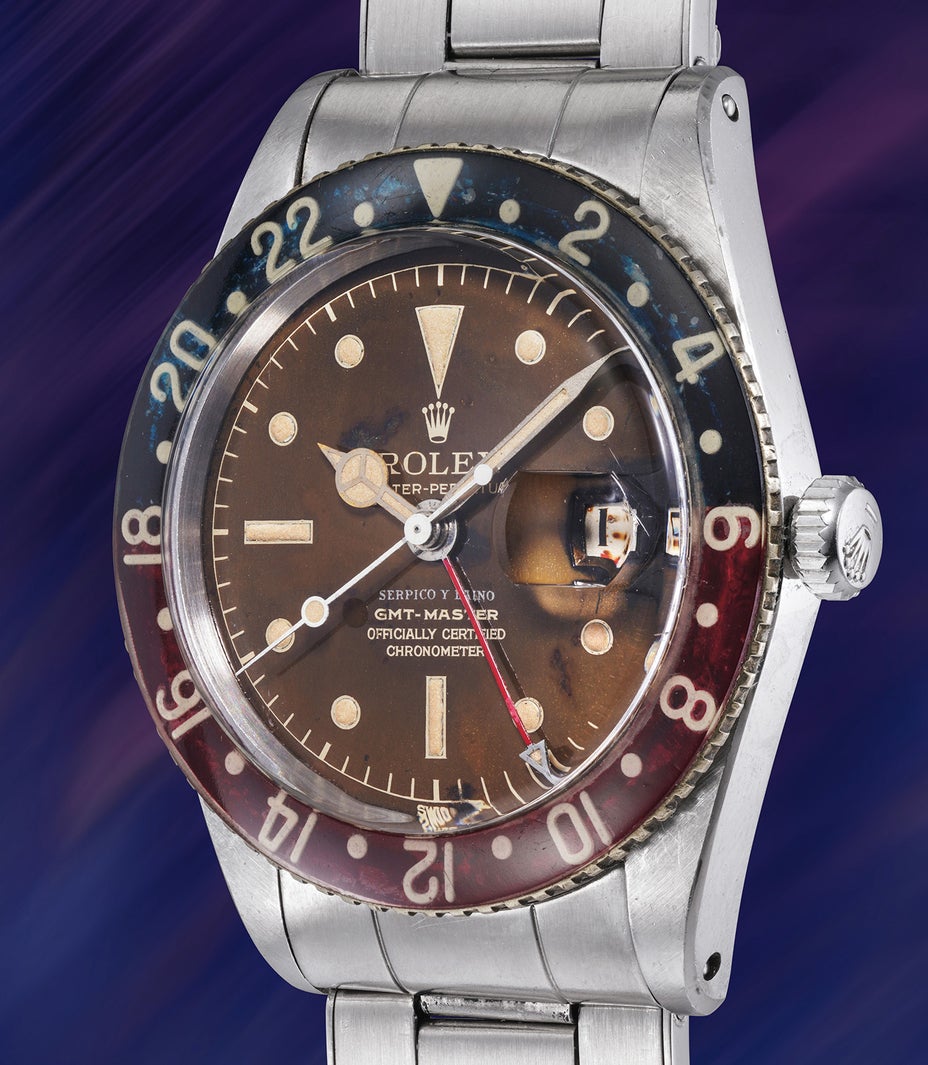
A very well preserved and highly striking stainless steel dual-time wristwatch with center seconds, date, bakelite bezel and bracelet, retailed by Serpico y Laino
- Estimate
- CHF100,000 - 200,000€107,000 - 215,000$124,000 - 247,000
CHF127,000
Lot Details
- Manufacturer
- Rolex
- Year
- Circa 1956
- Reference No
- 6542
- Case No
- 212'435
- Model Name
- GMT-Master "Serpico y Laino"
- Material
- Stainless steel
- Calibre
- Automatic, cal. 1030, 25 jewels
- Bracelet/Strap
- Stainless steel Rolex Oyster bracelet, max length 195mm
- Clasp/Buckle
- Stainless steel Rolex deployant clasp stamped 2.59
- Dimensions
- 38mm diameter
- Signed
- Case, dial, movement and bracelet signed
Specialist
Full-Cataloguing
Catalogue Essay
The story of the Rolex GMT starts with an increase in the number of transatlantic flights enabled by the jet engine, and reaches its zenith thanks to a partnership with one of the most successful airline companies of the mid-20th century. The venerable Pan-American Airlines was looking for an extremely reliable tool watch that would allow its pilots to keep track of two different time zones. Rolex created an ingenious solution, using the rotating Bakelite bezel that worked in conjunction with a fourth, 24-hour hand permitting the wearer to clearly keep track of two time zones.
Instantly recognisable because of its colorful bezel, Rolex’s first GMT-Master was produced for only five short years before the brand addressed the fragility of a Bakelite bezel.
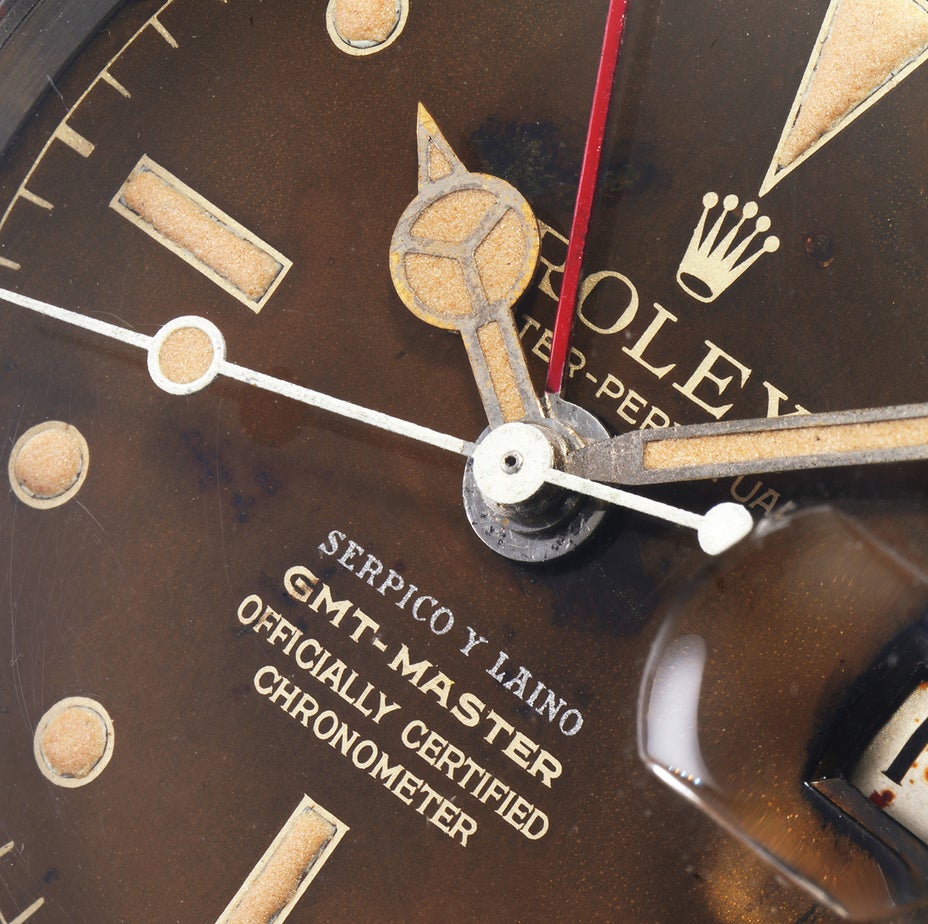
The present reference 6542 is a wonderful example of this seminal GMT-Master model. The glossy black lacquer dial has developed a golden sheen and tropical appearance over the years due to UV exposure which balances well with the well-preserved gilt minute track and gilt printing. The case retains crisp, architectural facets and lovely original dimensions.
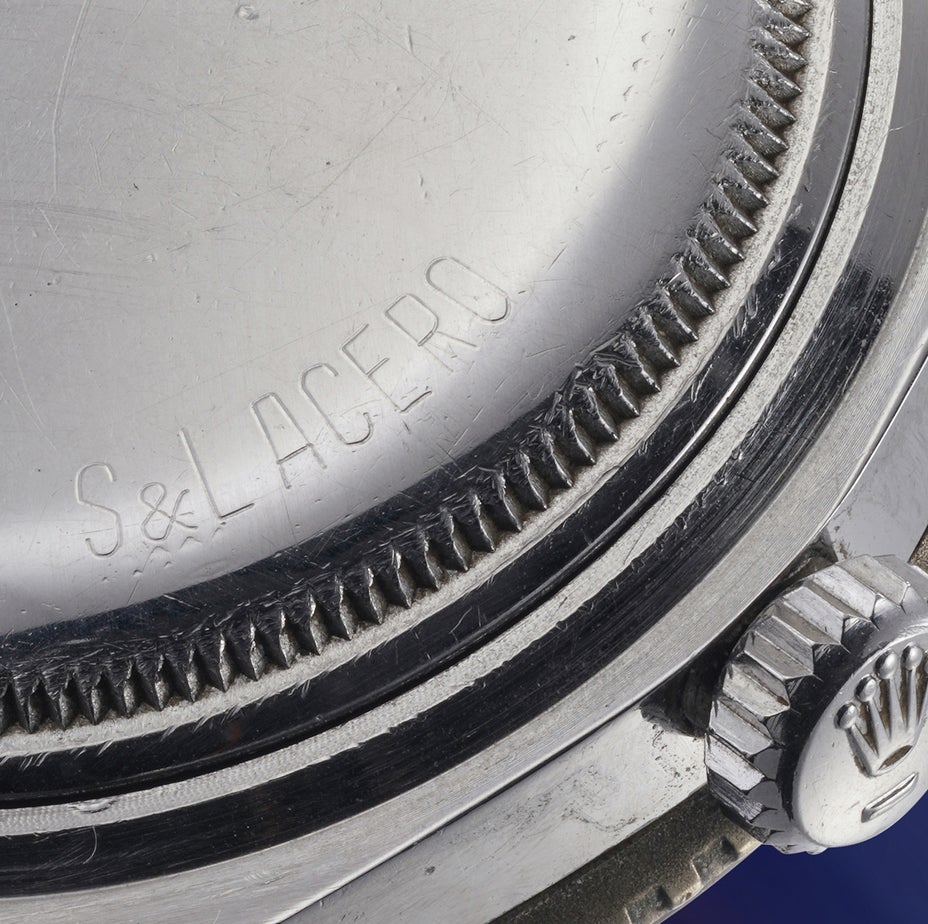
Even more impressive is the presence of the Serpico y Laino signature at 6 o'clock. Even the caseback retains the S&L engraving - a detail that would have been removed with continuous polishing. The present watch is one of a handful of correct examples with the signature of the storied retailer on the dial.
Caracas-based, Venezuelan retailer Serpico & Laino began its history in the 1930s, a result of the partnership of two Italian immigrants to Venezuela, Vincenzo Laino and Leopoldo Serpico. While Serpico was the industrial power behind the brand, Laino was the connossieur, having previously been a goldsmith in his native Basilicata. It was Laino, with Serpico’s encouragement, who negotiated first a partnership with Rolex.
Instantly recognisable because of its colorful bezel, Rolex’s first GMT-Master was produced for only five short years before the brand addressed the fragility of a Bakelite bezel.
The present reference 6542 is a wonderful example of this seminal GMT-Master model. The glossy black lacquer dial has developed a golden sheen and tropical appearance over the years due to UV exposure which balances well with the well-preserved gilt minute track and gilt printing. The case retains crisp, architectural facets and lovely original dimensions.
Even more impressive is the presence of the Serpico y Laino signature at 6 o'clock. Even the caseback retains the S&L engraving - a detail that would have been removed with continuous polishing. The present watch is one of a handful of correct examples with the signature of the storied retailer on the dial.
Caracas-based, Venezuelan retailer Serpico & Laino began its history in the 1930s, a result of the partnership of two Italian immigrants to Venezuela, Vincenzo Laino and Leopoldo Serpico. While Serpico was the industrial power behind the brand, Laino was the connossieur, having previously been a goldsmith in his native Basilicata. It was Laino, with Serpico’s encouragement, who negotiated first a partnership with Rolex.
Rolex
Swiss | 1905Founded in 1905 England by Hans Wilsdorf and Alfred Davis as Wilsdorf & Davis, it soon became known as the Rolex Watch Company in 1915, moving its headquarters to Geneva in 1919. Like no other company, the success of the wristwatch can be attributed to many of Rolex's innovations that made them one of the most respected and well-known of all luxury brands. These innovations include their famous "Oyster" case — the world's first water resistant and dustproof watch case, invented in 1926 — and their "Perpetual" — the first reliable self-winding movement for wristwatches launched in 1933. They would form the foundation for Rolex's Datejust and Day-Date, respectively introduced in 1945 and 1956, but also importantly for their sports watches, such as the Explorer, Submariner and GMT-Master launched in the mid-1950s.One of its most famous models is the Cosmograph Daytona. Launched in 1963, these chronographs are without any doubt amongst the most iconic and coveted of all collectible wristwatches. Other key collectible models include their most complicated vintage watches, including references 8171 and 6062 with triple calendar and moon phase, "Jean Claude Killy" triple date chronograph models and the Submariner, including early "big-crown" models and military-issued variants.
Browse Maker