


117
Rolex
Ref. 8323
"Neptune"
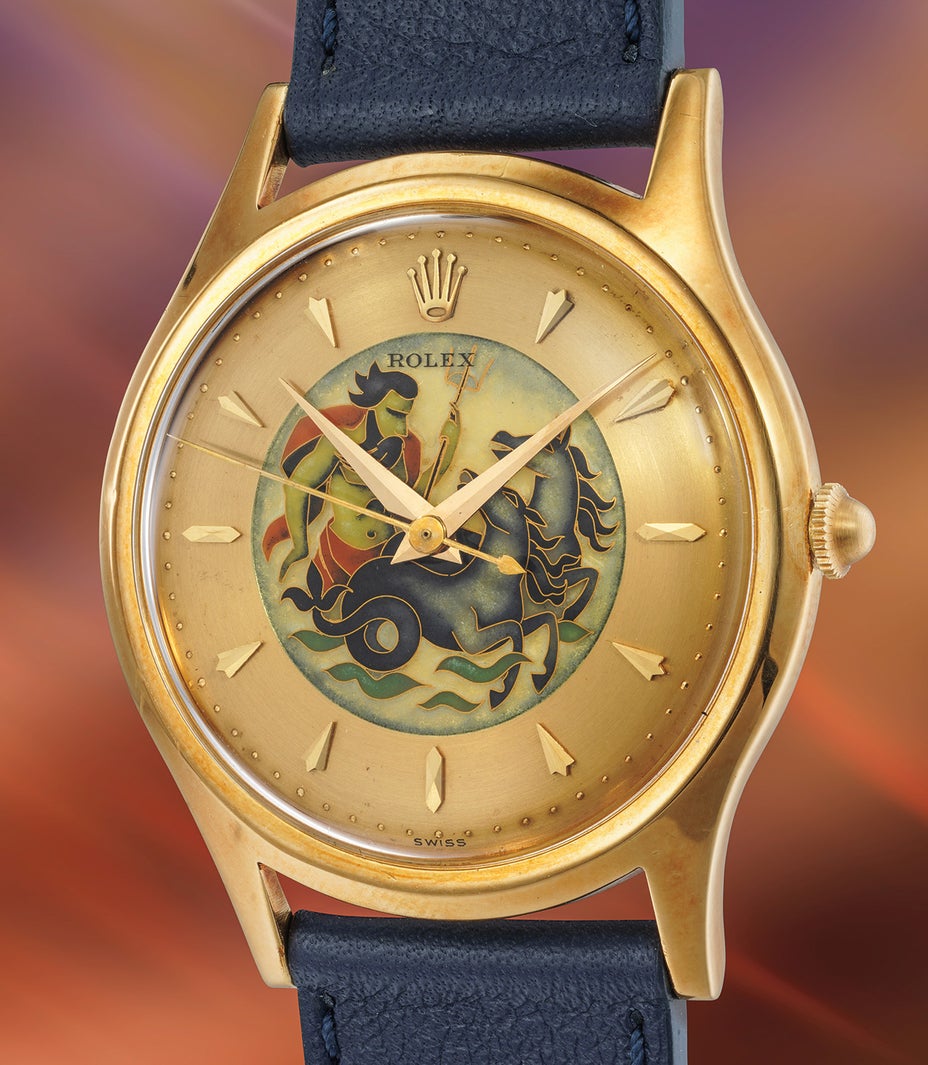
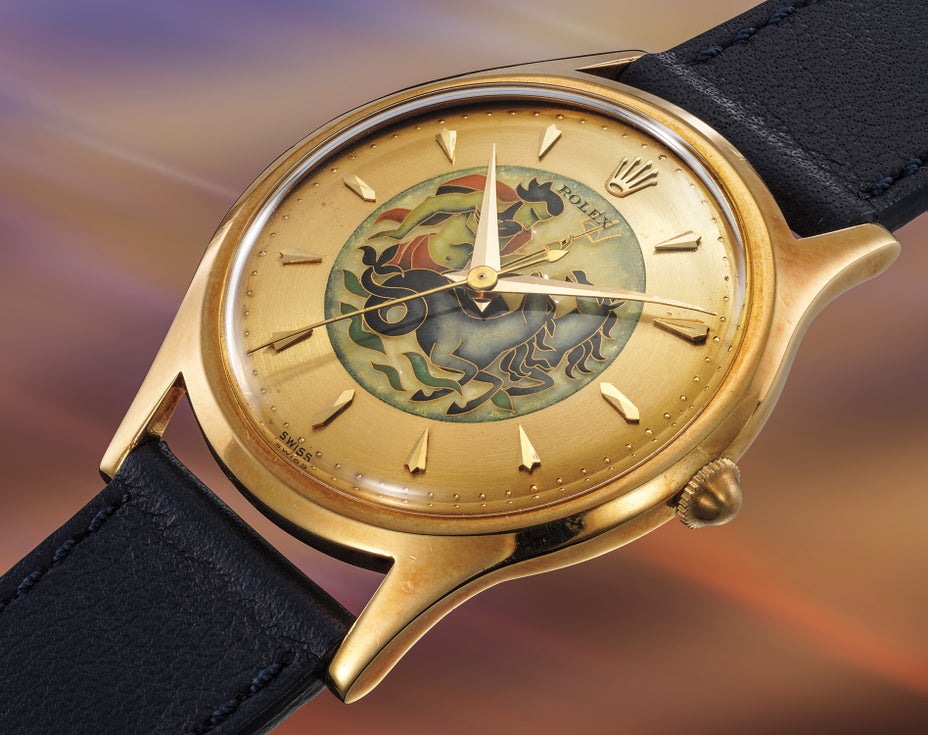
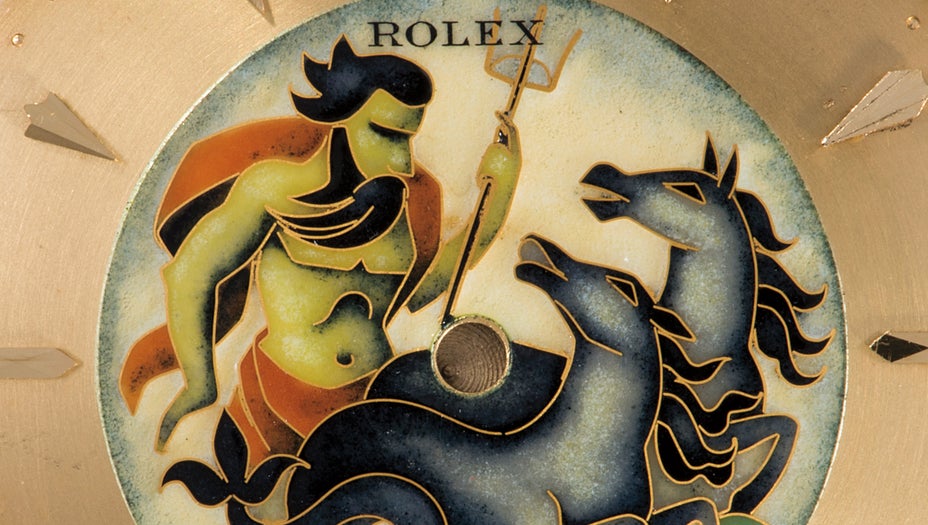
An extremely rare and attractive yellow gold wristwatch with cloisonné enamel dial depicting Neptune
- Estimate
- CHF300,000 - 600,000€319,000 - 638,000$349,000 - 698,000
CHF381,000
Lot Details
- Manufacturer
- Rolex
- Year
- Circa 1953
- Reference No
- 8323
- Movement No
- 82'425
- Model Name
- "Neptune"
- Material
- 18K yellow gold
- Calibre
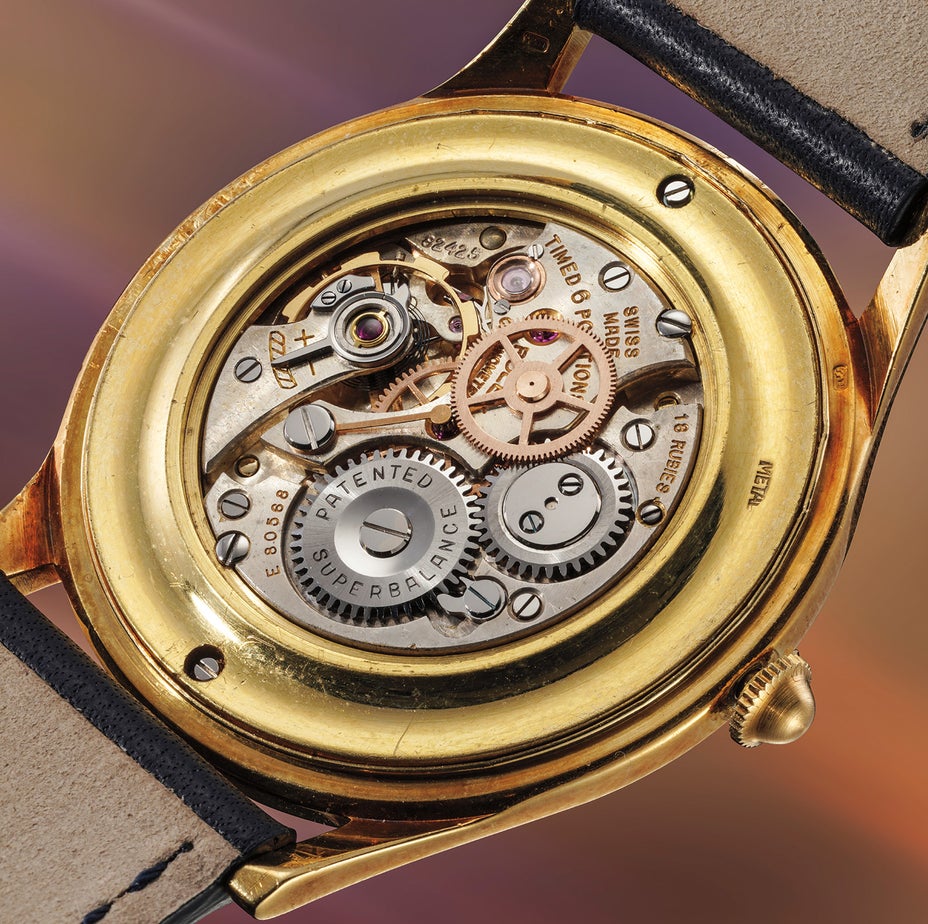
- Manual, cal. E80'568, 19 jewels
- Bracelet/Strap
- Leather
- Clasp/Buckle
- 18K yellow gold Rolex buckle
- Dimensions
- 37mm Diameter
- Signed
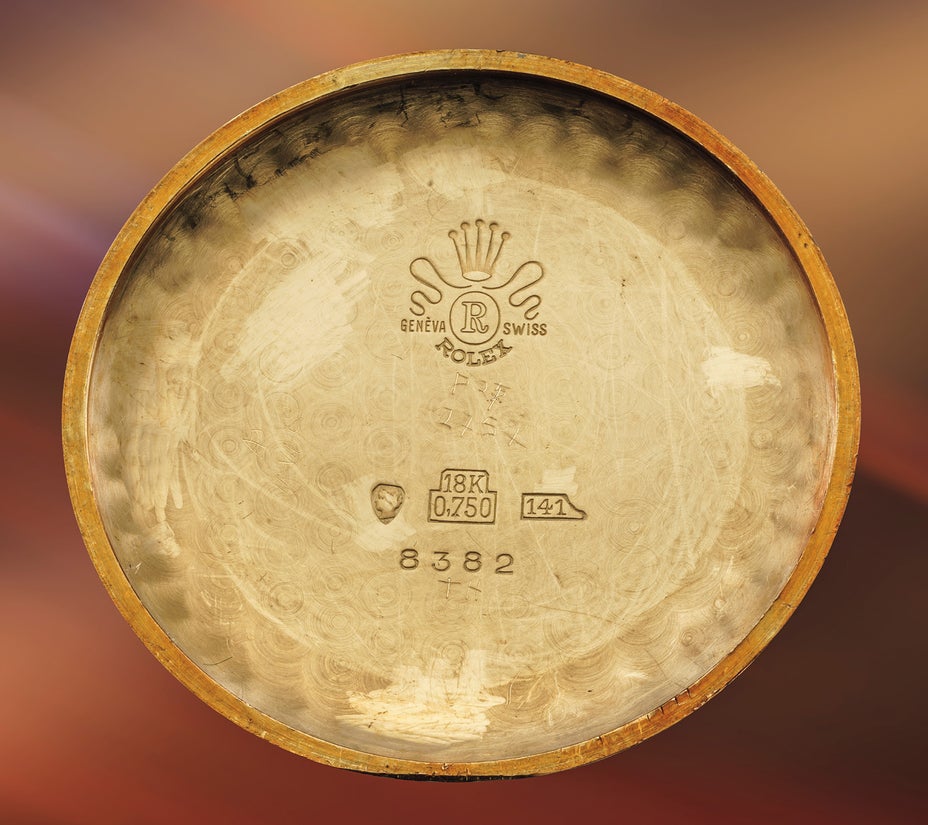
- Case, dial, movement and buckle signed
Specialist
Full-Cataloguing
Catalogue Essay
Rolex has long reserved its finest and most outstanding work for its most exclusive clients - a trend that goes on today with the infamously impossible to obtain out-of-catalogue pieces. While the company is obviously best known for its sport's and professional model, they have conducted throughout their history rare but extremely impressive forays in the realm of high watchmaking. From the mechanical point of view, examples of this trend are the triple calendar with moonphases pieces from the 1950s or the Datocompax models from the 1940s. Surprisingly though, Rolex attempted - and awesomely succeeded as this watch testifies - watches which would today fall in the "Rare Handcraft" category: enamelled timepieces. Particularly during the 1940s and 1950s, Rolex commissioned the dial maker Stern Frères - arguably the best on the market at the time - a remarkably scarce amount of enamel dials. Most of these consist in the sublime monochrome Grand Feu enamel dials found on models such as ref. 6102. The true masterpieces are however the cloisonne' enamel dials such as the present "Neptune" dial - of which only other 2 examples are known, one of them prominently illustrated and described in 100 Superlative Rolex Watches by John Goldberger, pp. 46 & 47.
To bring a cloisonné enamel dial to life, gold wire is painstakingly moulded and hammered to the desired shape, placed on the dial plate, filled with enamel powder and eventually fired in a kiln - these last two steps repeated multiple times. The immense production difficulty unavoidably prompted high cost ultimately resulting in the utmost rarity of these creations.
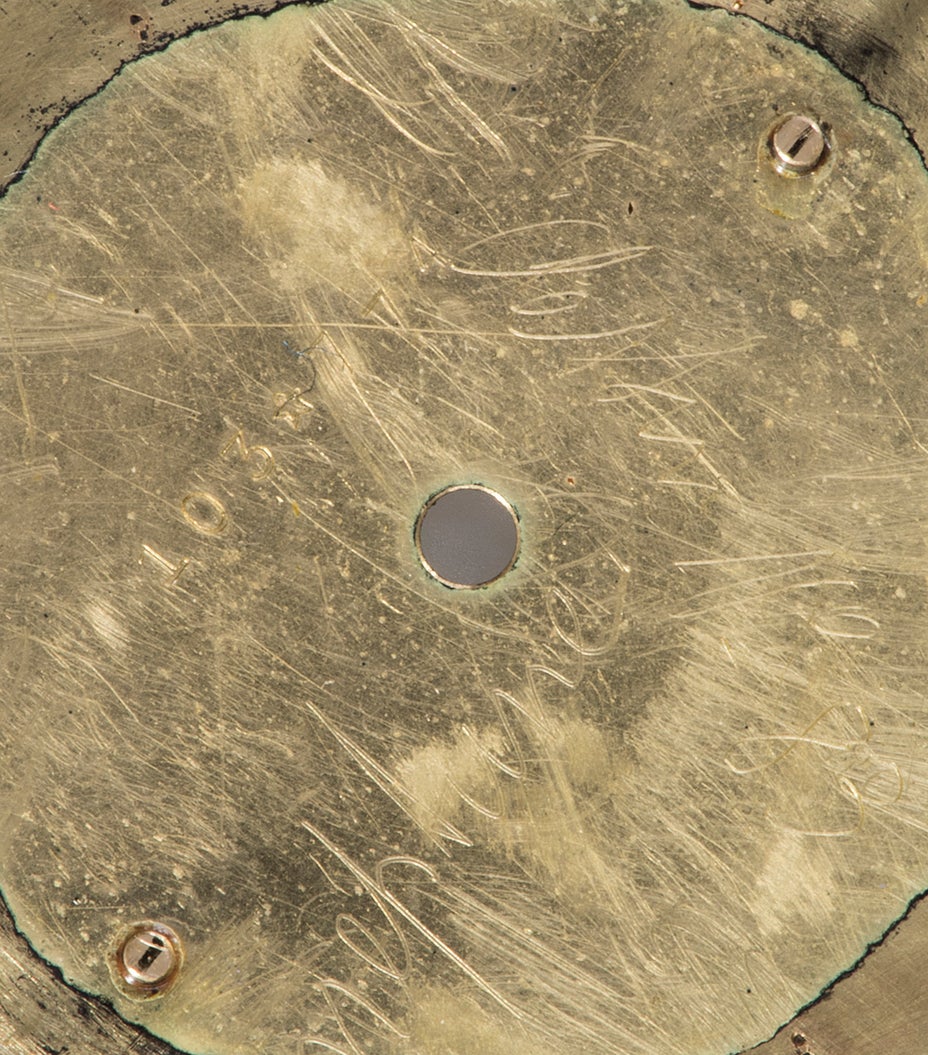
This spectacular masterpiece representing the Neptune was indeed made by Stern Frères. It is inscribed on the back with the code 103*774 - with "103" being Stern's internal code for Rolex, the star being Stern's logo, and "774" being the order number - and furthermore hand-scratched Neptune . In fact, order 774 can be retraced in Stern's archive, which confirms the Neptune design and disclose that the artist was Nelly Richard, one of the most gifted enamelers of the time.
Another highly unusual feature of the present watch is its large and, for Rolex, unusual case design. With a substantial diameter of 37 mm., it is not only larger in size than its Oyster cased peers with enamel dials but has even some resemblance to Patek Philippe's celebrated reference 565.
A timeless design, an exquisite cloisonné enamel dial, a historic brand and ultimate rarity make the present lot a trophy watch for the most discerning collectors.
To bring a cloisonné enamel dial to life, gold wire is painstakingly moulded and hammered to the desired shape, placed on the dial plate, filled with enamel powder and eventually fired in a kiln - these last two steps repeated multiple times. The immense production difficulty unavoidably prompted high cost ultimately resulting in the utmost rarity of these creations.
This spectacular masterpiece representing the Neptune was indeed made by Stern Frères. It is inscribed on the back with the code 103*774 - with "103" being Stern's internal code for Rolex, the star being Stern's logo, and "774" being the order number - and furthermore hand-scratched Neptune . In fact, order 774 can be retraced in Stern's archive, which confirms the Neptune design and disclose that the artist was Nelly Richard, one of the most gifted enamelers of the time.
Another highly unusual feature of the present watch is its large and, for Rolex, unusual case design. With a substantial diameter of 37 mm., it is not only larger in size than its Oyster cased peers with enamel dials but has even some resemblance to Patek Philippe's celebrated reference 565.
A timeless design, an exquisite cloisonné enamel dial, a historic brand and ultimate rarity make the present lot a trophy watch for the most discerning collectors.
Rolex
Swiss | 1905Founded in 1905 England by Hans Wilsdorf and Alfred Davis as Wilsdorf & Davis, it soon became known as the Rolex Watch Company in 1915, moving its headquarters to Geneva in 1919. Like no other company, the success of the wristwatch can be attributed to many of Rolex's innovations that made them one of the most respected and well-known of all luxury brands. These innovations include their famous "Oyster" case — the world's first water resistant and dustproof watch case, invented in 1926 — and their "Perpetual" — the first reliable self-winding movement for wristwatches launched in 1933. They would form the foundation for Rolex's Datejust and Day-Date, respectively introduced in 1945 and 1956, but also importantly for their sports watches, such as the Explorer, Submariner and GMT-Master launched in the mid-1950s.One of its most famous models is the Cosmograph Daytona. Launched in 1963, these chronographs are without any doubt amongst the most iconic and coveted of all collectible wristwatches. Other key collectible models include their most complicated vintage watches, including references 8171 and 6062 with triple calendar and moon phase, "Jean Claude Killy" triple date chronograph models and the Submariner, including early "big-crown" models and military-issued variants.
Browse Maker