815
Rolex
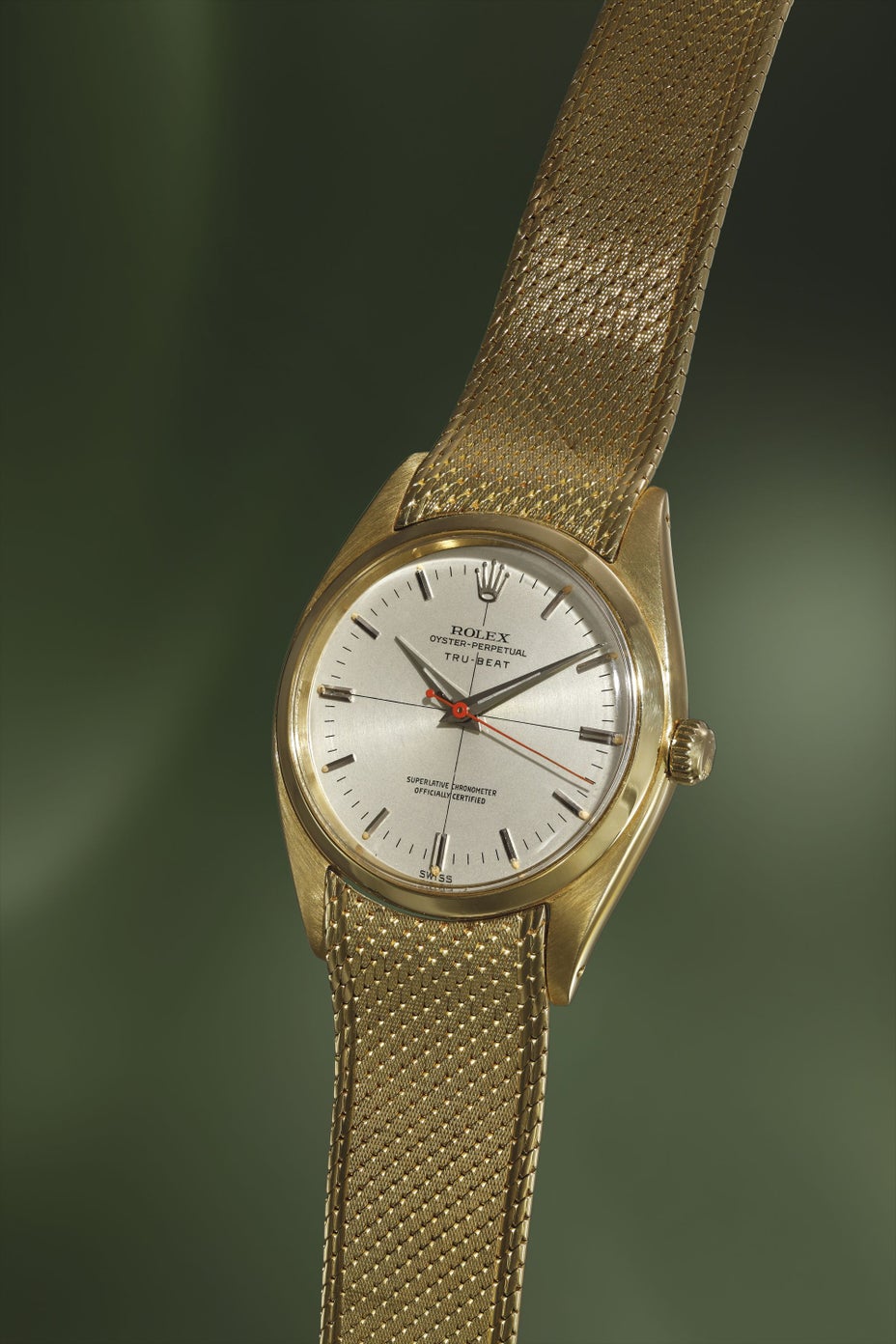
Ref. 6556
Tru-Beat
An incredibly fine and rare yellow gold wristwatch with dead-beat seconds, unusual mesh bracelet, original guarantee and fitted presentation box
Full-Cataloguing
Many watchmakers did not have the ability to repair such movements, and switched out the mechanism in favor of typical automatic movements, hence the rarity of a correct example today. Another element of delight is the watch’s provenance, having been sold at Antiquorum’s historic The Mondani Collection of 309 Rolex Wristwatches sale.
John Goldberger's Opinion
The present watch, cased in yellow gold and fitted with a mesh bracelet, is possibly the finest and most complete ‘Tru-Beat’ I have ever seen. The silvered dial is lovely. The white gold markers reflect the yellow gold case, and are acommpanied by original, perfectly round, luminous that has aged to a warm orange colour. Most striking is the ‘cross’ on the dial, usually reserved for examples cased in stainless steel.
The case features a sharp milled finish to the top of the lugs and a crisp hallmark beneath. The accompanying bracelet, stamped for the first quarter of 1962, is beautifully crafted. Less than 10 examples cased in yellow gold are known to the market today, and I particularly like that this watch is accompanied by its original guarantee and box.
Rolex
Swiss | 1905Founded in 1905 England by Hans Wilsdorf and Alfred Davis as Wilsdorf & Davis, it soon became known as the Rolex Watch Company in 1915, moving its headquarters to Geneva in 1919. Like no other company, the success of the wristwatch can be attributed to many of Rolex's innovations that made them one of the most respected and well-known of all luxury brands. These innovations include their famous "Oyster" case — the world's first water resistant and dustproof watch case, invented in 1926 — and their "Perpetual" — the first reliable self-winding movement for wristwatches launched in 1933. They would form the foundation for Rolex's Datejust and Day-Date, respectively introduced in 1945 and 1956, but also importantly for their sports watches, such as the Explorer, Submariner and GMT-Master launched in the mid-1950s.
One of its most famous models is the Cosmograph Daytona. Launched in 1963, these chronographs are without any doubt amongst the most iconic and coveted of all collectible wristwatches. Other key collectible models include their most complicated vintage watches, including references 8171 and 6062 with triple calendar and moon phase, "Jean Claude Killy" triple date chronograph models and the Submariner, including early "big-crown" models and military-issued variants.