Property of a Private New York Collector
10
Robert Gober
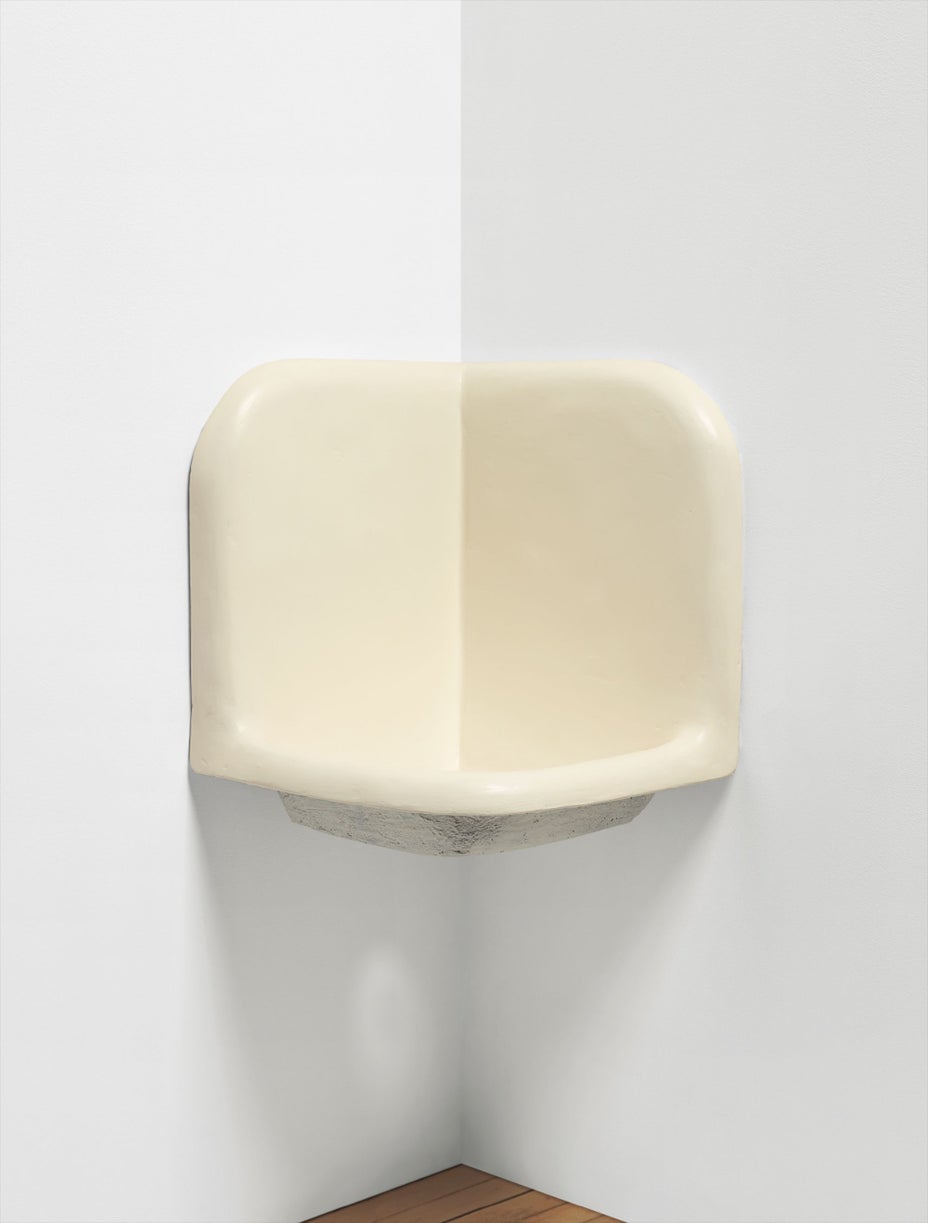
The Sad Sink
Estimate
$2,000,000–3,000,000
Sold For
$2,225,000
plaster, wood, wire lath, steel and semi-gloss enamel paint
22 1/2 x 18 x 18 in. (57.2 x 45.7 x 45.7 cm)
Signed, titled and dated "'The Sad Sink' 1985 Bob Gober" on the reverse.
Full-Cataloguing
“One of my earliest memories is of standing in front of the counter that held our kitchen sink. The top of my head was much lower than the height of the sink, where I would watch my mother for countless hours. I remember thinking that life would be different when I could see for myself the interior of the sink.” OR “Most of my sculptures have been memories remade, recombined, and filetered through my current experiences.”
Robert Gober’s early and seminal work from 1985, The Sad Sink, is a profound realization of the artist’s emotional, formal, and conceptual investigations within his nearly four decade long art practice. Through his depiction of seemingly mundane objects such as a sink, crib, chair, along with isolated body parts, Gober explores themes of family, religion, sexuality, alienation and memory, both collective and private. With painstaking and meticulous detail he renders these thought-provoking sculptures by hand to build a universe that investigates the psychological and symbolic power of the objects in our everyday lives.
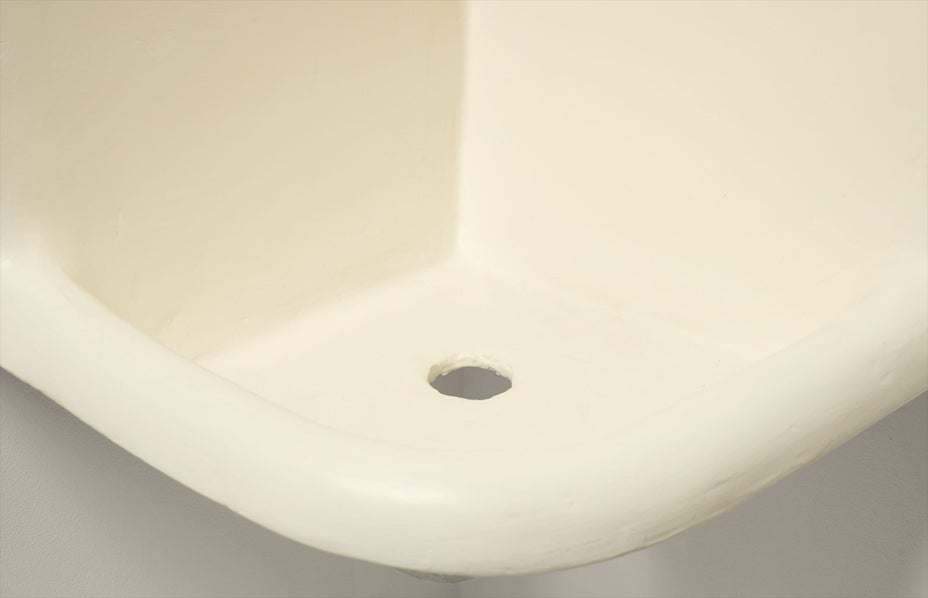
The Sad Sink is one of Gober’s earliest Sinks and one of the few that he titled. Resting in the corner as it must, a function of its form, the work acts as a reference not only for the object which it literally represents but also the myriad art-historical and personal instances of the corner and its implicit psychological underpinnings. Having grown up in a Catholic household, Gober was deeply involved in the proceedings of the Church, an experience which has heavily influenced the symbology throughout his oeuvre. Just as Gober may have felt cornered by the competing psychological draws of his familial history and religion against his own sexuality, the sink sits silently and remotely unto itself. With no faucets, no water, it is useless as a sink, and yet, in its silence, the power of the object and the artist’s intent reverberates stridently from the corner outward. The viewer cannot help but think of the young child, caught guilty and sent to contemplate and reflect on the transgression in the corner, back to the room, face to the wall. And like when the child in the corner, everyone who enters the room of The Sad Sink cannot help but be drawn to its sadness, its sense of purposiveness without purpose.
Seen literally cornered, The Sad Sink has all the brooding, uncanny qualities of a dream made real. Though the purity of its form is almost minimalist in its reduction, the hand-made quality of The Sad Sink contradicts its formal austerity and minimal coolness. Meticulously crafted by the artist, this work is composed of the humblest materials—plaster, wire, wood and enamel paint—in striking contrast to its real-life porcelain counterpart. The smooth contours invite the viewer’s touch, and the sheen of all-white enamel perfectly mimics the cleanliness and rigor of porcelain. But the difference in encountering the warmth of plaster and wood versus the cold, unfeeling indifference of porcelain provides a striking contrast. The work exudes that particular frisson, the unexpected, chill-producing effect that two seemingly illogical objects could produce when combined. Although here, the two objects are not so much objects but the juxtaposition between the viewer’s expectations and the concocted reality of Gober’s sink. This object is resolutely handmade, carefully constructed with a human quality, reinforcing the artist’s search for meaning in form, objects, and content rather than the conceptual strategizing that is associated with Duchamp’s readymades.
The Sad Sink is a triumph of Gober’s oeuvre, perfectly blending his ability to create an object that is at once representational and abstract, physical and ethereal, referent and wholly self-contained. “To get what Gober wanted meant making it, piece by piece, from the bottom up. Only that activity would yield a specific, recognizable thing, related deeply to everyday life, yet uncannily possessing something unknown, perhaps unexpected, that would appear somehow in the activity of making. To make things meant bringing them to the precipitous brink between the real and the strange.” (E. Sussman, “Robert Gober: Installation and Sculpture,” in T. Vischer (ed.), Robert Gober: Sculpture and Installations 1979-2007, exh. cat., Schaulager Basel, 2007, p. 19)
Robert Gober’s early and seminal work from 1985, The Sad Sink, is a profound realization of the artist’s emotional, formal, and conceptual investigations within his nearly four decade long art practice. Through his depiction of seemingly mundane objects such as a sink, crib, chair, along with isolated body parts, Gober explores themes of family, religion, sexuality, alienation and memory, both collective and private. With painstaking and meticulous detail he renders these thought-provoking sculptures by hand to build a universe that investigates the psychological and symbolic power of the objects in our everyday lives.
The Sad Sink is one of Gober’s earliest Sinks and one of the few that he titled. Resting in the corner as it must, a function of its form, the work acts as a reference not only for the object which it literally represents but also the myriad art-historical and personal instances of the corner and its implicit psychological underpinnings. Having grown up in a Catholic household, Gober was deeply involved in the proceedings of the Church, an experience which has heavily influenced the symbology throughout his oeuvre. Just as Gober may have felt cornered by the competing psychological draws of his familial history and religion against his own sexuality, the sink sits silently and remotely unto itself. With no faucets, no water, it is useless as a sink, and yet, in its silence, the power of the object and the artist’s intent reverberates stridently from the corner outward. The viewer cannot help but think of the young child, caught guilty and sent to contemplate and reflect on the transgression in the corner, back to the room, face to the wall. And like when the child in the corner, everyone who enters the room of The Sad Sink cannot help but be drawn to its sadness, its sense of purposiveness without purpose.
Seen literally cornered, The Sad Sink has all the brooding, uncanny qualities of a dream made real. Though the purity of its form is almost minimalist in its reduction, the hand-made quality of The Sad Sink contradicts its formal austerity and minimal coolness. Meticulously crafted by the artist, this work is composed of the humblest materials—plaster, wire, wood and enamel paint—in striking contrast to its real-life porcelain counterpart. The smooth contours invite the viewer’s touch, and the sheen of all-white enamel perfectly mimics the cleanliness and rigor of porcelain. But the difference in encountering the warmth of plaster and wood versus the cold, unfeeling indifference of porcelain provides a striking contrast. The work exudes that particular frisson, the unexpected, chill-producing effect that two seemingly illogical objects could produce when combined. Although here, the two objects are not so much objects but the juxtaposition between the viewer’s expectations and the concocted reality of Gober’s sink. This object is resolutely handmade, carefully constructed with a human quality, reinforcing the artist’s search for meaning in form, objects, and content rather than the conceptual strategizing that is associated with Duchamp’s readymades.
The Sad Sink is a triumph of Gober’s oeuvre, perfectly blending his ability to create an object that is at once representational and abstract, physical and ethereal, referent and wholly self-contained. “To get what Gober wanted meant making it, piece by piece, from the bottom up. Only that activity would yield a specific, recognizable thing, related deeply to everyday life, yet uncannily possessing something unknown, perhaps unexpected, that would appear somehow in the activity of making. To make things meant bringing them to the precipitous brink between the real and the strange.” (E. Sussman, “Robert Gober: Installation and Sculpture,” in T. Vischer (ed.), Robert Gober: Sculpture and Installations 1979-2007, exh. cat., Schaulager Basel, 2007, p. 19)