Photographs from the Collection of Robert Richardson and Monona Wali
16
Robert Frank
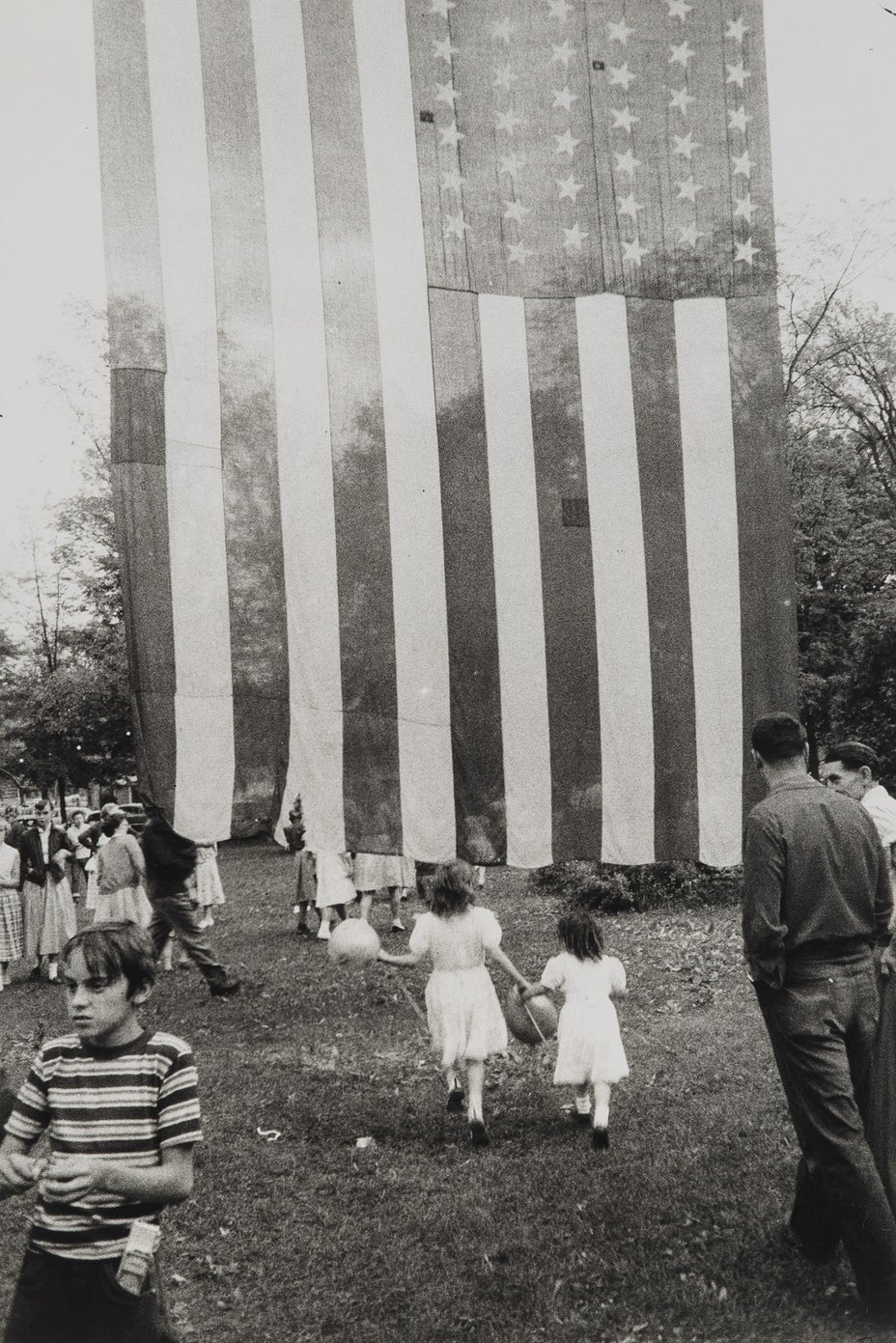
Fourth of July – Jay, New York
Estimate
$60,000–80,000
Sold For
$88,200
1954
Gelatin silver print, printed later.
11 7/8 x 8 in. (30.2 x 20.3 cm)
Signed, dated and annotated '4th of July' in ink in the margin.
Full-Cataloguing
As Robert Frank crossed the country on the series of photographic trips that would culminate in The Americans, he gravitated to a number of themes that, in the book, create a wordless narrative of the country in the mid to late 1950s. The American flag is one such motif, and it appears throughout the book. Frank said, ‘I liked the visual, graphic image of the flag. I think it’s a very good flag’ (Katalog, Vol. 9., No. 4, Fall 1997). In Fourth of July – Jay, New York, its somewhat ragged incarnation dominates the picture frame. The diaphanous flag, and the spatially ambiguous placement of the figures in relationship to it, create a visual riddle that invites the kind of prolonged visual contemplation inherent in Frank’s statement, 'When people look at my pictures I want them to feel the way they do when they want to read a line of a poem twice.'
The choice selection of images from Robert Frank’s The Americans offered here as lots 13 through 18 all come from the collection of Robert Richardson and Monona Wali. These were acquired from the photographer in the late 1980s and early 1990s. Mr. Richardson is a three-time Academy Award winning cinematographer who has worked with such acclaimed directors as Martin Scorsese, Quentin Tarantino, Oliver Stone, and Errol Morris. In 2019 he received the prestigious Lifetime Achievement Award from The American Society of Cinematographers. Ms. Wali is an award-winning writer, filmmaker, and teacher. Their collection began in the 1980s with acquisitions of work by Frank, Henri Cartier-Bresson, Robert Adams, Edward Weston, Tina Modotti, Danny Lyon, and many others – all images that synthesized the then-married couple’s dual interests in photography’s visual and narrative power.
Mr. Richardson writes, 'Robert Frank’s work was my teacher in so many ways. He taught me with his precise vision how to look upon an America that others could not, or would not, or were unable to see. His career was not simply one book, The Americans, although many hold that up as perhaps the finest of his work, and the finest of anyone’s. But his later images and films with his family brought out the emotional heart of what he captured through his lens as he grew older and wiser. Many call him a documentary photographer. I see that perspective, but I also see vastly more. I see and feel the subjective point of view of a master – in my mind, the master.'
The choice selection of images from Robert Frank’s The Americans offered here as lots 13 through 18 all come from the collection of Robert Richardson and Monona Wali. These were acquired from the photographer in the late 1980s and early 1990s. Mr. Richardson is a three-time Academy Award winning cinematographer who has worked with such acclaimed directors as Martin Scorsese, Quentin Tarantino, Oliver Stone, and Errol Morris. In 2019 he received the prestigious Lifetime Achievement Award from The American Society of Cinematographers. Ms. Wali is an award-winning writer, filmmaker, and teacher. Their collection began in the 1980s with acquisitions of work by Frank, Henri Cartier-Bresson, Robert Adams, Edward Weston, Tina Modotti, Danny Lyon, and many others – all images that synthesized the then-married couple’s dual interests in photography’s visual and narrative power.
Mr. Richardson writes, 'Robert Frank’s work was my teacher in so many ways. He taught me with his precise vision how to look upon an America that others could not, or would not, or were unable to see. His career was not simply one book, The Americans, although many hold that up as perhaps the finest of his work, and the finest of anyone’s. But his later images and films with his family brought out the emotional heart of what he captured through his lens as he grew older and wiser. Many call him a documentary photographer. I see that perspective, but I also see vastly more. I see and feel the subjective point of view of a master – in my mind, the master.'
Robert Frank
Swiss | 1924As one of the leading visionaries of mid-century American photography, Robert Frank has created an indelible body of work, rich in insight and poignant in foresight. In his famed series The Americans, Frank travelled the United States, capturing the parade of characters, hierarchies and imbalances that conveyed his view of the great American social landscape.
Frank broke the mold of what was considered successful documentary photography with his "snapshot aesthetic." It is Frank's portrayal of the United States through grit and grain that once brought his work to the apex of criticism, but has now come to define the art of documentary photography.