9
Richard Prince
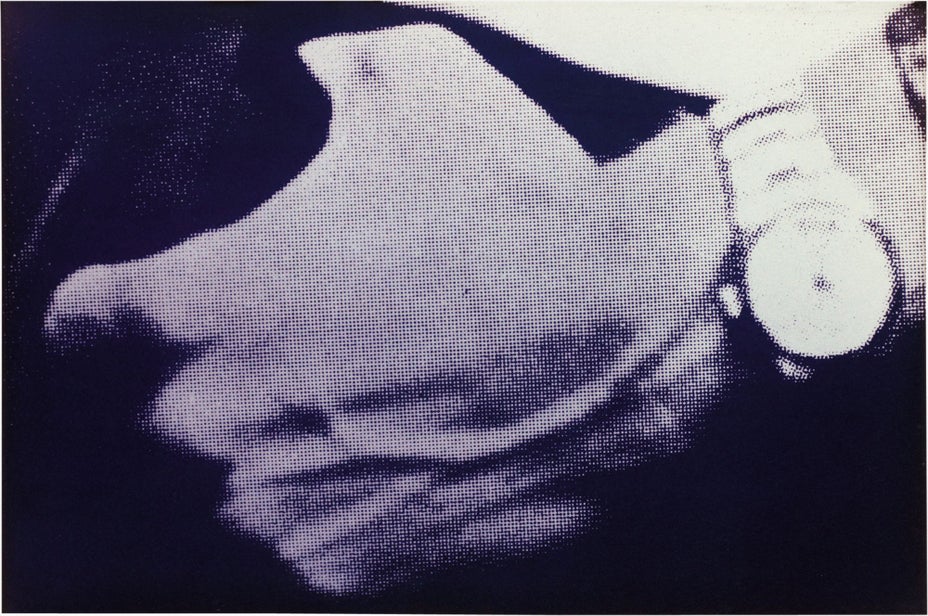
Untitled (Man's hand with watch)
This work is unique.
Full-Cataloguing
RICHARD PRINCE, 1988
Prince’s early practice of re-photography largely set the tone for his extensive body of work that followed. The artist spent the beginning of his career in TIME magazine’s
tear sheets department, sparking his interest in appropriation and iconography alike. Untitled (Man’s hand with watch), 1980, is exemplary of the artist’s early impulse to
completely de-aestheticize work as a means of infusing meaning and creating a sleight of hand conceptual dimension.
In simultaneously enlarging the image of the watch and reducing the print advertisement to an image of the product in isolation, Prince commenced his discourse at the juncture of high art and mainstream media– an exploration that has spanned the narrative of his career to date. In presenting his audience with a magazine advertisement even further diluted than they may have initially encountered it in their everyday lives, the artist implicitly challenges the viewer to approach the work with a heightened consciousness and thus to evaluate the effect of advertisements and images being routinely force fed to them on a daily basis. Here, and throughout the early stages of his career, Prince sought to unhinge the art image binary, building upon the minimalist maxims that had gained traction throughout the 1970s, and cementing his own place in the history of art.
Richard Prince
American | 1947For more than three decades, Prince's universally celebrated practice has pursued the subversive strategy of appropriating commonplace imagery and themes – such as photographs of quintessential Western cowboys and "biker chicks," the front covers of nurse romance novellas, and jokes and cartoons – to deconstruct singular notions of authorship, authenticity and identity.
Starting his career as a member of the Pictures Generation in the 1970s alongside such contemporaries as Cindy Sherman, Robert Longo and Sherrie Levine, Prince is widely acknowledged as having expanded the accepted parameters of art-making with his so-called "re-photography" technique – a revolutionary appropriation strategy of photographing pre-existing images from magazine ads and presenting them as his own. Prince's practice of appropriating familiar subject matter exposes the inner mechanics of desire and power pervading the media and our cultural consciousness at large, particularly as they relate to identity and gender constructs.