
Property of a Distinguished Private Collector
15✱
Richard Prince
Nurse Kathy
- Estimate
- HK$31,000,000 - 41,000,000€3,420,000 - 4,530,000$3,970,000 - 5,260,000
Lot Details
inkjet and acrylic on canvas
signed, titled and dated '"Nurse Kathy" R Prince 2006-08' on the reverse
213.7 x 137.1 cm. (84 1/8 x 53 7/8 in.)
Executed in 2006-2008.
Specialist
Full-Cataloguing
Catalogue Essay
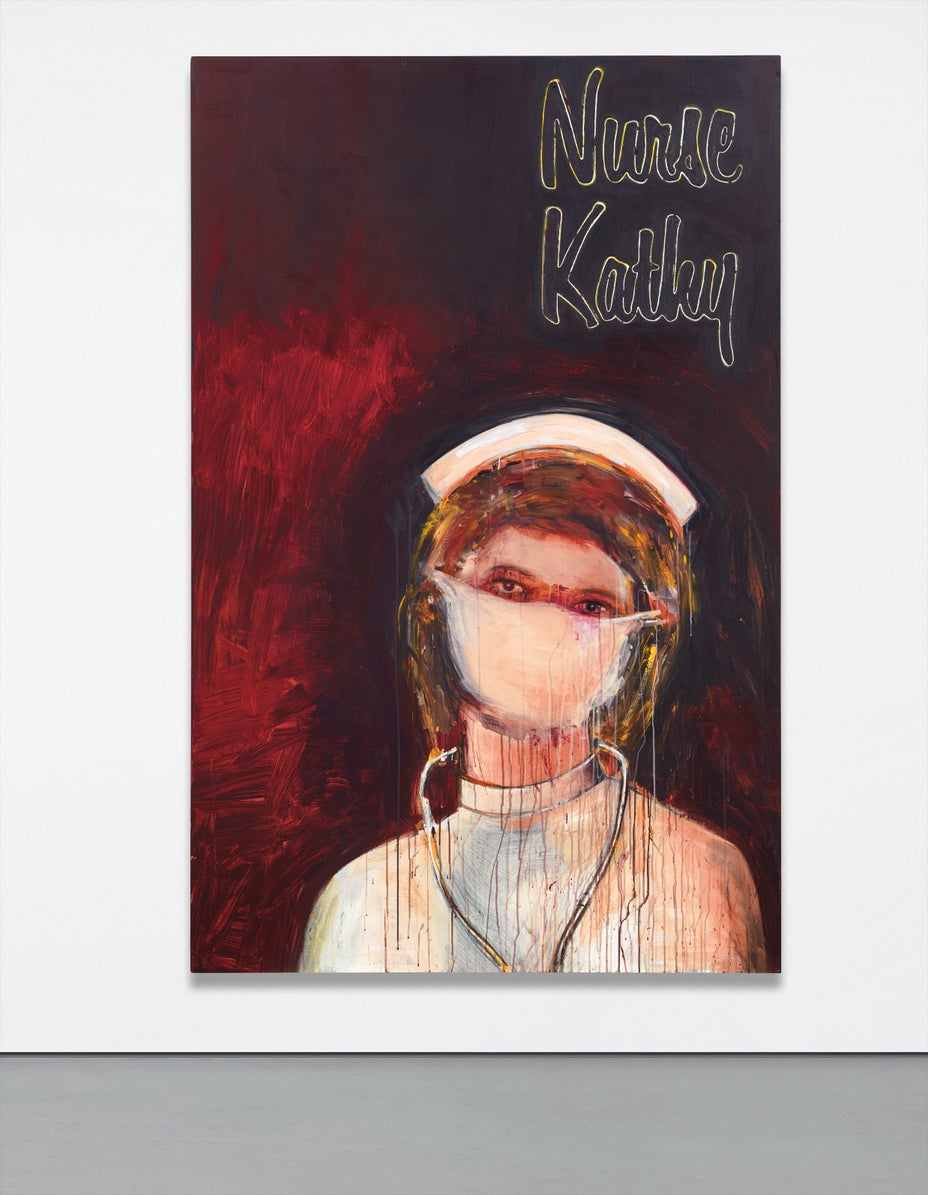
Painted in 2006-08, Nurse Kathy is from one of Richard Prince’s famous series of ‘Nurse’ paintings. In these pictures, Prince presents the viewer with an image of striking and deceptive simplicity: a nurse, masked, with paint dripping down the surface, is shown alongside a title. There is a painterly quality to these images: in Nurse Kathy, the brushstrokes and the glow of colours evoke the Abstract Expressionism of Mark Rothko. Yet this is an image based in part on images manipulated by computer. In this way, Prince’s Nurse paintings manage to balance impossible extremes: they are in-your-face, direct, assaults on the senses, taking their visual impact from art, book design and advertising. Yet they are also elusive, with Prince himself presenting the viewer with a work that is a cipher, a riddle, filled with layers of meaning. Prince has combined digital imaging with gestural brushwork in order to create a work that challenges notions of authorship.
Nurse Kathy takes its title from a book by the author Adeline McElfresh, who wrote a number of popular, essentially trashy romances during the 1950s. Prince has even preserved the font and positioning of the title in this image, taking it directly from a paperback copy of McElfresh’s book. But he has appropriated the image of the nurse from another book, removed any other extraneous details, and added the face mask. In this way, the romance of the nurse fiction that had been such a sensation in the middle of the Twentieth Century is disrupted, with Prince invoking horror. That Nurse Kathy itself is a Frankenstein creation, created from snippets of various sources is analogous to our masked heroine’s profession. The masked nurse tells of operations under way, and of concealed identities. This reflects Prince’s own playful manipulation of identity. The fact that McElfresh worked under a number of pseudonyms and pen-names, some of them male and others female, only reinforces the potency of Prince’s assault on concepts of authorship.
Having worked as a picture archivist earlier in his career, and as an ardent bibliophile, Prince has developed an incredible visual and literary erudition, and puts it to play in pictures such as Nurse Kathy. Concepts of brushwork, modernist ideas of what an artist should be, notions of the machismo of the Action Painters, are all disrupted through Prince’s compressing of romantic, trashy fiction and digital printing. He is lambasting the pedestals that sustain so many of the cultural hierarchies at work today. The collage and composition that underpins Nurse Kathy has evolved from his cropping of Marlboro advertisements earlier in his career. Just as those works explored clichés of masculinity in the form of the cowboys he showed in epic landscapes, derived from cigarette advertisements, so here he has revealed stereotypical views of femininity as similar fictions. Prince manages to attack a number of targets in his pictures, which balance apparent expressionism with a detached yet humorous inscrutability.
Nurse Kathy takes its title from a book by the author Adeline McElfresh, who wrote a number of popular, essentially trashy romances during the 1950s. Prince has even preserved the font and positioning of the title in this image, taking it directly from a paperback copy of McElfresh’s book. But he has appropriated the image of the nurse from another book, removed any other extraneous details, and added the face mask. In this way, the romance of the nurse fiction that had been such a sensation in the middle of the Twentieth Century is disrupted, with Prince invoking horror. That Nurse Kathy itself is a Frankenstein creation, created from snippets of various sources is analogous to our masked heroine’s profession. The masked nurse tells of operations under way, and of concealed identities. This reflects Prince’s own playful manipulation of identity. The fact that McElfresh worked under a number of pseudonyms and pen-names, some of them male and others female, only reinforces the potency of Prince’s assault on concepts of authorship.
Having worked as a picture archivist earlier in his career, and as an ardent bibliophile, Prince has developed an incredible visual and literary erudition, and puts it to play in pictures such as Nurse Kathy. Concepts of brushwork, modernist ideas of what an artist should be, notions of the machismo of the Action Painters, are all disrupted through Prince’s compressing of romantic, trashy fiction and digital printing. He is lambasting the pedestals that sustain so many of the cultural hierarchies at work today. The collage and composition that underpins Nurse Kathy has evolved from his cropping of Marlboro advertisements earlier in his career. Just as those works explored clichés of masculinity in the form of the cowboys he showed in epic landscapes, derived from cigarette advertisements, so here he has revealed stereotypical views of femininity as similar fictions. Prince manages to attack a number of targets in his pictures, which balance apparent expressionism with a detached yet humorous inscrutability.
Provenance
Richard Prince
American | 1947For more than three decades, Prince's universally celebrated practice has pursued the subversive strategy of appropriating commonplace imagery and themes – such as photographs of quintessential Western cowboys and "biker chicks," the front covers of nurse romance novellas, and jokes and cartoons – to deconstruct singular notions of authorship, authenticity and identity.Starting his career as a member of the Pictures Generation in the 1970s alongside such contemporaries as Cindy Sherman, Robert Longo and Sherrie Levine, Prince is widely acknowledged as having expanded the accepted parameters of art-making with his so-called "re-photography" technique – a revolutionary appropriation strategy of photographing pre-existing images from magazine ads and presenting them as his own. Prince's practice of appropriating familiar subject matter exposes the inner mechanics of desire and power pervading the media and our cultural consciousness at large, particularly as they relate to identity and gender constructs.
Browse Artist