180
Richard Pettibone
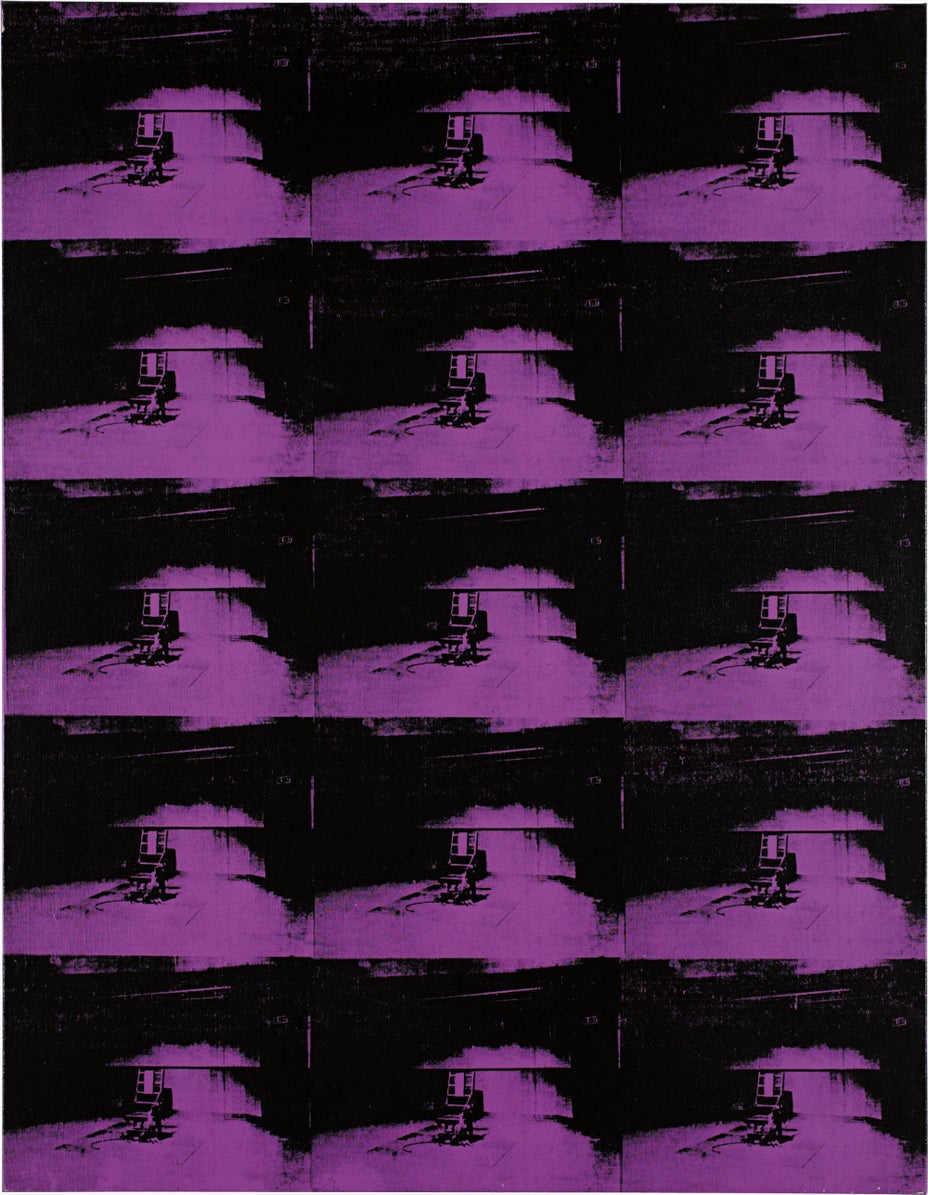
Andy Warhol, 'Lavender Disaster', 1963
Estimate
$80,000–120,000
Sold For
$209,000
acrylic and silkscreen on canvas
24 3/4 x 19 1/4 in. (62.9 x 48.9 cm.)
Signed, titled and dated "Andy Warhol 'Lavender Disaster,' 1963" "Richard Pettibone 1996" on the reverse. This work is registered in the archives of Leo Castelli under the number RP-84.
Full-Cataloguing
“What’s the reason for art? To entertain. If you don’t do that, what’s the point?” RICHARD PETTIBONE, 2005
In 1963, the electric chair in Sing Sing State Penitentiary, New York, performed the state’s last two executions: Frederick Charles Wood on March 21, and eddie Lee Mays on August 15. Andy Warhol used the same photograph throughout his several series of Electric Chair paintings, produced in 1963, 1965, and 1967: an image of an unoccupiedelectric chair in an empty execution chamber, the word “Silence” appears on a sign at the right. Warhol’s Lavender Disaster, 1963, currently in the Menil Collection, has been referred to in the past as a nearly perfect work of art, ripe with meditations on existential dread yet aesthetically marvelous.
Richard Pettibone, working a generation after Warhol, found his calling in “conceptual pop”, or the appropriation of iconic Pop Art. in keeping with his fascinating appropriation techniques, the present lot blurs the line between artistic representation and artistic appropriation. Pettibone is, of course, creating a representation of Warhol’s masterpiece, but it is, conceptually, his own work—a study in pure artistic appropriation. by putting parentheses around Warhol’s work, Pettibone reigns in the unbridled dominance of Warhol’s renown, while simultaneously rendering Warhol’s appropriation of Pop Culture imagery a form of the past. in addition, Pettibone pays tribute to the astronomical level of Warhol’s work’s iconicity—by declaring it a popular image.
In 1963, the electric chair in Sing Sing State Penitentiary, New York, performed the state’s last two executions: Frederick Charles Wood on March 21, and eddie Lee Mays on August 15. Andy Warhol used the same photograph throughout his several series of Electric Chair paintings, produced in 1963, 1965, and 1967: an image of an unoccupiedelectric chair in an empty execution chamber, the word “Silence” appears on a sign at the right. Warhol’s Lavender Disaster, 1963, currently in the Menil Collection, has been referred to in the past as a nearly perfect work of art, ripe with meditations on existential dread yet aesthetically marvelous.
Richard Pettibone, working a generation after Warhol, found his calling in “conceptual pop”, or the appropriation of iconic Pop Art. in keeping with his fascinating appropriation techniques, the present lot blurs the line between artistic representation and artistic appropriation. Pettibone is, of course, creating a representation of Warhol’s masterpiece, but it is, conceptually, his own work—a study in pure artistic appropriation. by putting parentheses around Warhol’s work, Pettibone reigns in the unbridled dominance of Warhol’s renown, while simultaneously rendering Warhol’s appropriation of Pop Culture imagery a form of the past. in addition, Pettibone pays tribute to the astronomical level of Warhol’s work’s iconicity—by declaring it a popular image.