Property from a Private Collection
27
R. W. Martin & Brothers
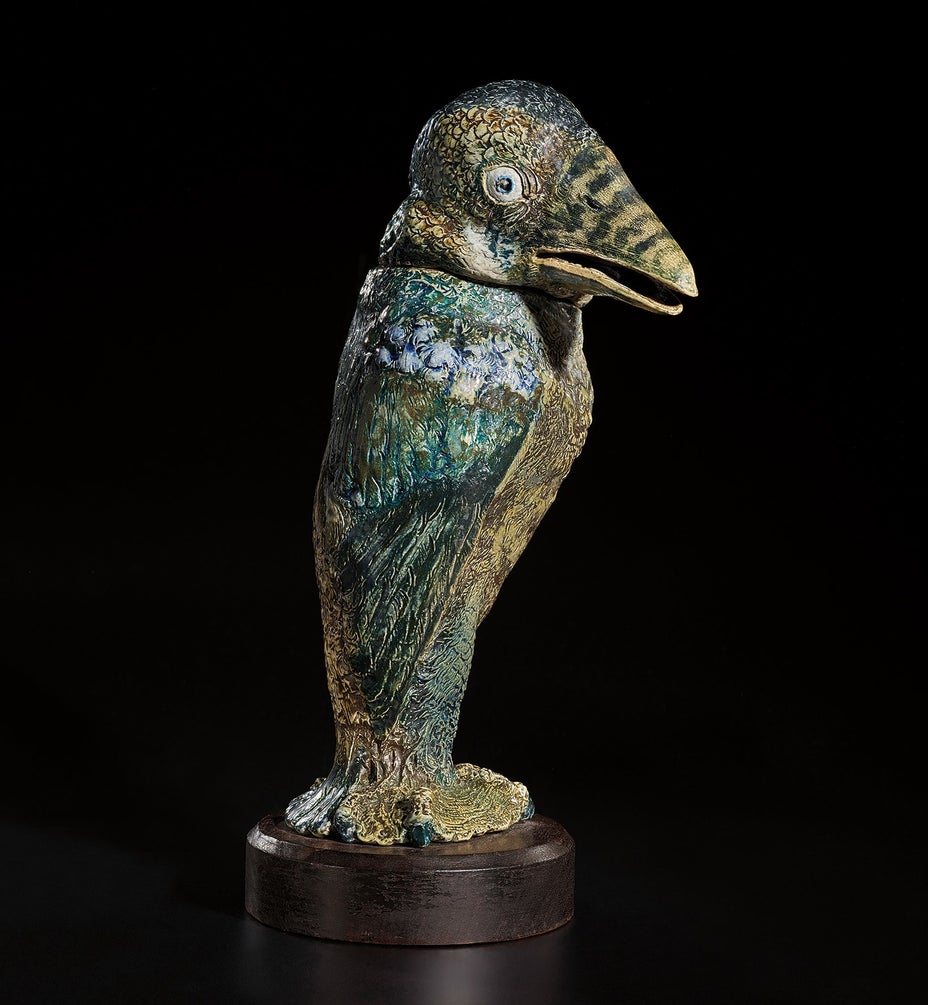
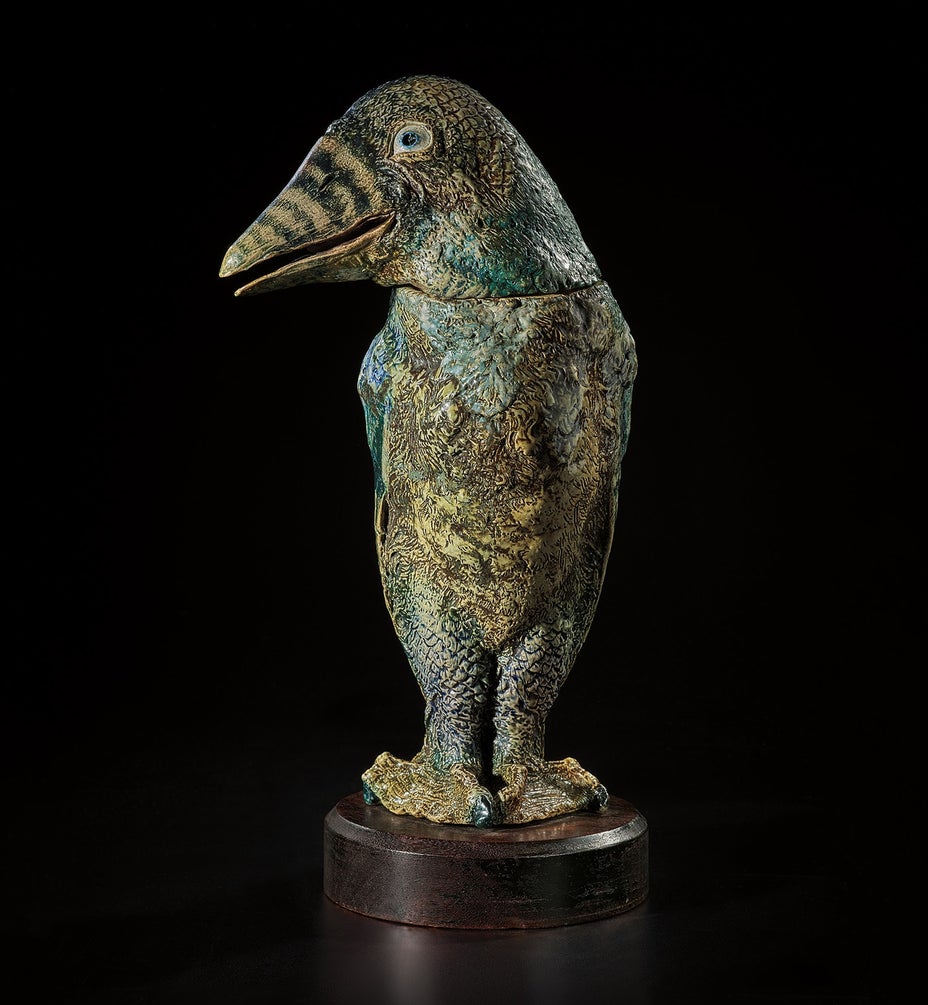
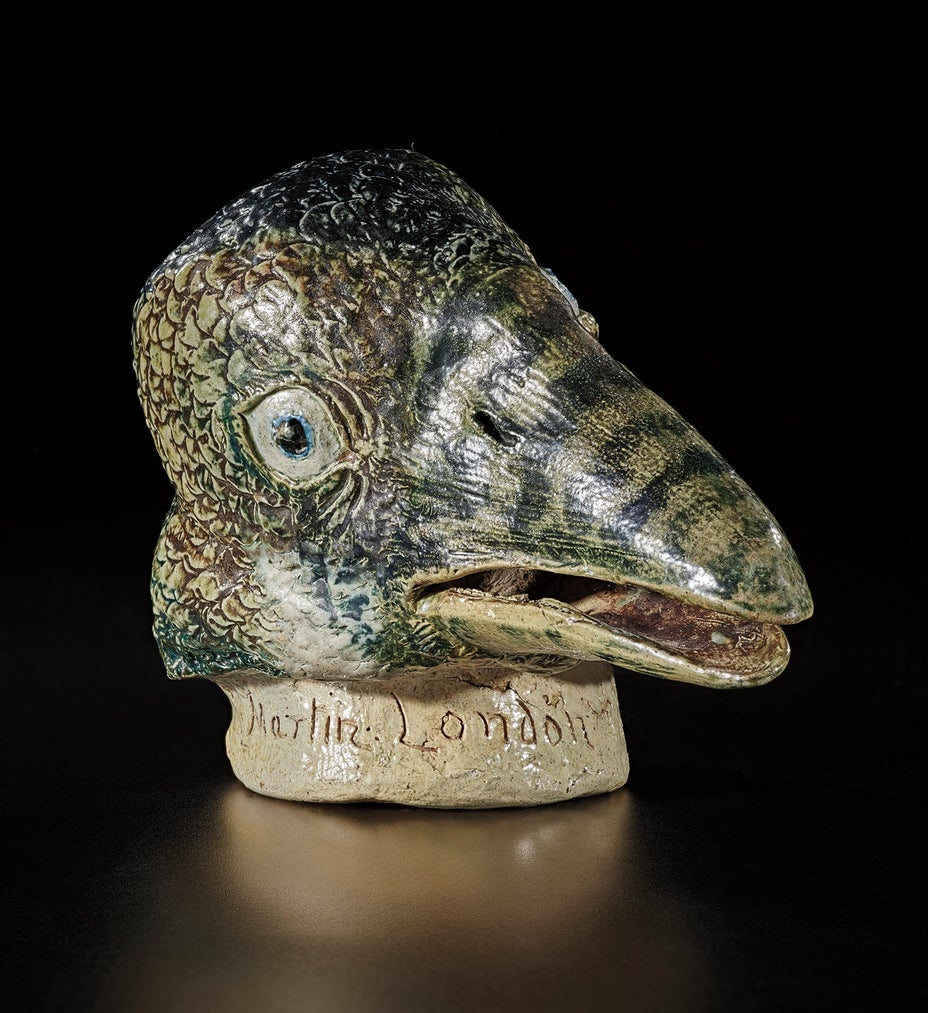
Massive mendiculus aquatic bird jar and cover
Estimate
$100,000–150,000
Sold
January 1883
Salt-glazed stoneware, ebonized wood.
21 1/8 in. (53.5 cm) high
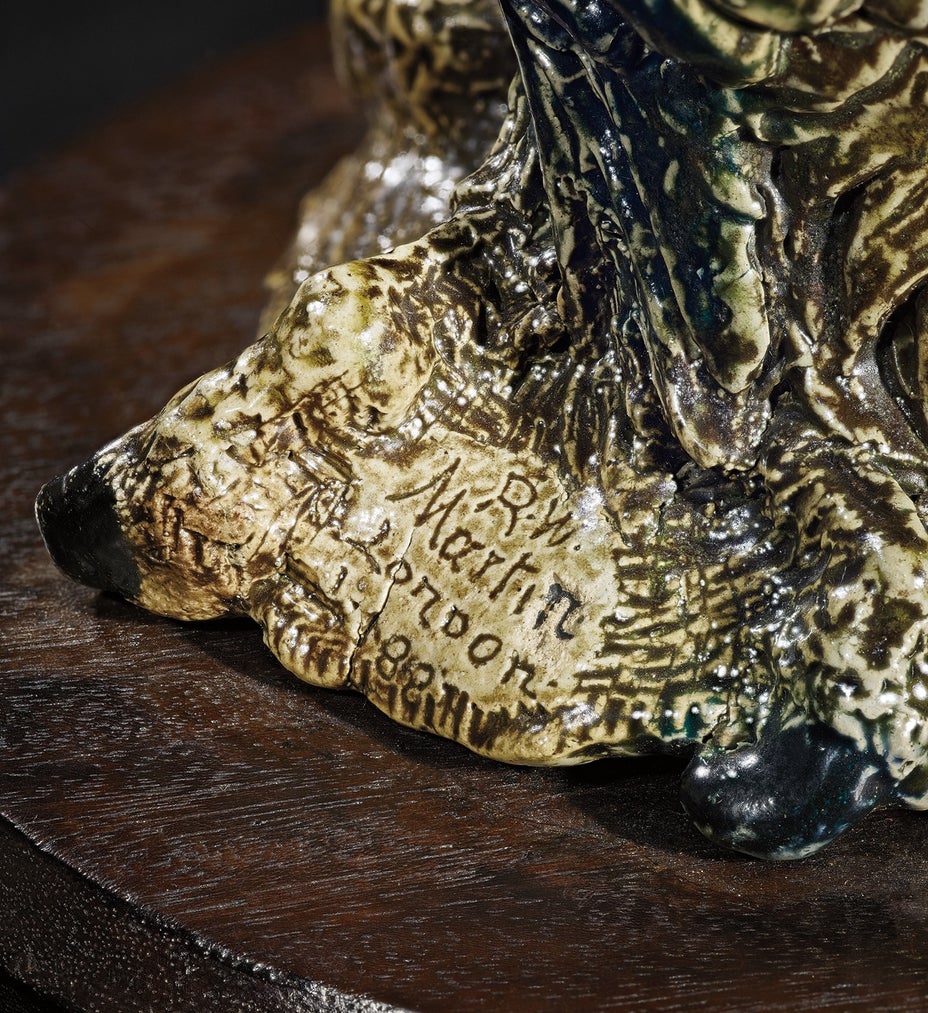
Collar incised Martin London + Southall. 1. 1883 and body incised R.W./Martin/London/1.1883. Underside of base inscribed MARTIN BRO/LONDON.
Full-Cataloguing
One of the largest "Wally-birds" ever made, this rather meditative example testifies to an unusually flourishing period in the history of the Martin brothers' pottery. A measure of commercial success in the early 1880s gave Robert Wallace Martin the opportunity to develop his grotesques and experiment with tobacco jars in the form of strange—but very human—birds. An account of the Martins' work, written by Holbrook Jackson for T.P's Magazine in 1910, discusses Wallace's bird-jars and proposes humor as their chief motivation and achievement. He comments: "Lewis Carroll and Edward Lear thought along the same lines as Wallace Martin; they dreamed similar dreams, only Wallace Martin has dreamt them in clay." But did Wallace have a hidden agenda? When, as a young assistant, he had worked for the Pre-Raphaelite sculptor Alexander Munro in the early 1860s, he might well have met both Carroll, one of Munro's intimate friends, and Lear who sometimes dropped by the studio. He might too have become aware of, perhaps even browsed through, Thomas Wright's book A History of Caricature and the Grotesque, published in 1865, which contained a lengthy chapter on medieval carvings. It was also in 1865 that Wallace joined the Plymouth Brethren who totally rejected any sort of ecclesiastical organisation. So he would have read with delight Wright's assertion that medieval grotesque art often carried an anti-clerical message, either overt or hidden. "The popular feeling against the clergy," Wright stated, "was strong in the middle ages, and no caricature was received with more fervour than those which expressed the immorality or dishonesty of a monk or a priest." Moreover, at Munro's studio, Wallace would have heard, if he had not already known, about an instance of such lampooning in modern times, for amongst the ornament of the new Oxford Museum (for which Munro made statues of several leading scientists) the stonemason O'Shea had caricatured members of the university Convocation as parrots. Some of Wallace Martin's birds are modeled as tonsured monks, while others caricature pillars of the establishment such as judges or generals. There is, more often than one had perhaps realized, a subversive element in these tobacco jars, an element Wallace would have been loathe to disclose to the mostly middle-class readers of T.P's Magazine. Who knows which parson, magistrate or major-general has been morphed by Wallace into this magnificent, giant bird?