A Discerning Vision
Property from an Important Private Collection
Property from an Important Private Collection
118Ο︎◆︎
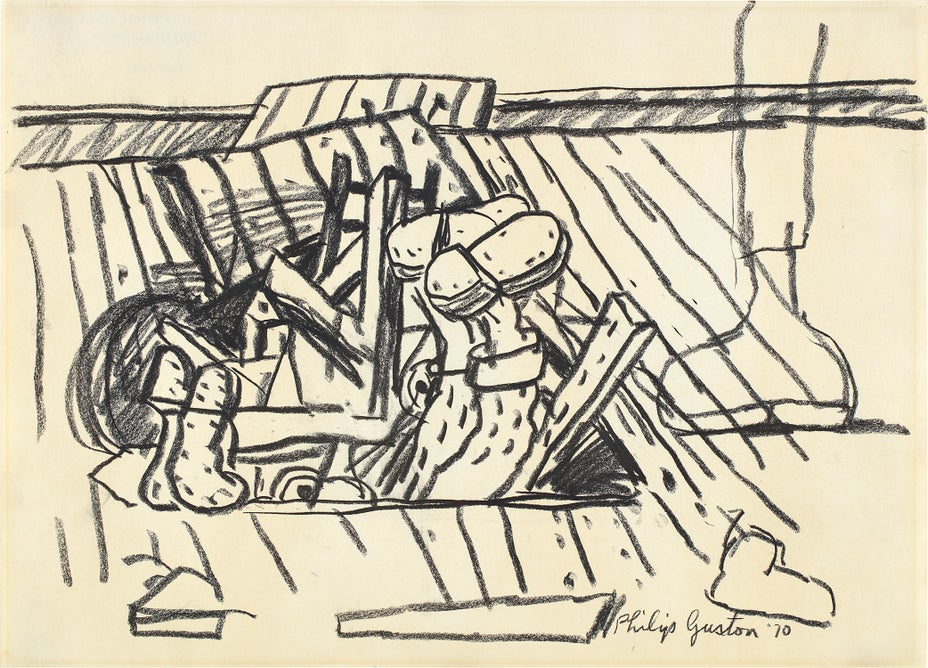
Philip Guston
Drawing for Cellar
Estimate
$280,000–350,000
Sold For
$350,000
signed and dated "Philip Guston "70" lower right; further signed, titled and dated "PHILIP GUSTON “DRAWING FOR CELLAR” 1970" on the reverse
charcoal on paper
17 1/4 x 24 in. (43.9 x 61.1 cm.)
Executed in 1970.
Full-Cataloguing
“Guston was locked away in his breeze block studio in Woodstock doing these minimal drawings of the things around him - clocks, shoes, books - that were both figurative and abstract. Drawing was a crucial aspect in his development. He always returned to drawing to work out where the paintings were going…when you look at those works, the use of colour, the composition, the line, it's all just virtuoso.” David McKee
Executed in 1970, Philip Guston’s Drawing for Cellar is a powerful drawing articulating the figurative style that the artist embarked upon two years prior, and that would dominate the last twelve years of the artist’s life. His radical, and at the time highly controversial, break with abstraction not only represented a re-introduction of the human form, but also of a narrative content. As is characteristic for works from this time, Drawing for Cellar depicts ominous figures that are threatened, or in conflict, with overpowering architectural configurations. Harkening back to his figurative phase of the late 1930s and 1940s, Guston recasts his signature motifs of piled legs and nail-studded shoes in presenting the viewer with a charged vignette of disembodied limbs tumbling down a trapdoor into a cellar. This evocative composition notably served as the blueprint for Guston's exceptional painting Cellar from the same year. Rendered with simple and decisive lines, Drawing for Cellar illustrates Guston’s celebrated draftsmanship – its significance underscored by its inclusion in some of the most influential Guston exhibitions in the past decades.
For Guston, who began drawing at age 12, drawing played a central role in his restless explorations of form, space, and pictorial structure. As he declared in 1973, three years after completing Drawing for Cellar, “It is the bareness of drawing that I like. The act of drawing is what locates, suggests, discovers. At times it seems enough to draw, without the distractions of color and mass” (Philip Guston, “Ten Drawings”, Boston University Journal, vol. 21, Fall 1973, n.p.). The importance of drawing becomes particularly evident when one considers that it was through drawing that Guston radically returned to figuration, notably exclusively focusing on drawing during his hiatus from painting between 1967 and 1969. While often titling his works on paper as “studies”, Guston in fact rarely followed his drawings closely in his painted compositions.
Drawing for Cellar exemplifies the distinctive pictorial idiom that Guston developed in drawing as in painting, one which masterfully fused both high and low art references into a style that is uniquely Guston’s. Guston, who had initially intended to become a comic strip artist, here clearly channels the reduced aesthetic of cartoons. Echoing the underground aesthetic of Robert Crumb in the late 1960s, it is perhaps no coincidence that this work was initially in the collection of famed illustrator Rick Meyerowitz. Simultaneously, however, Guston’s drawings from this time also show clear affinities with Max Beckmann’s graphic oeuvre – both in terms of the crudely outlined forms, the psychological charge and foreboding sense of underlying the depicted vignettes. Preceding Guston's celebrated Nixon Drawings from 1971-1975, Drawing for Cellar as such is a remarkable work that resonates as powerfully today as it did at the time of its conception.
Executed in 1970, Philip Guston’s Drawing for Cellar is a powerful drawing articulating the figurative style that the artist embarked upon two years prior, and that would dominate the last twelve years of the artist’s life. His radical, and at the time highly controversial, break with abstraction not only represented a re-introduction of the human form, but also of a narrative content. As is characteristic for works from this time, Drawing for Cellar depicts ominous figures that are threatened, or in conflict, with overpowering architectural configurations. Harkening back to his figurative phase of the late 1930s and 1940s, Guston recasts his signature motifs of piled legs and nail-studded shoes in presenting the viewer with a charged vignette of disembodied limbs tumbling down a trapdoor into a cellar. This evocative composition notably served as the blueprint for Guston's exceptional painting Cellar from the same year. Rendered with simple and decisive lines, Drawing for Cellar illustrates Guston’s celebrated draftsmanship – its significance underscored by its inclusion in some of the most influential Guston exhibitions in the past decades.
For Guston, who began drawing at age 12, drawing played a central role in his restless explorations of form, space, and pictorial structure. As he declared in 1973, three years after completing Drawing for Cellar, “It is the bareness of drawing that I like. The act of drawing is what locates, suggests, discovers. At times it seems enough to draw, without the distractions of color and mass” (Philip Guston, “Ten Drawings”, Boston University Journal, vol. 21, Fall 1973, n.p.). The importance of drawing becomes particularly evident when one considers that it was through drawing that Guston radically returned to figuration, notably exclusively focusing on drawing during his hiatus from painting between 1967 and 1969. While often titling his works on paper as “studies”, Guston in fact rarely followed his drawings closely in his painted compositions.
Drawing for Cellar exemplifies the distinctive pictorial idiom that Guston developed in drawing as in painting, one which masterfully fused both high and low art references into a style that is uniquely Guston’s. Guston, who had initially intended to become a comic strip artist, here clearly channels the reduced aesthetic of cartoons. Echoing the underground aesthetic of Robert Crumb in the late 1960s, it is perhaps no coincidence that this work was initially in the collection of famed illustrator Rick Meyerowitz. Simultaneously, however, Guston’s drawings from this time also show clear affinities with Max Beckmann’s graphic oeuvre – both in terms of the crudely outlined forms, the psychological charge and foreboding sense of underlying the depicted vignettes. Preceding Guston's celebrated Nixon Drawings from 1971-1975, Drawing for Cellar as such is a remarkable work that resonates as powerfully today as it did at the time of its conception.