PROPERTY FROM A DISTINGUISHED EUROPEAN COLLECTION
176
Paul Outerbridge, Jr.
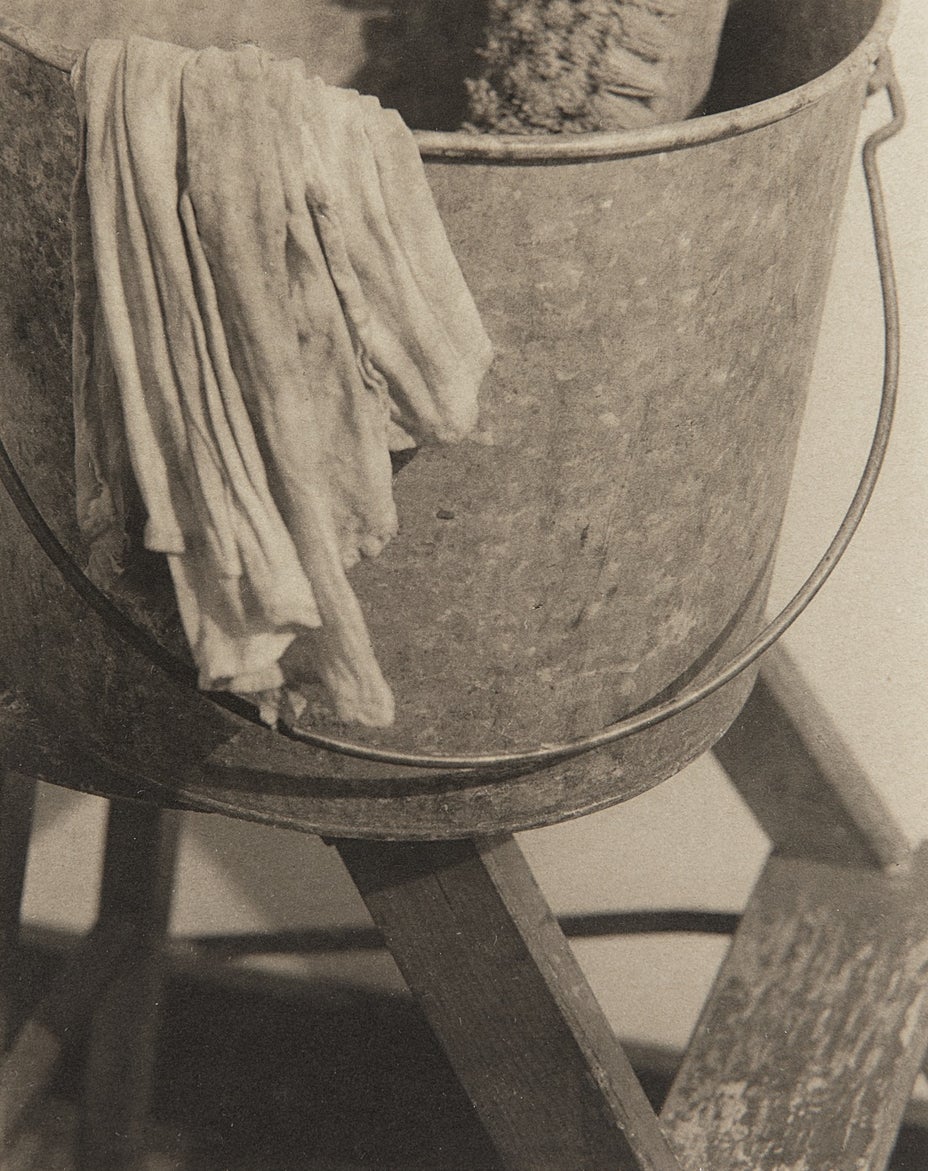
Pail on Ladder (Wash Bucket)
Estimate
$60,000–80,000
1922
Platinum print.
4 5/8 x 3 5/8 in. (11.7 x 9.2 cm)
Credited and signed by Lois Outerbridge in ink on a Laguna Beach Art Association label affixed to the reverse of the mount.
Full-Cataloguing
In Pail on Ladder (Wash Bucket), 1922, Paul Outerbridge Jr. embodies many of the groundbreaking tenets in Arthur Wesley Dow’s celebrated book Composition: A Series of Exercises in Art Structure for the Use of Students and Teachers, 1913 in which he stated that the “study of composition of Line, Mass and Color leads to appreciation of all forms of art and of the beauty of nature.” Outerbridge revealed his astute management of space as well as his ability to create a carefully balanced composition by stripping utilitarian objects of their functional purpose down to their formalist qualities. Consequently, viewers are met with a still life that is a study in the agreeable interaction between curves, lines, hue gradation and surface treatments.
Most likely, Outerbridge’s approach was also buffered by his readings of Paul Strand’s essay Photography published by Alfred Stieglitz in 1917 in the last issue of Camera Work, the groundbreaking publication that oversaw the transition of photography from Pictorialism to Modernism from 1903 through 1917. The last issue of Camera Work, was solely devoted to Strand’s strong Formalist works, symbolically heralding an era in which the foundations of photography—clarity, linearity and tonality—were propelled to the foreground. In all likelihood, by the time Outerbridge created Pail on Ladder (Wash Bucket), he had been exposed to Strand’s Formalist works Bowls, 1916; Ceramic and Fruit, 1916; Pear and Bowl, 1916; and Jug and Fruit, 1916, among others.
Pail on Ladder (Wash Bucket), 1922, is a synthesis of Outerbridge’s formal education, personal research and his own intuitive eye. By internalizing Dow’s assertion that “If a few elements can be united harmoniously, a step has been taken toward further creation” and Strand’s declaration that the photographer “must strive for form, to devise
effective ways of organizing and using the material,” Outerbridge created a masterpiece composition that embodies the intellectual principles of the formalist movement.
Most likely, Outerbridge’s approach was also buffered by his readings of Paul Strand’s essay Photography published by Alfred Stieglitz in 1917 in the last issue of Camera Work, the groundbreaking publication that oversaw the transition of photography from Pictorialism to Modernism from 1903 through 1917. The last issue of Camera Work, was solely devoted to Strand’s strong Formalist works, symbolically heralding an era in which the foundations of photography—clarity, linearity and tonality—were propelled to the foreground. In all likelihood, by the time Outerbridge created Pail on Ladder (Wash Bucket), he had been exposed to Strand’s Formalist works Bowls, 1916; Ceramic and Fruit, 1916; Pear and Bowl, 1916; and Jug and Fruit, 1916, among others.
Pail on Ladder (Wash Bucket), 1922, is a synthesis of Outerbridge’s formal education, personal research and his own intuitive eye. By internalizing Dow’s assertion that “If a few elements can be united harmoniously, a step has been taken toward further creation” and Strand’s declaration that the photographer “must strive for form, to devise
effective ways of organizing and using the material,” Outerbridge created a masterpiece composition that embodies the intellectual principles of the formalist movement.