

25Σ
Patek Philippe
Ref. 2497
"Secondi al Centro"
An early, extremely fine, and rare yellow gold perpetual calendar wristwatch with sweep center seconds and moon phase
- Estimate
- $200,000 - 400,000
$304,800
Lot Details
- Manufacturer
- Patek Philippe
- Year
- 1951
- Reference No
- 2497
- Movement No
- 888’008
- Case No
- 674’373
- Model Name
- "Secondi al Centro"
- Material
- 18K yellow gold
- Calibre
- Manual, cal. 27 CS, 18 jewels
- Bracelet/Strap
- Crocodile
- Clasp/Buckle
- 18K Patek Philippe yellow gold buckle
- Dimensions
- 37mm Diameter
- Signed
- Case, dial, movement and buckle signed
Specialist
Full-Cataloguing
Catalogue Essay
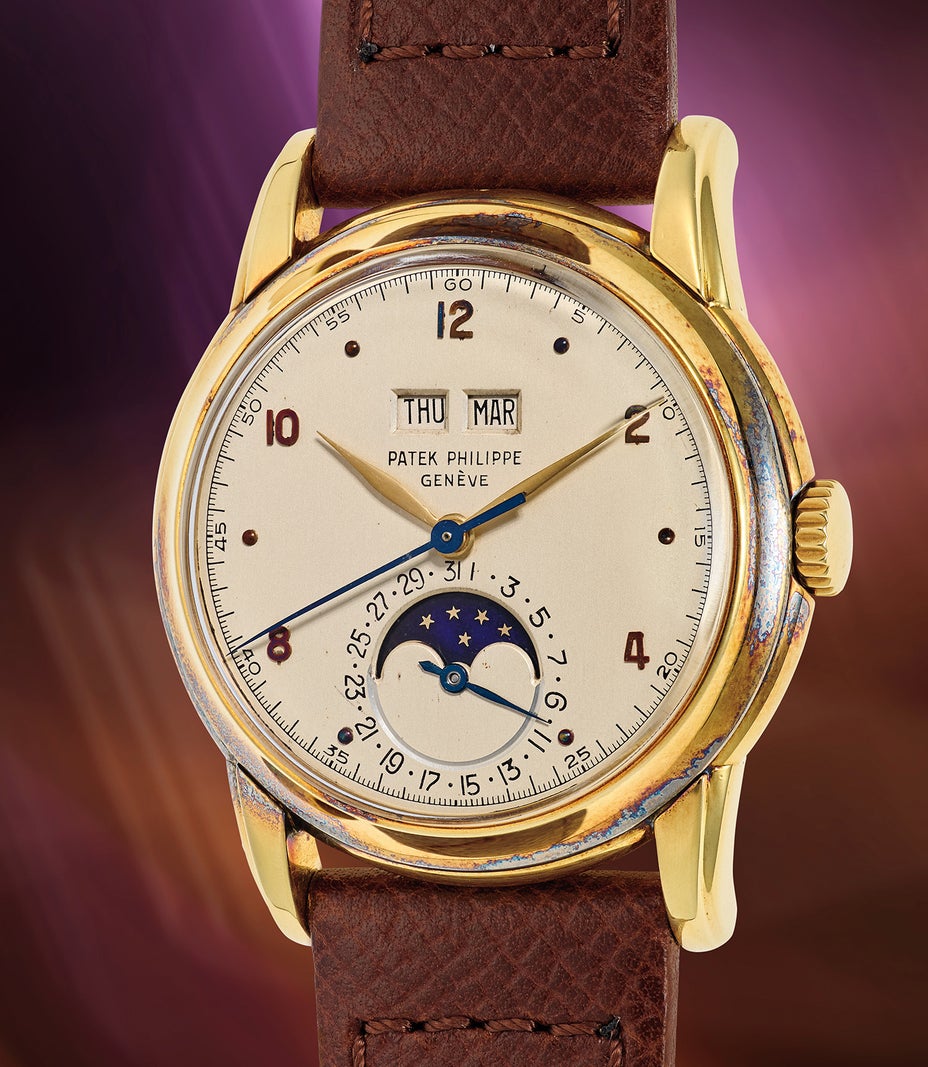
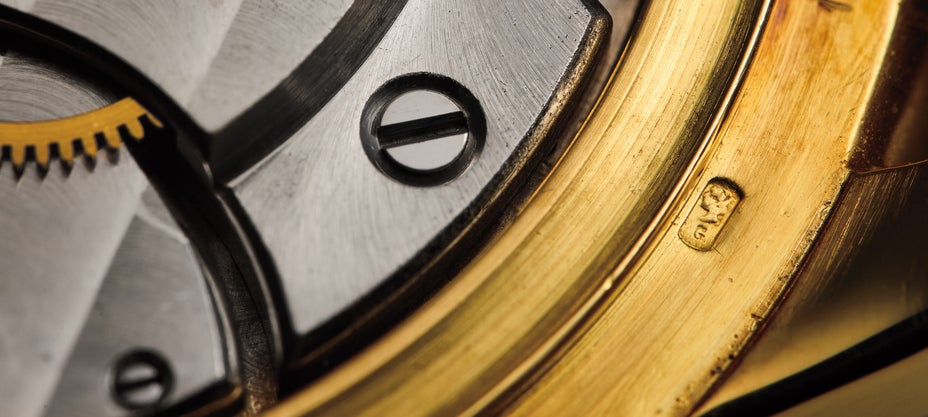
Alongside the famed perpetual calendar chronograph reference 2499, Patek Philippe released the simple perpetual calendar reference 2497, just as it had released the predecessor reference 1518 alongside the reference 1526. The references 2497 and 2499 were designed with larger diameter cases featuring more robust and elaborate lugs compared with their predecessors. Additionally, a waterproof companion was introduced shortly after the reference 2497, the rare reference 2438/1. Established scholarship tells us that there were a combined total of only 179 total examples made across both references 2497 and 2438/1, with movement numbers spanning from 888’000 to 888’178. Some two thirds of these movements were placed within the reference 2497 over a production span of over 10 years. In fact, Patek Philippe took the challenge of creating a so-called “simple” perpetual calendar (if such a thing is not an oxymoron) to heart, adapting their much-lauded caliber 27 SC (SC for “seconde au centre”) to have a perpetual calendar function, transforming it into the 27 SC Q (Q for “quantième”). The sibling references 2497 and 2438/1 were the world’s first perpetual calendar wristwatches with center seconds.
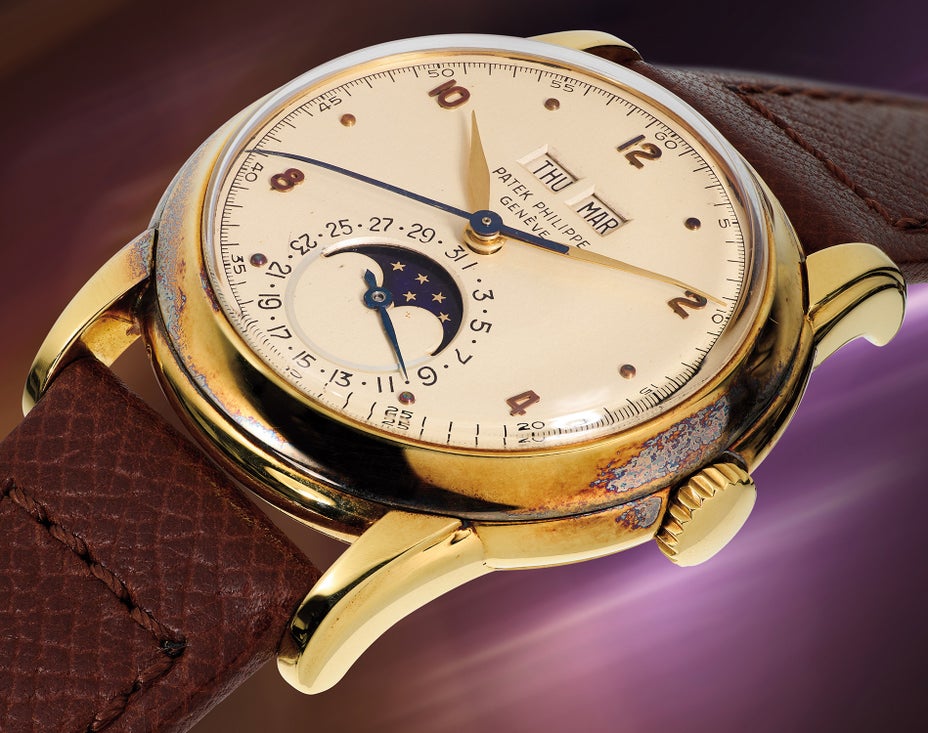
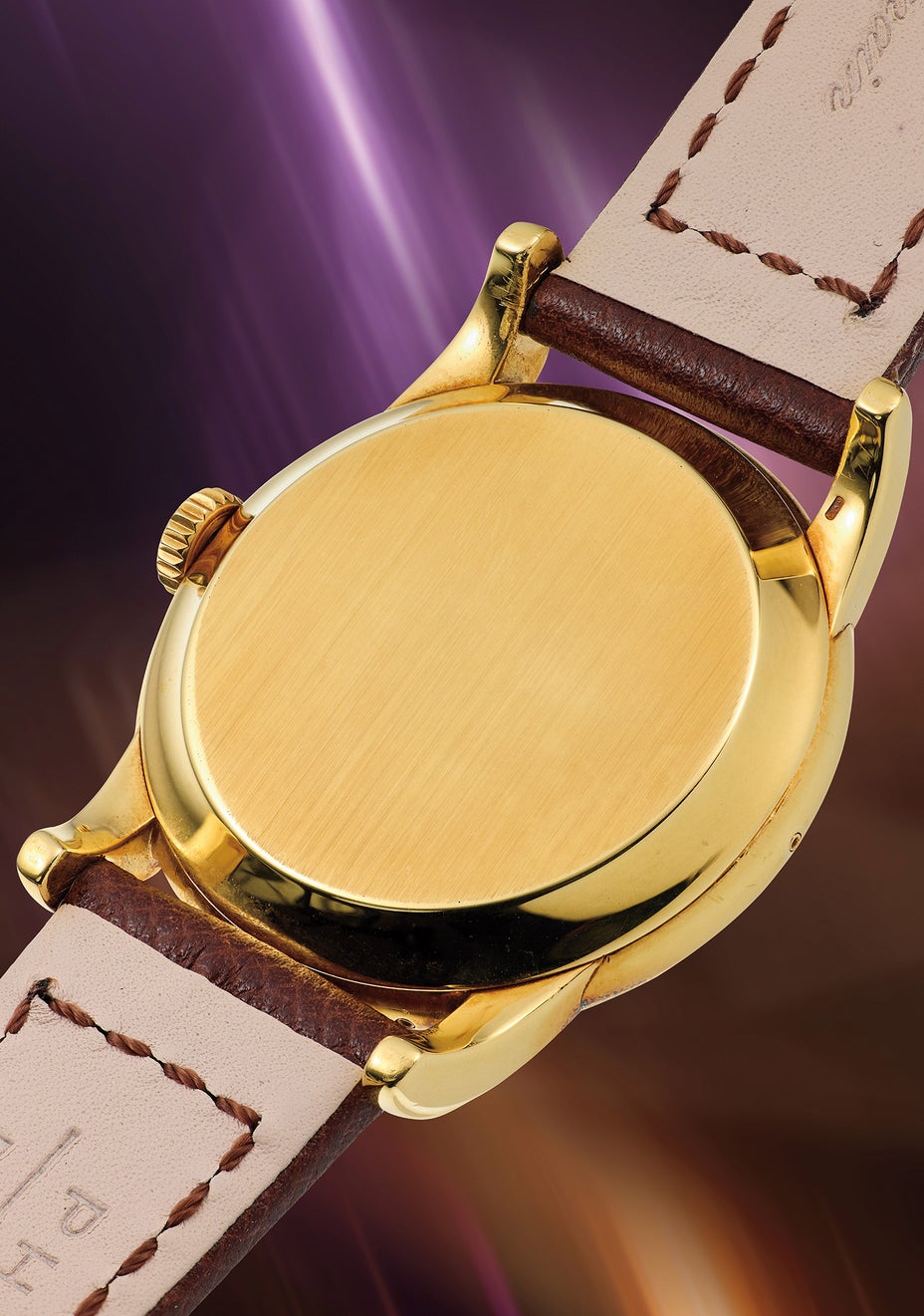
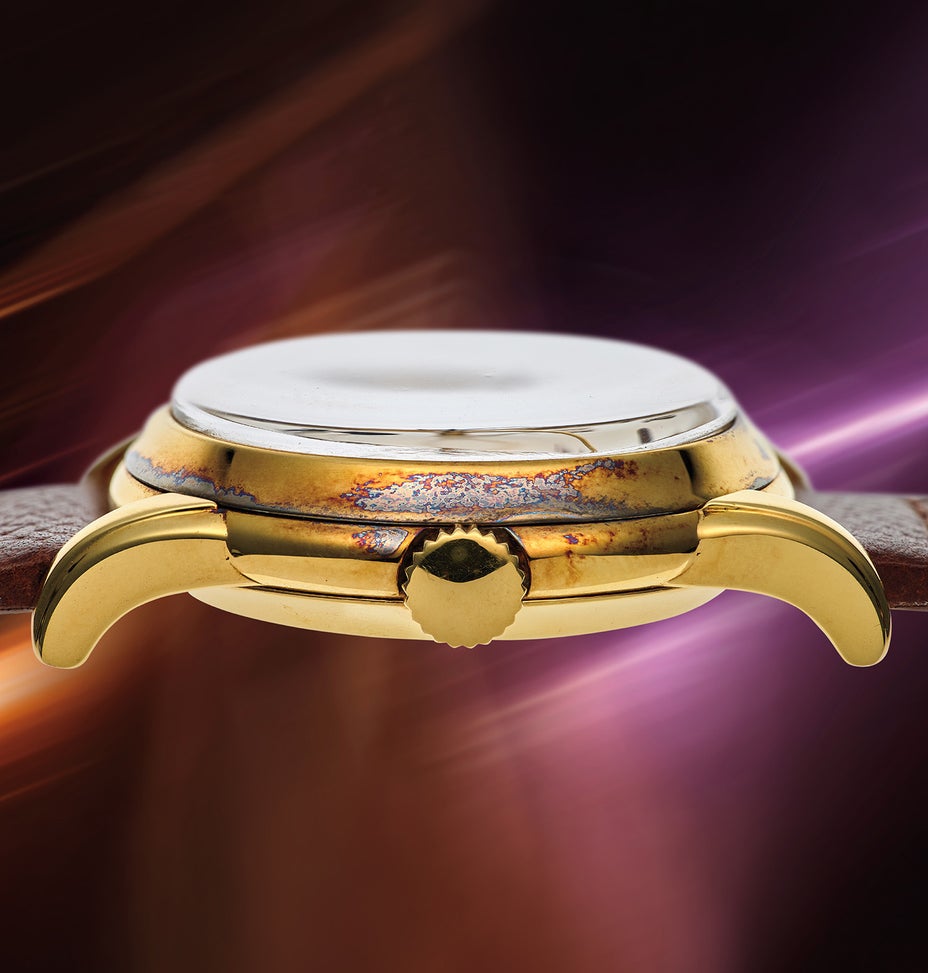
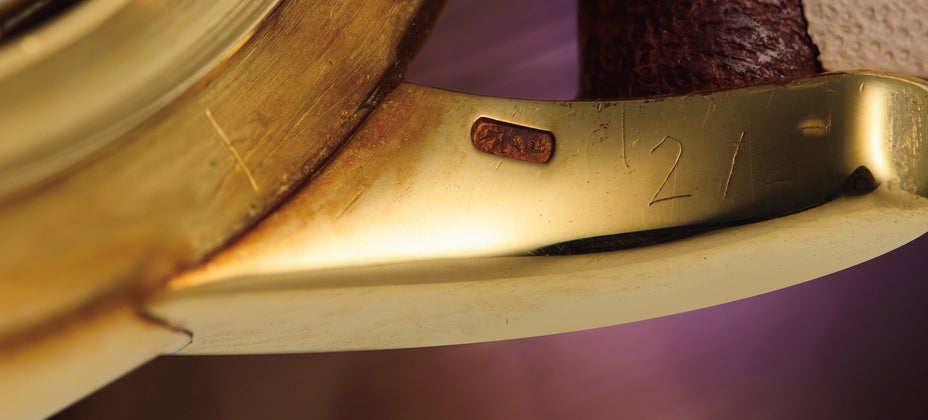
The case is virtually identical to the reference 2499, with gracefully fluted lugs and a robust, stepped case. Early examples such as the present lot are further characterized by delicate feuille hands and alternating gold dot and Arabic numeral indices. While the majority of the cases were made by Wenger, the earliest examples in the series, such as the present lot with the movement number 888’008, were manufactured by Vichet. These are characterized by a flat caseback and elongated, more dramatically downturned lugs that permit the watch to be elevated when laid flat on a surface. The simplified dial with center seconds instead of subsidiary seconds, as well as the removal of the railway-style outer seconds track gives the watch an overall cleaner and highly legible appearance. Scholarship estimates that only approximately 15 examples of the reference 2497 with a Vichet case are believed to have been produced in yellow gold.
Rarely does this reference appear at auction in such superlative condition, but even more rare is the appearance of a 2497 with such an early movement number – the ninth example ever produced. In fact, the yellow gold 2497 currently in the collection of the Patek Philippe Museum is also fitted with a Vichet case with case serial number only five digits later than the present lot, with a movement serial number 11 digits later.
A fascinating detail of the present lot is the movement number: 888’008. The number eight has long held great significance in most of the world’s religions and cultures, as well as architecture, music, and mathematics. In both Hinduism and Chinese culture, the number eight signifies wealth, while in Islam, eight signifies the number of angels that carry the throne of Allah in heaven. In Buddhism, the Noble Eightfold Path is a list of eight tenets that one must keep to in order to escape the cycle of rebirth.
The present Patek Philippe reference 2497 is preserved in exceptional condition, with a crisp case having developed a beautiful rainbow-colored patina from lack of wear, it is a worthy addition for a distinguished collection of complicated vintage Patek Philippe watches
The case is virtually identical to the reference 2499, with gracefully fluted lugs and a robust, stepped case. Early examples such as the present lot are further characterized by delicate feuille hands and alternating gold dot and Arabic numeral indices. While the majority of the cases were made by Wenger, the earliest examples in the series, such as the present lot with the movement number 888’008, were manufactured by Vichet. These are characterized by a flat caseback and elongated, more dramatically downturned lugs that permit the watch to be elevated when laid flat on a surface. The simplified dial with center seconds instead of subsidiary seconds, as well as the removal of the railway-style outer seconds track gives the watch an overall cleaner and highly legible appearance. Scholarship estimates that only approximately 15 examples of the reference 2497 with a Vichet case are believed to have been produced in yellow gold.
Rarely does this reference appear at auction in such superlative condition, but even more rare is the appearance of a 2497 with such an early movement number – the ninth example ever produced. In fact, the yellow gold 2497 currently in the collection of the Patek Philippe Museum is also fitted with a Vichet case with case serial number only five digits later than the present lot, with a movement serial number 11 digits later.
A fascinating detail of the present lot is the movement number: 888’008. The number eight has long held great significance in most of the world’s religions and cultures, as well as architecture, music, and mathematics. In both Hinduism and Chinese culture, the number eight signifies wealth, while in Islam, eight signifies the number of angels that carry the throne of Allah in heaven. In Buddhism, the Noble Eightfold Path is a list of eight tenets that one must keep to in order to escape the cycle of rebirth.
The present Patek Philippe reference 2497 is preserved in exceptional condition, with a crisp case having developed a beautiful rainbow-colored patina from lack of wear, it is a worthy addition for a distinguished collection of complicated vintage Patek Philippe watches
Patek Philippe
Swiss | 1839Since its founding in 1839, this famous Geneva-based firm has been surprising its clientele with superbly crafted timepieces fitted with watchmaking's most prestigious complications. Traditional and conservative designs are found across Patek Philippe's watches made throughout their history — the utmost in understated elegance.Well-known for the Graves Supercomplication — a highly complicated pocket watch that was the world’s most complicated watch for 50 years — this family-owned brand has earned a reputation of excellence around the world. Patek's complicated vintage watches hold the highest number of world records for results achieved at auction compared with any other brand. For collectors, key models include the reference 1518, the world's first serially produced perpetual calendar chronograph, and its successor, the reference 2499. Other famous models include perpetual calendars such as the ref. 1526, ref. 3448 and 3450, chronographs such as the reference 130, 530 and 1463, as well as reference 1436 and 1563 split seconds chronographs. Patek is also well-known for their classically styled, time-only "Calatrava" dress watches, and the "Nautilus," an iconic luxury sports watch first introduced in 1976 as the reference 3700 that is still in production today.
Browse Maker