

US import tariffs: Non-US origin lots in this sale (including watches and timepieces with Swiss-made or non-US made movements) will be subject to special tariffs upon import to the USA, currently ranging from 10% to 39% on the total invoice price (hammer price plus buyer’s premium). Buyers are responsible for paying any applicable tariffs, duties, taxes and charges when importing their purchased lots. Due to the evolving nature of international trade regulations, we recommend clients consult with their local customs office or advisor for up-to-date information on the applicable tariffs.
99Σ
Patek Philippe
Ref. 3940
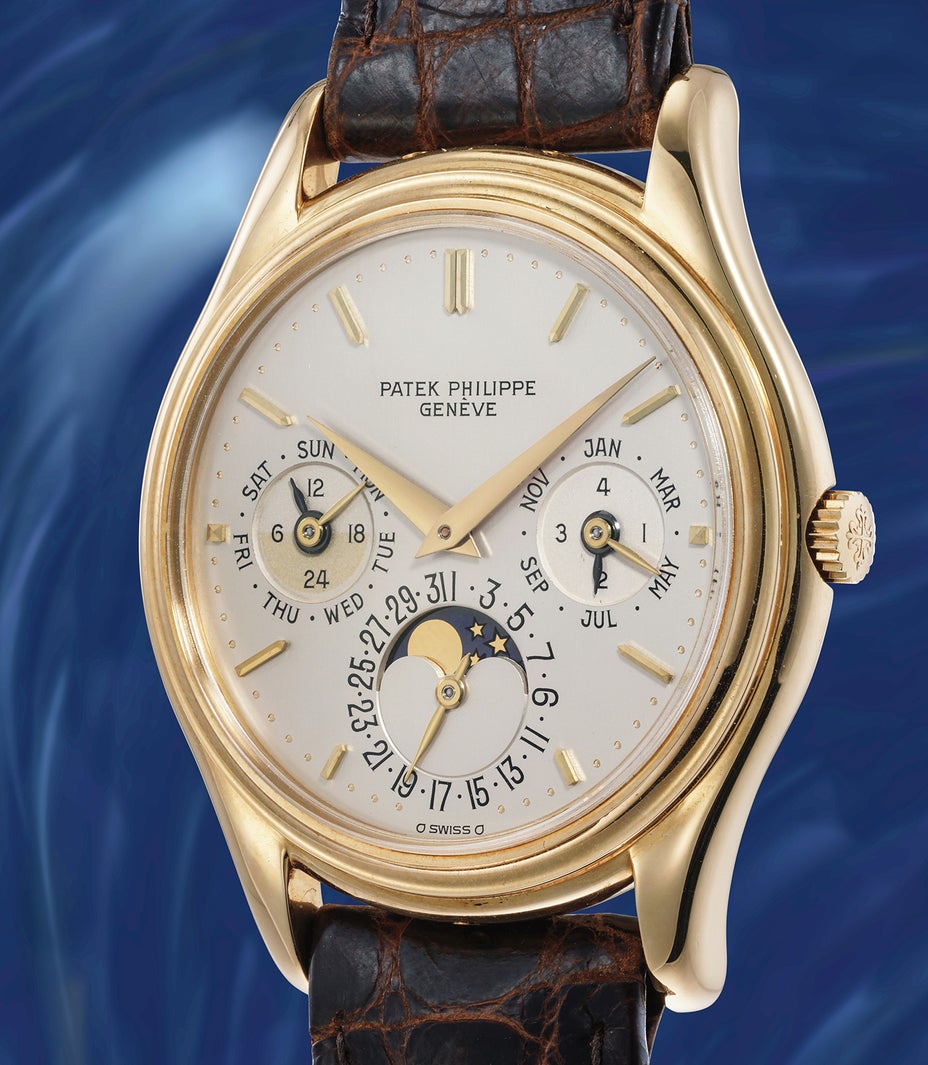
An extremely rare and early yellow gold automatic perpetual calendar wristwatch with moonphases, leap year indication, 24-hour indication, "First Series" dial and box
- Estimate
- CHF25,000 - 50,000€27,000 - 53,900$31,400 - 62,800
CHF114,300
Lot Details
- Manufacturer
- Patek Philippe
- Year
- 1985
- Reference No
- 3940
- Movement No
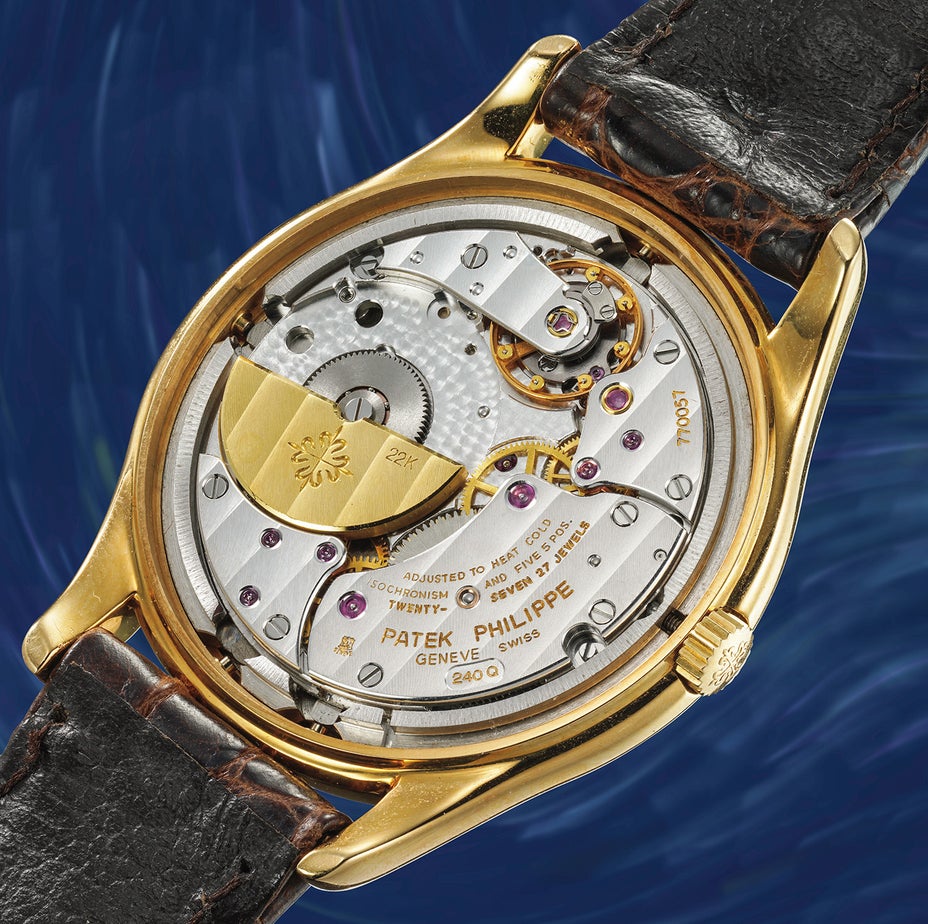
- 770'057
- Case No
- 2'823'612
- Material
- 18k yellow gold
- Calibre
- Automatic, cal. 240 Q, 27 jewels, stamped with the Geneva Seal
- Bracelet/Strap
- Patek Philippe alligator strap
- Clasp/Buckle
- 18k yellow gold Patek Philippe pin buckle
- Dimensions
- 36mm Diameter
- Signed
- Case, dial, movement, strap and buckle signed
- Accessories
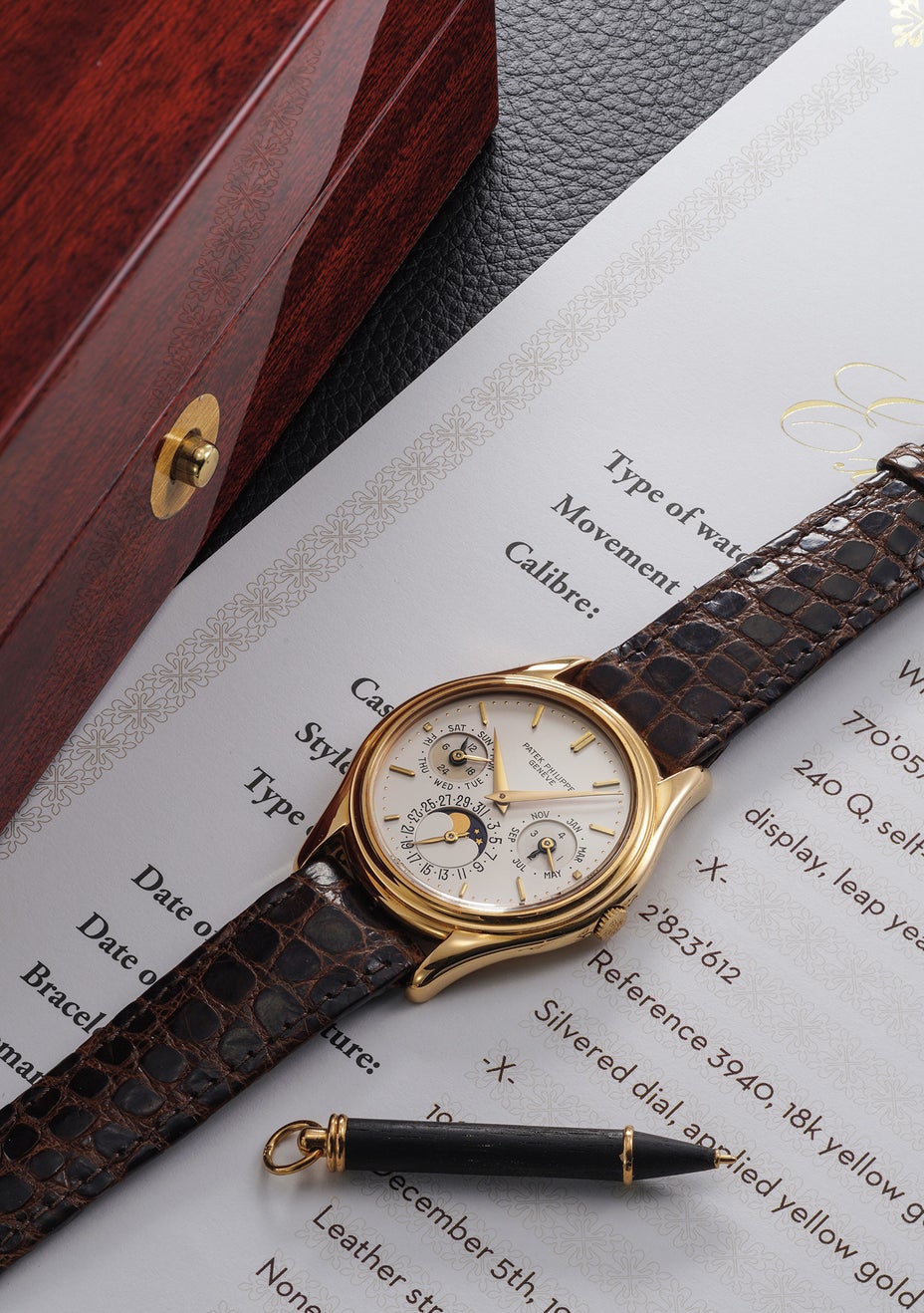
- Accompanied by Patek Philippe Extract from the Archives confirming production of the present watch in 1985 and its subsequent sale on December 5, 1985, setting pin, wooden box and outer packaging
Specialist
Full-Cataloguing
Catalogue Essay
The Patek Philippe ref. 3940 was first released in 1985. Realised in different variants ranging from yellow, pink and white gold to platinum, this reference was predominantly encased in yellow gold and had enjoyed a long and triumphant production run which only ceased in 2007.
The present ref. 3940J from circa 1985 bears a movement numbered 770’057 that belongs to the “First Series” production. With the first 25 pieces made for Zurich based retailer Beyer considered a limited edition “pre-Series”, the first “standard production” iteration of this model begins with movement 770’025, making this movement the 33rd examples made.
The most apparent feature of a First Series 3940 is the dial featuring sub-registers with vertical “walls”, a detail later substituted by a gentle slope. It is little known, however, that there are 3 versions of the First Series dial, two made internally by Stern, and one made externally by Singer.
Stern dial A: the middle line of the Es in the signature is shorter than the top and bottom line; two-tone 24-hour counter.
Stern dial B: The middle line of the Es is about the same length as the other 2, monotone 24-hour counter.
Singer dial: the walls of the subsidiary counters present a rounded junction with subcounter surface (rather than the perfectly 90 degrees merging found on Stern dials), the swiss designation reads σ . SWISS . σ (Stern dials have no dots).
Fresh to the market and offered in remarkable condition, this is one of the scarcest and most collectible iterations of one of the most celebrated automatic perpetual calendar wristwatches in recent history.
The present ref. 3940J from circa 1985 bears a movement numbered 770’057 that belongs to the “First Series” production. With the first 25 pieces made for Zurich based retailer Beyer considered a limited edition “pre-Series”, the first “standard production” iteration of this model begins with movement 770’025, making this movement the 33rd examples made.
The most apparent feature of a First Series 3940 is the dial featuring sub-registers with vertical “walls”, a detail later substituted by a gentle slope. It is little known, however, that there are 3 versions of the First Series dial, two made internally by Stern, and one made externally by Singer.
Stern dial A: the middle line of the Es in the signature is shorter than the top and bottom line; two-tone 24-hour counter.
Stern dial B: The middle line of the Es is about the same length as the other 2, monotone 24-hour counter.
Singer dial: the walls of the subsidiary counters present a rounded junction with subcounter surface (rather than the perfectly 90 degrees merging found on Stern dials), the swiss designation reads σ . SWISS . σ (Stern dials have no dots).
Fresh to the market and offered in remarkable condition, this is one of the scarcest and most collectible iterations of one of the most celebrated automatic perpetual calendar wristwatches in recent history.
Patek Philippe
Swiss | 1839Since its founding in 1839, this famous Geneva-based firm has been surprising its clientele with superbly crafted timepieces fitted with watchmaking's most prestigious complications. Traditional and conservative designs are found across Patek Philippe's watches made throughout their history — the utmost in understated elegance.Well-known for the Graves Supercomplication — a highly complicated pocket watch that was the world’s most complicated watch for 50 years — this family-owned brand has earned a reputation of excellence around the world. Patek's complicated vintage watches hold the highest number of world records for results achieved at auction compared with any other brand. For collectors, key models include the reference 1518, the world's first serially produced perpetual calendar chronograph, and its successor, the reference 2499. Other famous models include perpetual calendars such as the ref. 1526, ref. 3448 and 3450, chronographs such as the reference 130, 530 and 1463, as well as reference 1436 and 1563 split seconds chronographs. Patek is also well-known for their classically styled, time-only "Calatrava" dress watches, and the "Nautilus," an iconic luxury sports watch first introduced in 1976 as the reference 3700 that is still in production today.
Browse Maker