965
Patek Philippe
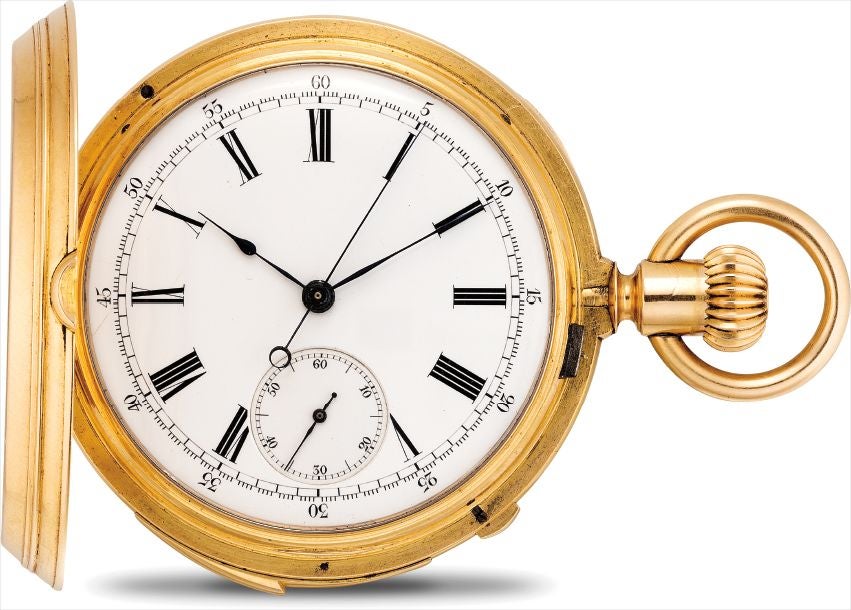
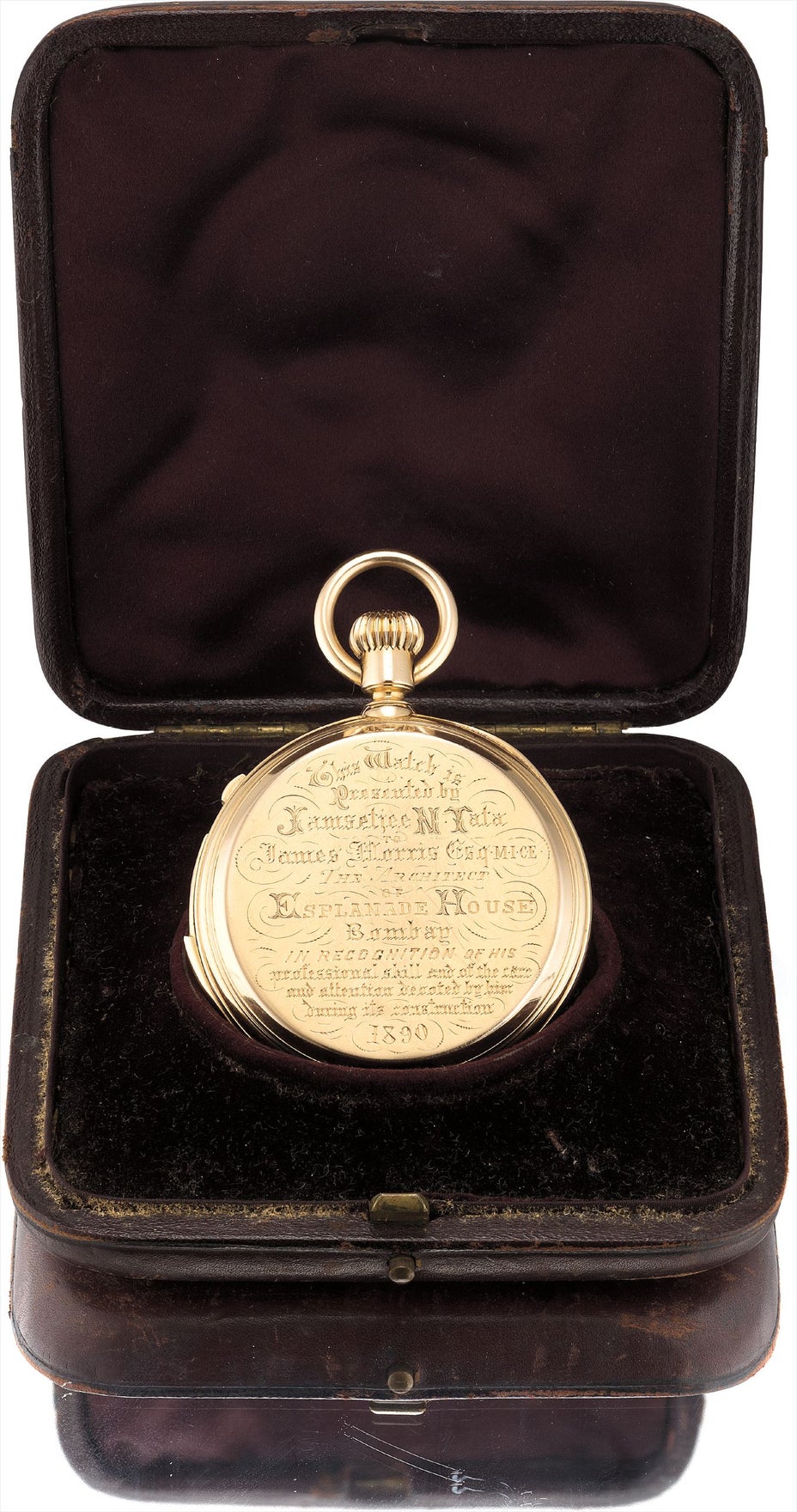
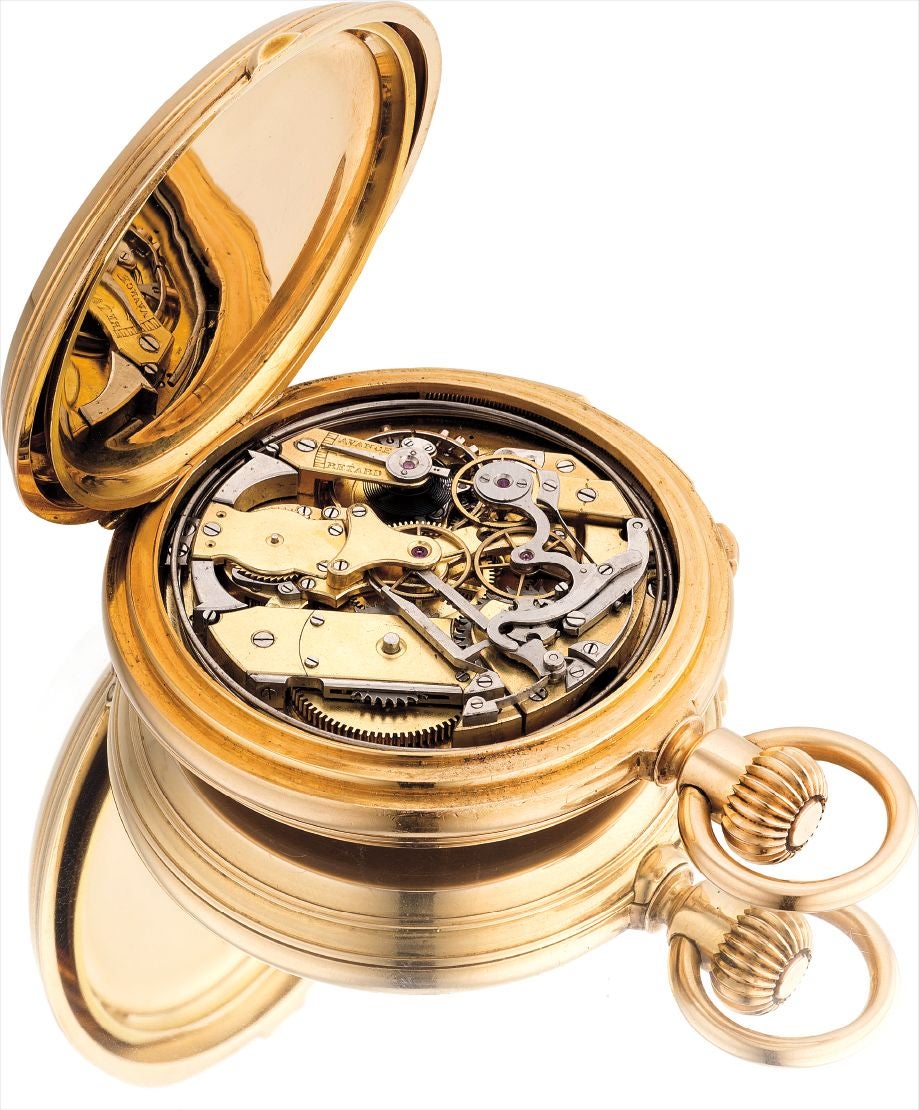
A fine, rare and historically interesting pink gold five minute repeating hunter case chronograph presentation pocket watch, presented by Jamsetji N Tata To James Morris Esq M.I.C.E, The Architect of Esplanade House Bombay
Full-Cataloguing
Jamsetji Tata (1839-1904) was a legendary entrepreneur regarded as the founder of Indian industry, having founded Tata, now the largest conglomerate in India with annual revenue of over US$100 billion and best known as the owner of Jaguar Land Rover. But beyond mere mercantile accomplishments, Tata built the business with a near mythical probity and integrity that gives him a hallowed status unparallelled in Indian business.
In the late 1880s, having found some measure of success, Jamsetji Tata hired English architect James Morris to build a new family home in modern day Mumbai. Construction began in 1885 on what was named Esplanade House, one of the first homes in the country to feature electricity, as well as elevators. Complete with a portico for carriages, expansive inner courtyard and impressive library, Esplanade House was worthy of India’s first captain of industry.
The building remained in the Tata family until it was sold in 1934, and is today a conservation building that is home to a charity that funds scholarships for Indian students. The wrought iron gates to Esplanade House still bear the Tata crest, which carries the Parsi saying “Humata, Hukhta, Hvarshta”, which translate as “Good Thoughts, Good Words, Good Deeds”, a philosophy that turned Tata into the grandest name in corporate India.
This Patek Philippe watch was Tata’s gift to Morris on completion of Esplanade House. Patek Philippe watches appear to have been a favoured gift of Tata’s for significant people, unsurprising given that considerable effort was required to acquire such timepieces as they had to be imported to colonial India from Switzerland via England.
Near the end of his life, Tata bequeathed a Patek Philippe pocket watch to his first cousin Ratanji Dadabhoy Tata, one of his successors at the Tata company. Literature shows that Tata presented the watch along with some pithy advice: "Make Tatas grow, or at least not lose what had been gained.”
This watch is an artefact from a particularly crucial era in Indian history, made all the more important by its intimate link to Jamsetji Tata. It is furthermore accompanied by a leather presentation box decorated with the architect's monogram.
Patek Philippe
Swiss | 1839Since its founding in 1839, this famous Geneva-based firm has been surprising its clientele with superbly crafted timepieces fitted with watchmaking's most prestigious complications. Traditional and conservative designs are found across Patek Philippe's watches made throughout their history — the utmost in understated elegance.
Well-known for the Graves Supercomplication — a highly complicated pocket watch that was the world’s most complicated watch for 50 years — this family-owned brand has earned a reputation of excellence around the world. Patek's complicated vintage watches hold the highest number of world records for results achieved at auction compared with any other brand. For collectors, key models include the reference 1518, the world's first serially produced perpetual calendar chronograph, and its successor, the reference 2499. Other famous models include perpetual calendars such as the ref. 1526, ref. 3448 and 3450, chronographs such as the reference 130, 530 and 1463, as well as reference 1436 and 1563 split seconds chronographs. Patek is also well-known for their classically styled, time-only "Calatrava" dress watches, and the "Nautilus," an iconic luxury sports watch first introduced in 1976 as the reference 3700 that is still in production today.