

75Σ
Patek Philippe
Ref. 1436
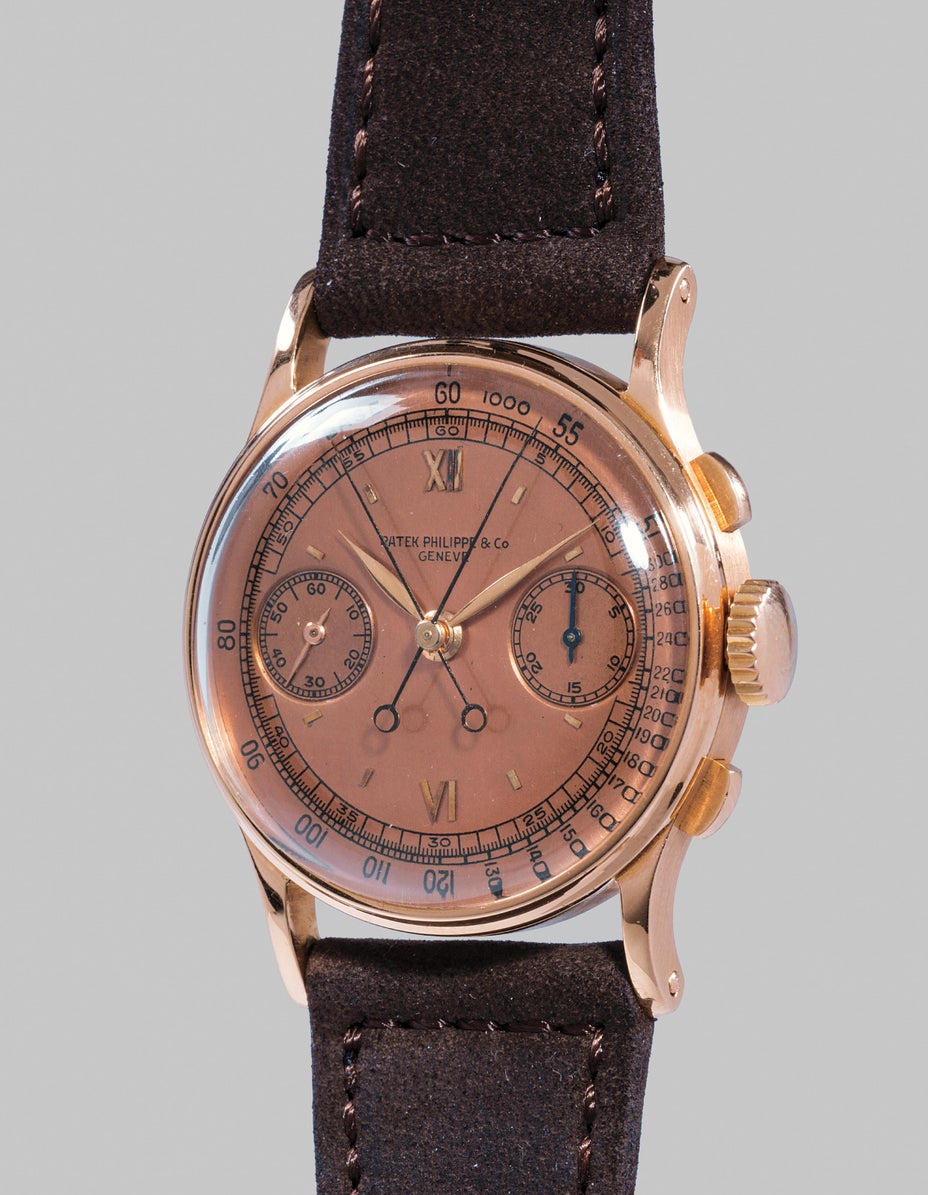
An extremely fine and rare pink gold split seconds chronograph wristwatch with pink dial, original certificate, envelope, invoice and presentation box
- Estimate
- CHF350,000 - 550,000€324,000 - 509,000$347,000 - 545,000
CHF466,000
Lot Details
- Manufacturer
- Patek Philippe
- Year
- 1941
- Reference No
- 1436
- Movement No
- 862'781
- Case No
- 638'790
- Material
- 18K pink gold
- Calibre
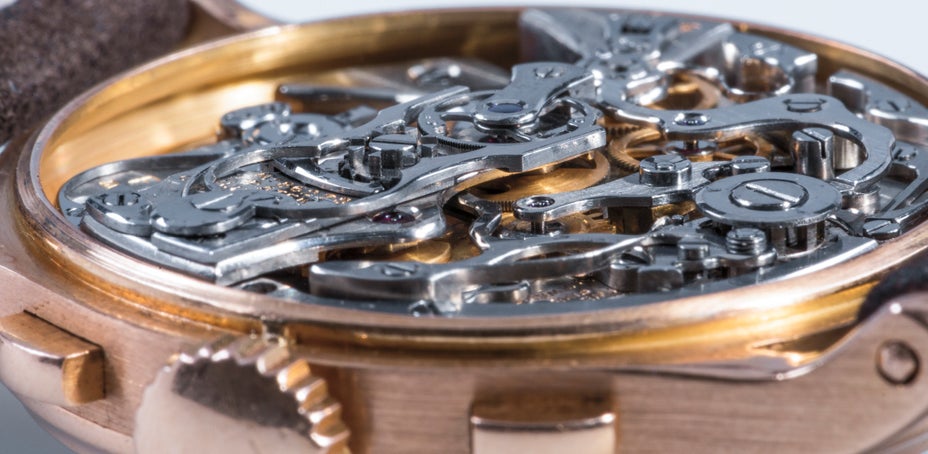
- Manual, cal. 13''', 25 jewels
- Bracelet/Strap
- Leather
- Clasp/Buckle
- 18K pink gold Patek Philippe buckle stamped PPco
- Dimensions
- 33mm. Diameter
- Signed
- Case, dial, movement and buckle signed
- Accessories
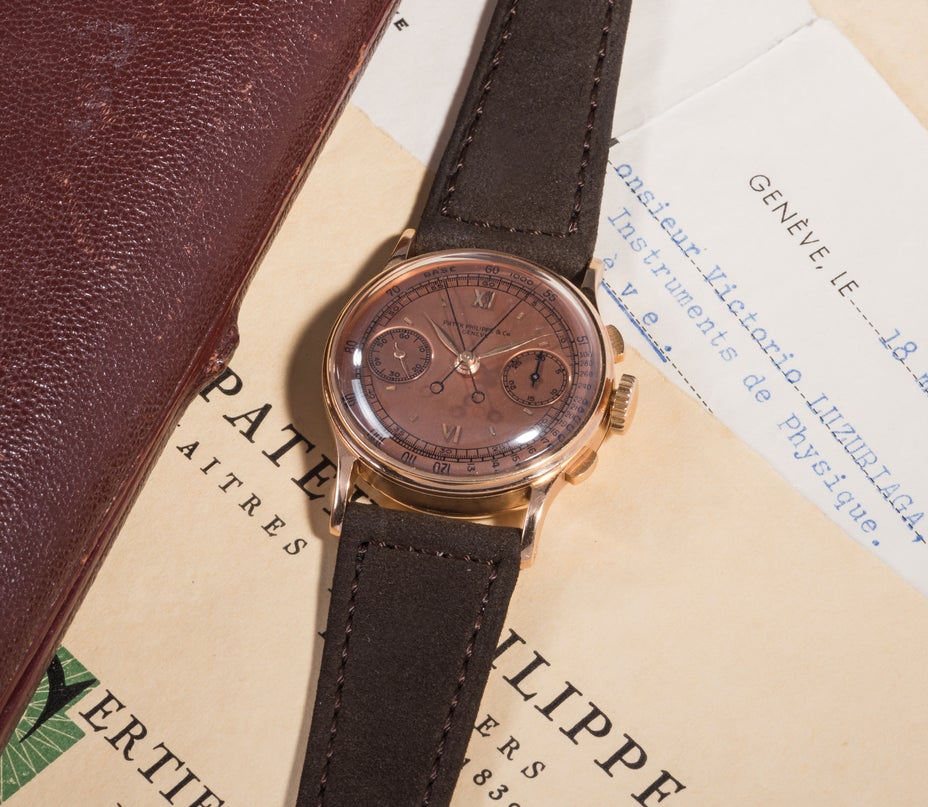
- Accompanied by Patek Philippe presentation box, Certificate of Origin, envelope, original bill of sale dated 18 May 1946 and Extract from the Archives confirming production of the present watch with applied gold hour markers and tachometer scale in 1941 and its subsequent sale on 18 May 1946.
Specialist
Full-Cataloguing
Catalogue Essay
Reference 1436 is the first split seconds chronograph wristwatch that Patek Philippe ever produced in a series. Originally launched in 1938, the model was used as a "tool watch" to time horse or automobile racing, along with scientific experiments. The reference is possibly one of the finest watches ever produced by the firm, with the rattrapante chronograph mechanism housed within the confines of a 33 millimeter case. Predominantly produced in yellow gold, the model was very rarely cased in pink gold. In fact, research suggests that less than 9 examples are known to gave survived in pink gold, with exceedingly few examples featuring a pink dial, such as the present watch. Its rarity, and infrequent appearance on the market has caused the reference to cultivate a mythical status.
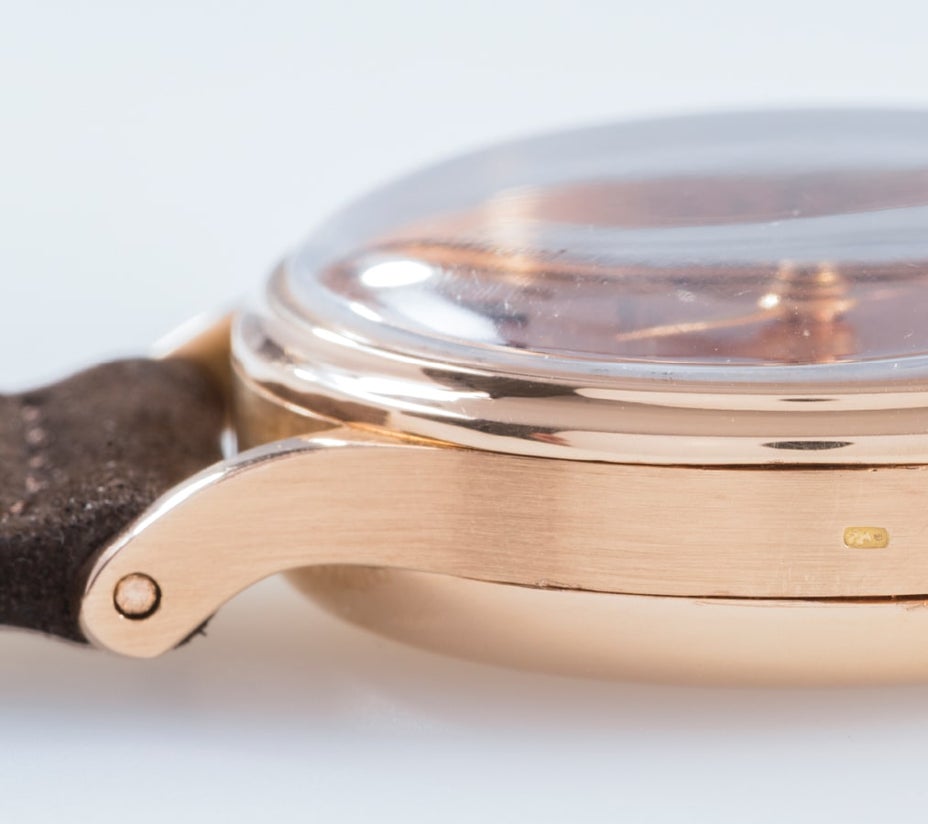
This watch combines, and displays, the rarest and most desirable components of the reference. An early first series example, this watch is nothing short of breathtaking and stunning. The pink gold case, confirmed by the Extract from the Archives and made by Emile Vichet, is preserved in amazing condition with sharp facets and finishes throughout. A hallmark is clearly punched to the left band, attesting to its crisp nature. The unsigned crown is correct and original. Early examples featured a crown that would act as a button to split and reunite the two seconds chronograph hands. It was only later that the crown was fitted with a co-axial push button the reunite the split seconds function.
Yet, the beauty of the watch lies in the extraordinary pink dial. The correct long signature is present, and all printing is intact and legible. The hands and numerals have aged with light patina, giving the watch so much character and history.
Rarer still, this example is complete with all its original accessories such as its original certificate, bill of sale confirming the watch was cased in pink gold, envelope and fitted presentation box. The bill of sale furthermore states that the watch was sold to Monsieur Victorio Luzuriaga, c/o Instruments de Physique for 1900 Swiss Francs in 1946. A scion of the Luzuriaga dynasty, Monsieur Victorio Luzuriaga was a member of an entrepreneurial industrial family. Making his fortune through land, machinery and technical factories, Luzuriaga was a great businessman whose wealth was diversified in the coal, naval and oil industries. One can only imagine the plethora of uses for a split-seconds chronograph wristwatch in Monsieur Luzuriaga's world of business and development.
This watch combines, and displays, the rarest and most desirable components of the reference. An early first series example, this watch is nothing short of breathtaking and stunning. The pink gold case, confirmed by the Extract from the Archives and made by Emile Vichet, is preserved in amazing condition with sharp facets and finishes throughout. A hallmark is clearly punched to the left band, attesting to its crisp nature. The unsigned crown is correct and original. Early examples featured a crown that would act as a button to split and reunite the two seconds chronograph hands. It was only later that the crown was fitted with a co-axial push button the reunite the split seconds function.
Yet, the beauty of the watch lies in the extraordinary pink dial. The correct long signature is present, and all printing is intact and legible. The hands and numerals have aged with light patina, giving the watch so much character and history.
Rarer still, this example is complete with all its original accessories such as its original certificate, bill of sale confirming the watch was cased in pink gold, envelope and fitted presentation box. The bill of sale furthermore states that the watch was sold to Monsieur Victorio Luzuriaga, c/o Instruments de Physique for 1900 Swiss Francs in 1946. A scion of the Luzuriaga dynasty, Monsieur Victorio Luzuriaga was a member of an entrepreneurial industrial family. Making his fortune through land, machinery and technical factories, Luzuriaga was a great businessman whose wealth was diversified in the coal, naval and oil industries. One can only imagine the plethora of uses for a split-seconds chronograph wristwatch in Monsieur Luzuriaga's world of business and development.
Patek Philippe
Swiss | 1839Since its founding in 1839, this famous Geneva-based firm has been surprising its clientele with superbly crafted timepieces fitted with watchmaking's most prestigious complications. Traditional and conservative designs are found across Patek Philippe's watches made throughout their history — the utmost in understated elegance.Well-known for the Graves Supercomplication — a highly complicated pocket watch that was the world’s most complicated watch for 50 years — this family-owned brand has earned a reputation of excellence around the world. Patek's complicated vintage watches hold the highest number of world records for results achieved at auction compared with any other brand. For collectors, key models include the reference 1518, the world's first serially produced perpetual calendar chronograph, and its successor, the reference 2499. Other famous models include perpetual calendars such as the ref. 1526, ref. 3448 and 3450, chronographs such as the reference 130, 530 and 1463, as well as reference 1436 and 1563 split seconds chronographs. Patek is also well-known for their classically styled, time-only "Calatrava" dress watches, and the "Nautilus," an iconic luxury sports watch first introduced in 1976 as the reference 3700 that is still in production today.
Browse Maker