
15
Pablo Picasso
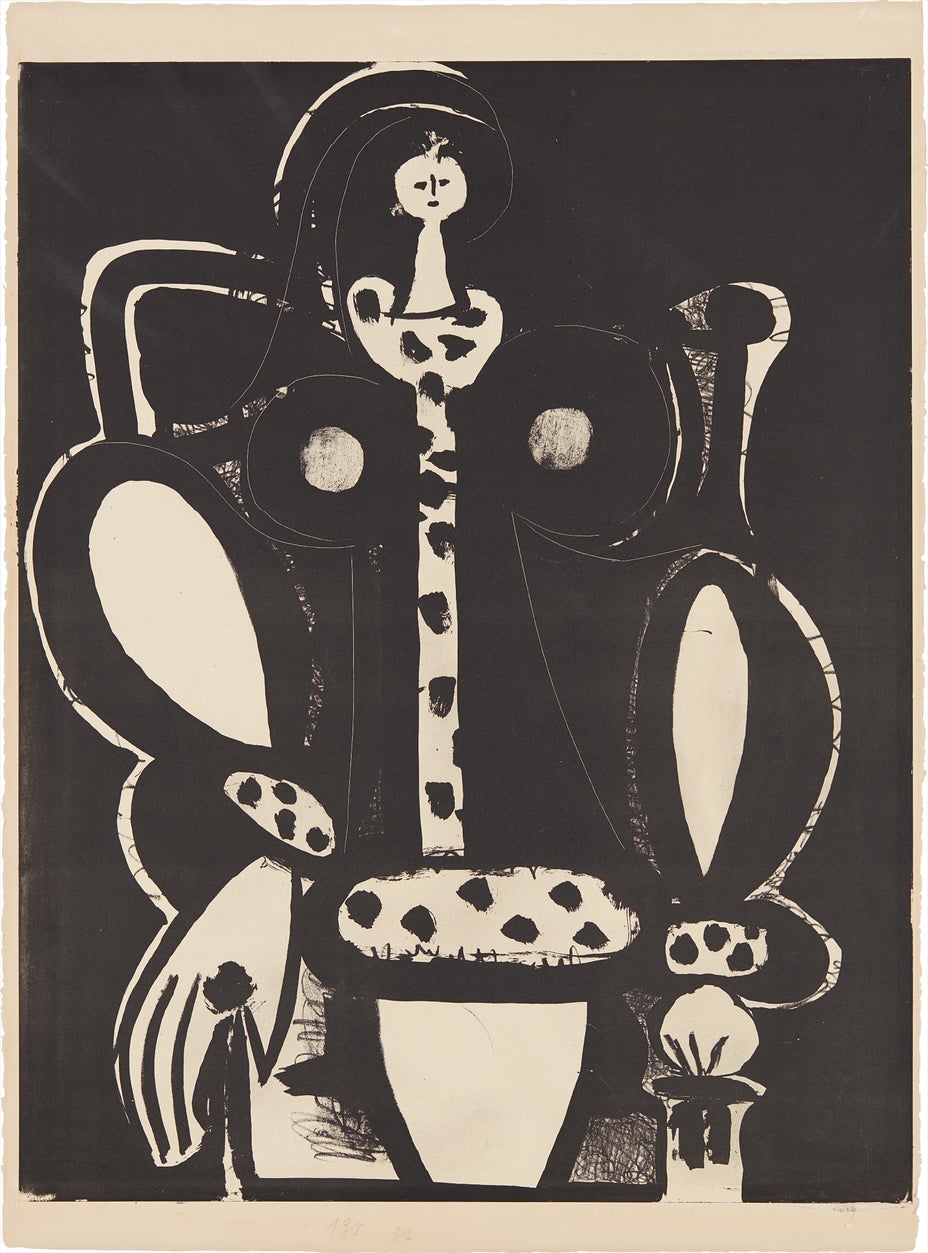
Femme au fauteuil (d'après le noir) (The Armchair Woman, from the black)
- Estimate
- $20,000 - 30,000
Lot Details
Lithograph, on Arches paper, the full sheet.
1948
I. 27 1/2 x 21 1/2 in. (69.9 x 54.6 cm)
S. 30 x 22 in. (76.2 x 55.9 cm)
A rare proof impression of the third state (of six), initialed in pencil by the printer Fernand Mourlot and annotated 'Epreuve d'Exposition' on the reverse, inscribed '138, 3E' on the reverse and in the lower center margin on the front, one of six proofs reserved for the artist and printer (there was no edition of this state), framed.
Specialist
Full-Cataloguing
Catalogue Essay
The original intention of The Armchair Woman series was to have been a complex five color lithograph (fig. right), but surprisingly for Picasso, it became a failed experiment. Instead of abandoning the project, he found each of the five plates much more interesting on their own. He began to work on each plate separately—reworking some plates, transferring and continuing to rework others. The result was more than 25 varying images—his most ambitious and boldest lithographs. This image is from the black plate of the color litho. and is the third image of six he reworked from this plate.
Provenance
Literature
Pablo Picasso
Spanish | B. 1881 D. 1973One of the most dominant and influential artists of the 20th century, Pablo Picasso was a master of endless reinvention. While significantly contributing to the movements of Surrealism, Neoclassicism and Expressionism, he is best known for pioneering the groundbreaking movement of Cubism alongside fellow artist Georges Braque in the 1910s. In his practice, he drew on African and Iberian visual culture as well as the developments in the fast-changing world around him.Throughout his long and prolific career, the Spanish-born artist consistently pushed the boundaries of art to new extremes. Picasso's oeuvre is famously characterized by a radical diversity of styles, ranging from his early forays in Cubism to his Classical Period and his later more gestural expressionist work, and a diverse array of media including printmaking, drawing, ceramics and sculpture as well as theater sets and costumes designs.
Browse Artist