193
Pablo Picasso
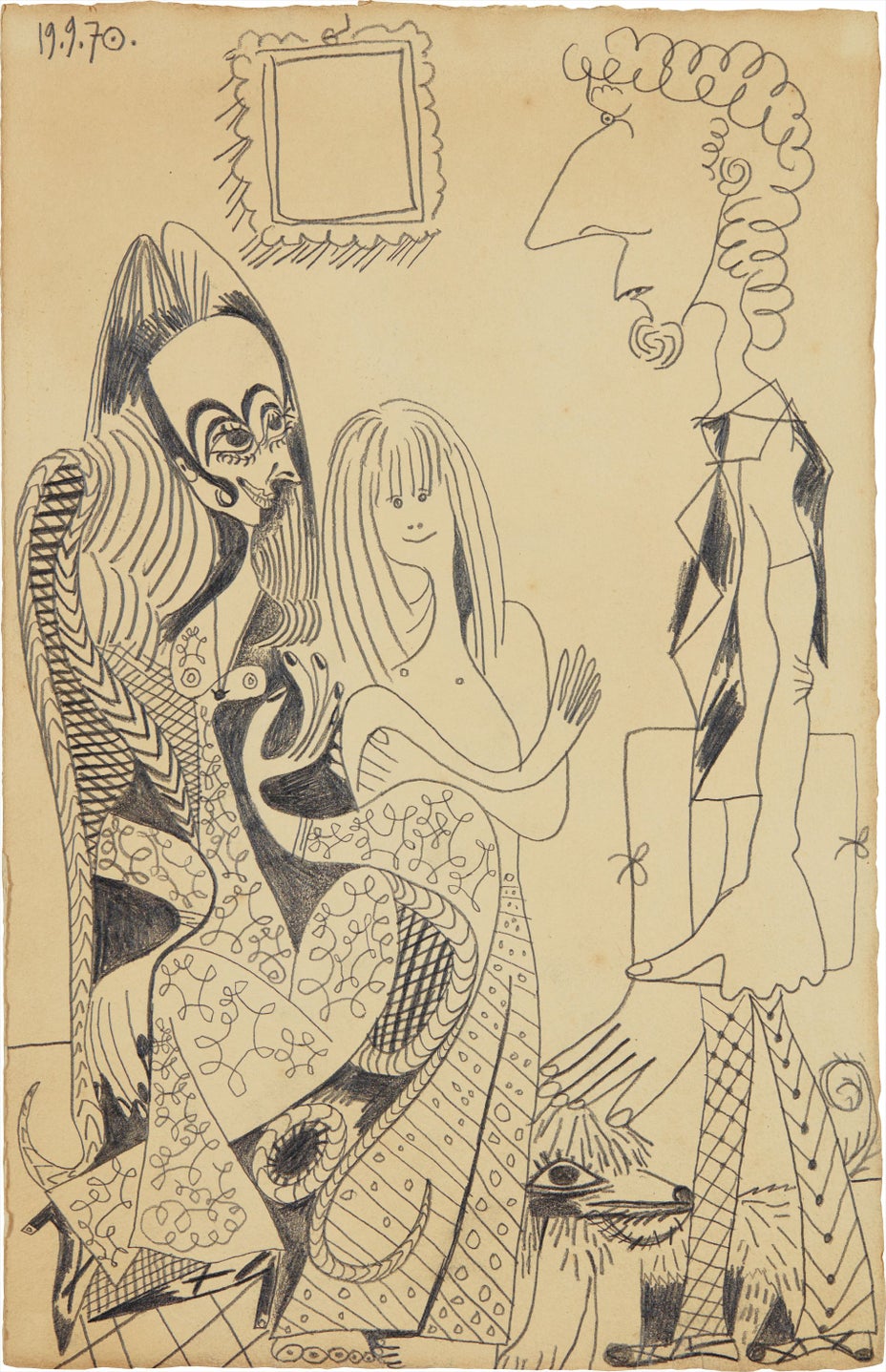
La famille de Piero Crommelynck
Full-Cataloguing
Picasso met Crommelynck in printmaker Roger Lacourière’s atelier while working on his Suite Vollard. Later, in the 1960s, the Crommelynck family moved to Mougins, close to Picasso’s villa Notre-Dame-de-Vie where he was living at this time. During these years, Crommelynck and his brother Aldo provided Picasso with the copper plates that he would use in his Trois cent quarante-sept gravures, La Célestine and the final Cent cinquante-six gravures graphic series. Crommelynck’s portrait can be found in a number of drawings and prints executed by Picasso during this time; however, the present lot is unique in its depiction of the master printer and his family. In La famille de Piero Crommelynck, he is depicted looking over at his wife and daughter, rendered with his characteristic goatee. His wife looks adoringly back at him, while his daughter maintains eye contact with the viewer via a simple smile. The gaze of Picasso’s subjects imbues the work with a sense of energy characteristic of the artist’s masterpieces on paper.
Pablo Picasso
Spanish | B. 1881 D. 1973One of the most dominant and influential artists of the 20th century, Pablo Picasso was a master of endless reinvention. While significantly contributing to the movements of Surrealism, Neoclassicism and Expressionism, he is best known for pioneering the groundbreaking movement of Cubism alongside fellow artist Georges Braque in the 1910s. In his practice, he drew on African and Iberian visual culture as well as the developments in the fast-changing world around him.
Throughout his long and prolific career, the Spanish-born artist consistently pushed the boundaries of art to new extremes. Picasso's oeuvre is famously characterized by a radical diversity of styles, ranging from his early forays in Cubism to his Classical Period and his later more gestural expressionist work, and a diverse array of media including printmaking, drawing, ceramics and sculpture as well as theater sets and costumes designs.