37
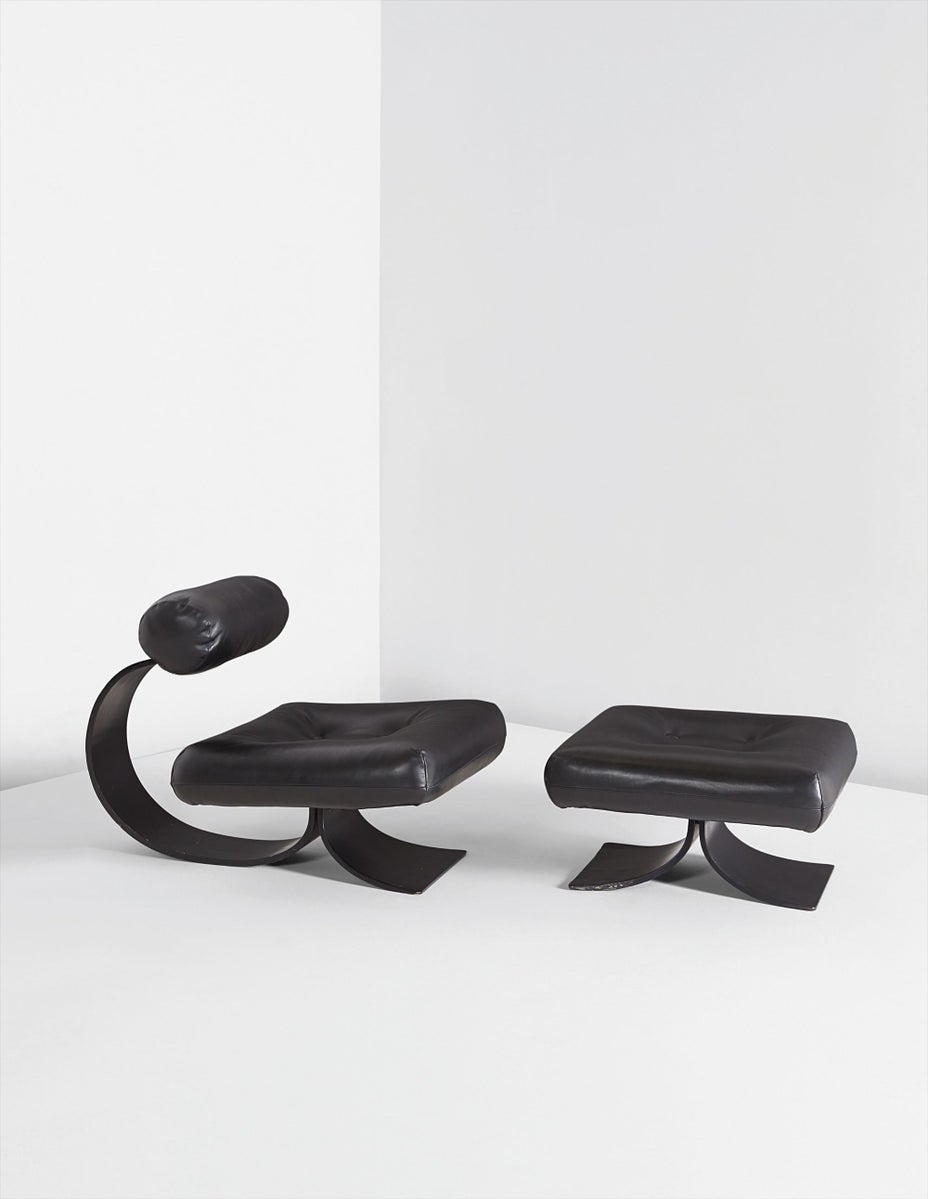
Oscar Niemeyer
Chair and ottoman
Estimate
$20,000–30,000
Sold For
$25,000
circa 1978
Leather, molded plywood.
Chair: 28 x 27 x 40 3/4 in. (71.1 x 68.6 x 103.5 cm)
Ottoman: 15 x 27 1/4 x 27 in. (38.1 x 69.2 x 68.6 cm)
Ottoman: 15 x 27 1/4 x 27 in. (38.1 x 69.2 x 68.6 cm)
Manufactured by Tendo Brasileira, Brazil. Underside with manufacturer's label TENDO BRASILEIRA/INDÚSTRIA E COMÉRCIO DE MÓVEIS LTDA./TAUBATÉ · S.PAULO · IND. BRAS./C.G.C(MF) 45.176.906 / 0001 · 08. Together with a certificate of authenticity issued by Soraia Cals, Rio de Janeiro on behalf of the Anna Maria Niemeyer estate.
Full-Cataloguing
Critics and researchers are yet to thoroughly investigate the parallel between Oscar Niemeyer’s architecture and design. The dialogues between functionality and elegance of forms, between artistic sensibility and intuition, are integral aspects of his work. From rational ideas, Niemeyer brings together conceptual and formal procedures with references to the Colonial Baroque and the aesthetics of more recent artistic styles such as surrealist Italian metaphysical art.
Like many great artists, Niemeyer structures thought through the act of drawing. As his lines abandon dimensional space, they create new forms and alter landscapes. In some projects, particularly Brasília, buildings form groups of extreme plasticity in which distinct scale and purposes are articulated in a playful way. Isolated, these buildings can be seen as instruments of pure design; in a smaller scale the quality of the forms of the original larger architectural project is accentuated.
Niemeyer created furniture, designed in collaboration with his daughter Anna Maria Niemeyer, to ensure that his interiors spoke the same language as his architecture; in both, Niemeyer was seduced by the curved line and sinuous angle. The elegance and economy of his forms resemble that of Portuguese colonial furniture in Brazil; the former is equally uncomplicated and stripped down, with a Japanese influence similar to that which inspired Charlotte Perriand, and with an organic aesthetic similar to those of Jean Arp and Henry Moore.
Niemeyer’s silkscreens affirm the quality of his drawing and his enchantment with the work of Matisse, in the use of colorful collages and also especially through their feelings of "joie de vivre." The curved line that defines the feminine figure, sensual and delicate, is the same line that defines Niemeyer’s architecture and his design. In his political drawings, the same enchantment for life and humanitarian qualities suggest that the world would be better if all humans were given the same opportunities. The poet Ferreira Gullar once said that in Niemeyer "beauty is weightless."
MARCUS DE LONTRA COSTA
Curator, "Poética da Forma – Oscar Niemeyer," Museu Brasileiro da Escultura, São Paulo, 2011 and "100 anos: Oscar Niemeyer Arquiteto Brasileiro Cidadão," Museu de Arte Contemporânea de Niterói, 2007
Like many great artists, Niemeyer structures thought through the act of drawing. As his lines abandon dimensional space, they create new forms and alter landscapes. In some projects, particularly Brasília, buildings form groups of extreme plasticity in which distinct scale and purposes are articulated in a playful way. Isolated, these buildings can be seen as instruments of pure design; in a smaller scale the quality of the forms of the original larger architectural project is accentuated.
Niemeyer created furniture, designed in collaboration with his daughter Anna Maria Niemeyer, to ensure that his interiors spoke the same language as his architecture; in both, Niemeyer was seduced by the curved line and sinuous angle. The elegance and economy of his forms resemble that of Portuguese colonial furniture in Brazil; the former is equally uncomplicated and stripped down, with a Japanese influence similar to that which inspired Charlotte Perriand, and with an organic aesthetic similar to those of Jean Arp and Henry Moore.
Niemeyer’s silkscreens affirm the quality of his drawing and his enchantment with the work of Matisse, in the use of colorful collages and also especially through their feelings of "joie de vivre." The curved line that defines the feminine figure, sensual and delicate, is the same line that defines Niemeyer’s architecture and his design. In his political drawings, the same enchantment for life and humanitarian qualities suggest that the world would be better if all humans were given the same opportunities. The poet Ferreira Gullar once said that in Niemeyer "beauty is weightless."
MARCUS DE LONTRA COSTA
Curator, "Poética da Forma – Oscar Niemeyer," Museu Brasileiro da Escultura, São Paulo, 2011 and "100 anos: Oscar Niemeyer Arquiteto Brasileiro Cidadão," Museu de Arte Contemporânea de Niterói, 2007