21Ο︎◆︎
Mira Schendel
Sem titulo (XII)
Full-Cataloguing
Having emigrated from Europe in the years following the devastation of the Second World War, Schendel settled in São Paulo, a dynamic and flourishing city in the midst of artistic revolution. There, she developed a vastly complex and unique body of work. During the early 1950s, Schendel never aligned herself with the prevalent art movements of the time. Belonging to neither Brazilian Concretist nor Neo-Concretist groups, she worked furiously and independently to produce and exhibit her work.
Mira Schendel's art transpired from her engagement with the intellectual circles she explored, discussing her interests in aesthetics and philosophy. Though she distanced herself from the critical art debates that focused more directly upon evolving formalist trends, she was a central figure in the circulation of dialogue with many of the period's leading artists and thinkers.
Throughout the 1960s and 1970s, Schendel produced her most iconic works: the Monotipias (Monotypes), Droguinhas (Little Nothings), and Objetos Gráficos (Graphic Objects). Executed on Japanese rice paper, these works are characterized by minimalist geometric motifs. Experimenting with ephemeral materials, Schendel became increasingly interested in transforming letters and linguistic elements into objects – an approach most commonly associated with Concrete poetry. In her graphic works, letters are liberated and deconstructed, raising questions about language, writing, drawing, and image.
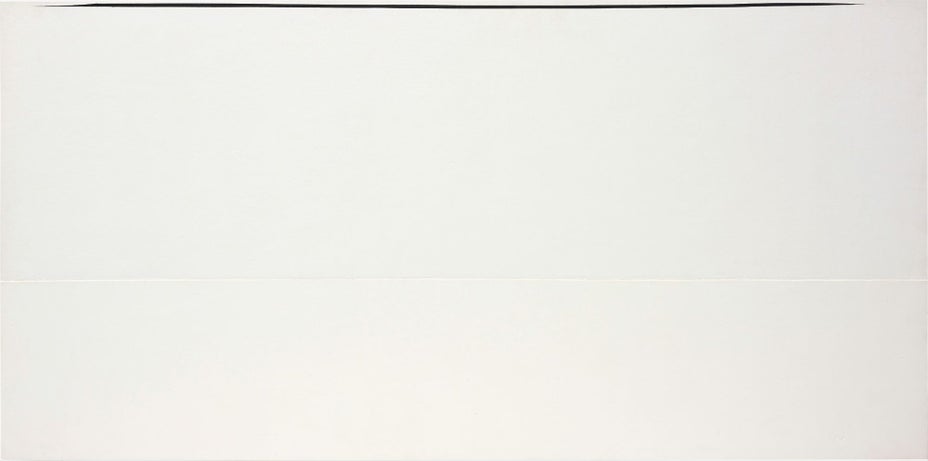
In the latter part of her career, Mira paired down her output to the very minimal and fundamental essence of her work: The line and its extraordinary power to convey meaning, vision and the sculptural space in which it achieves that principle. The present work completely captures this aesthetic depth. The tapering of black line along the upper edge hints at a vanishing point or horizon, while the faint white relief creates sculptural volume in the space created. Her earlier works, often referred to as 'The Graphic objects,' are like constellations. But in her final years of working Schendel comes to a poetic and minimal conclusion, aware of the permanent void she would soon be entering.
Mira Schendel
Brazilian | B. 1919 D. 1988Born in Zurich and of Jewish heritage, Mira Schendel escaped Switzerland during World War II to settle in Sarajevo and Rome, finally immigrating to Brazil in 1953. In the 1960s, she began to produce her iconic monotipas, delicate drawings on luminescent rice paper. She rejected the notion of painting as a primary medium, abandoning the genre in the 1970s for almost a decade. Schendel worked mostly with paper and objects made of unusual materials such as Plexiglas, fabrics and aqueous inks.
Recurring themes in her work include letters, geometric figures and phrases reflecting a radical lexicon, often juxtaposing elements from two languages (visual and numerical). Many of her works hover in the space between drawing and writing, creating a certain visual poetry that is completely her own. Schendel's works go beyond the materiality of making art and allow viewers to understand the relationship between language, time and human thought processes.