41
Michael Ray Charles
(Forever Free) The Watermelon Party
Estimate
$30,000–50,000
Sold For
$87,500
signed, inscribed and dated "MICHAEL RAY CHARLES AMERICAN PAINTER 96" lower right of upper element
acrylic and copper penny on wooden panel, in 2 parts
107 x 47 in. (271.8 x 119.4 cm)
Executed in 1996.
Full-Cataloguing
Using imagery reminiscent of the advertising of an unidentifiable American past, Michael Ray Charles’ (Forever Free) The Watermelon Party, 1996, subverts fictional commercial imagery and stereotypical portrayals of blackness to question the nature of representations of African Americans in the past and today. Charles, who lives and works in Houston, Texas, coopts caricatures and stereotypes of African Americans such as the Sambo, Aunt Jemima, and Uncle Tom to examine the unrealistic and often disparaging representations of black people and blackness in American art and advertising. The titular label Forever Free refers to an imaginary product of Charles’ creation that symbolizes the undelivered promises of liberation made to African Americans by America, particularly those advanced using the unrealistic and offensive representations of black people in consumer culture.
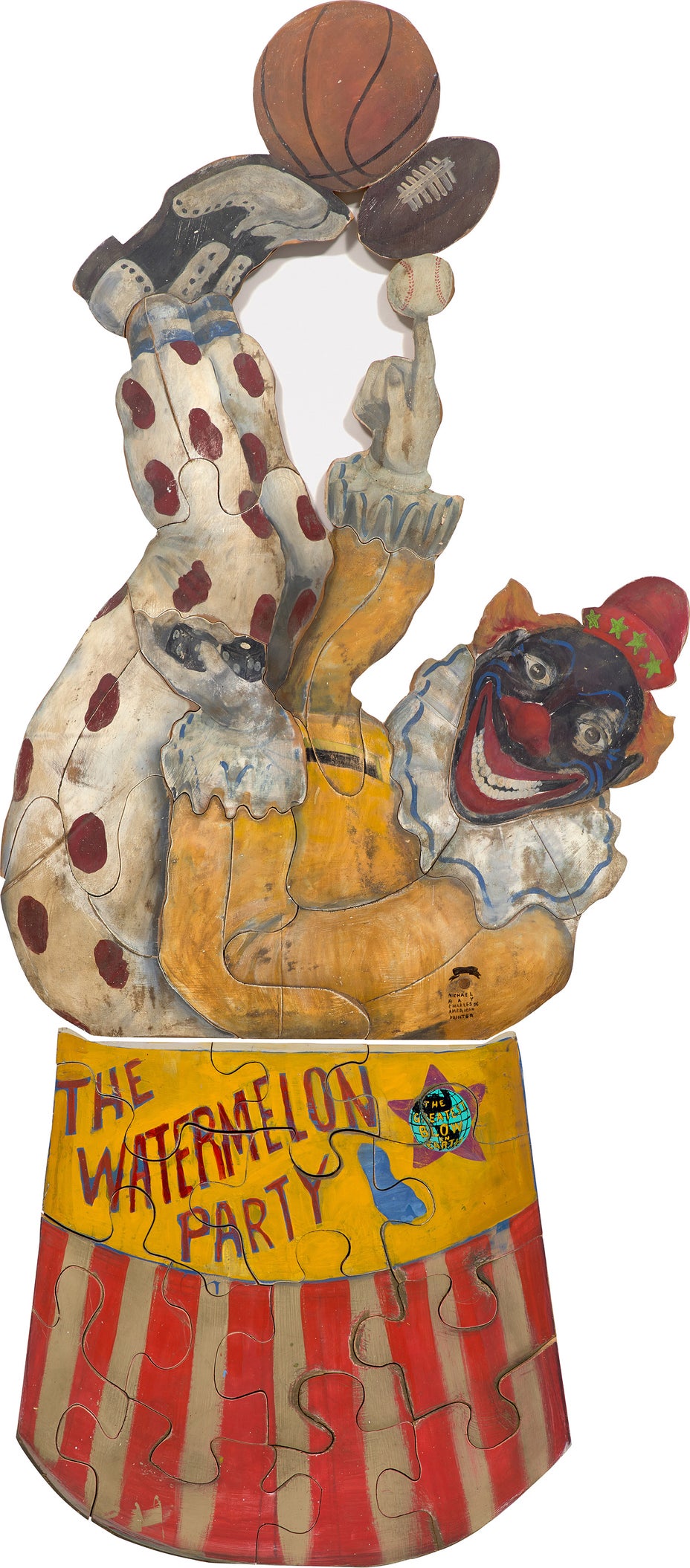
(Forever Free) The Watermelon Party recreates the ephemera of the travelling circus as it portrays a grinning minstrel balancing on the show’s characteristic striped pedestal, not as the event’s ringleader but as the contorted object of the spectacle. His twisted form serves to underpin the baseball, football, and basketball balanced between his forefinger and feet, while his free hand holds dice out to the viewer; these accoutrements of amusement suggest that the only widely acceptable modes of social advancement in mainstream America available to young black men are through sports or sheer luck; in either case, his Sisyphean travails, and the modes of culture they support, are relegated to the realm of mere entertainment consumed by white society. Charles coopts the famous motto of the Ringling Bros. and Barnum & Bailey Circus, “The Greatest Show on Earth,” both to highlight the proverbial insult added to the real-life sociological injury of this unbalanced relationship and to reaffirm the veritable cultural greatness of African Americans, unrecognized yet still consumed by white America.
(Forever Free) The Watermelon Party recreates the ephemera of the travelling circus as it portrays a grinning minstrel balancing on the show’s characteristic striped pedestal, not as the event’s ringleader but as the contorted object of the spectacle. His twisted form serves to underpin the baseball, football, and basketball balanced between his forefinger and feet, while his free hand holds dice out to the viewer; these accoutrements of amusement suggest that the only widely acceptable modes of social advancement in mainstream America available to young black men are through sports or sheer luck; in either case, his Sisyphean travails, and the modes of culture they support, are relegated to the realm of mere entertainment consumed by white society. Charles coopts the famous motto of the Ringling Bros. and Barnum & Bailey Circus, “The Greatest Show on Earth,” both to highlight the proverbial insult added to the real-life sociological injury of this unbalanced relationship and to reaffirm the veritable cultural greatness of African Americans, unrecognized yet still consumed by white America.