33
Mark Lombardi
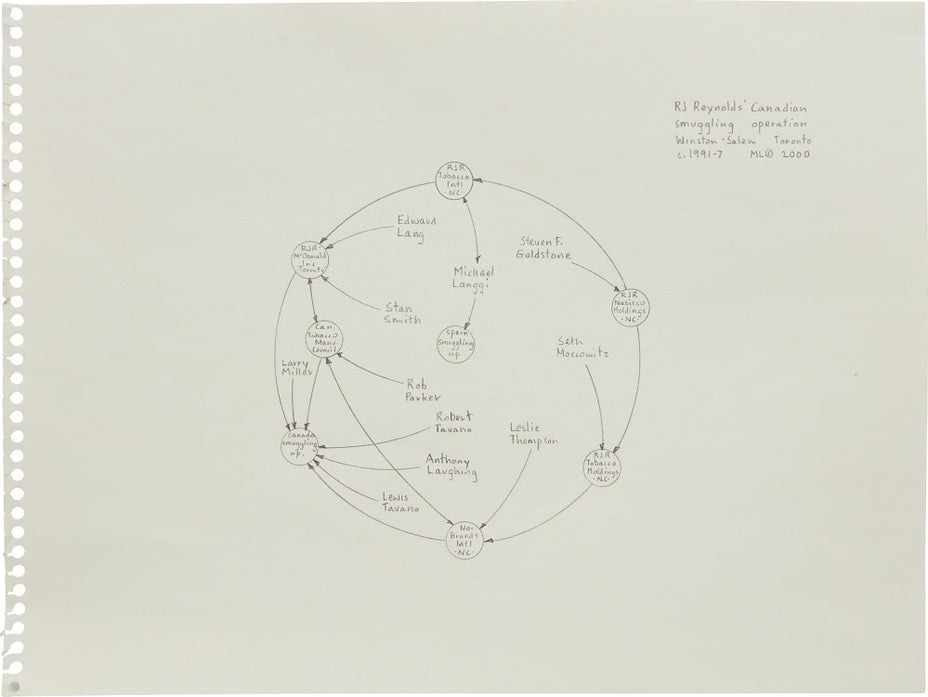
RJ Reynold's Canadian smuggling operation Winston-Salem Toronto c. 1991-7
Estimate
$8,000–12,000
signed with the artist's initials, titled and dated "RJ Reynold's Canadian smuggling operation Winston-Salem Toronto c. 1991-7 ML © 2000" upper right; further signed with the artist's initials and dated "ML © 2000" on the reverse
graphite on paper
9 x 12 in. (22.9 x 30.5 cm.)
Executed in 2000.
Full-Cataloguing
Mark Lombardi’s RJ Reynold's Canadian smuggling operation Winston-Salem Toronto c. 1991-7, 2000 is an evocative example from the artist’s intricate and politically charged practice. The present work is an illustration of the artist’s zealously researched connections between the second-largest tobacco company in the United States and named individuals such as Leslie Thompson, who in 1999 pleaded guilty to charges of helping smugglers sell nearly $700 million worth of cigarettes on the Canadian black market. Lombardi, who died by suicide the same year that he completed the present work, had collected more than 7,000 index cards based on his research regarding links between global finance and international corruption and terrorism. His works have outlined corporate conspiracy theories, including those concerning Banca Nazionale del Lavoro-who helped Reagan and Thatcher provide Iraq with militaristic weapons and the Lippo Group, whom Clinton assisted in the transfer of US missile technology to China. A few weeks after the September 11th terrorist attacks, the FBI contacted the Whitney Museum of American Art in New York to see one of Lombardi’s drawings as it related to their ongoing investigations of what lead to the event.
Materially, the work appears unassuming and straightforward: with just graphite on paper, Lombardi created intricate patterns of curves and arcs to illustrate his fervently well-researched links between global finance and international terrorism. The work’s inherently delicate beauty in its pared down composition is weighted by the ominously mysterious subject matter. These drawings are not only a culmination of fragments of a hidden history, but also are examples of expert draftsmanship, some even redolent of astrological clusters or finite cosmoses. The combination of elegance and restraint in Lombardi’s drawings coalesces the personal and the political.
Materially, the work appears unassuming and straightforward: with just graphite on paper, Lombardi created intricate patterns of curves and arcs to illustrate his fervently well-researched links between global finance and international terrorism. The work’s inherently delicate beauty in its pared down composition is weighted by the ominously mysterious subject matter. These drawings are not only a culmination of fragments of a hidden history, but also are examples of expert draftsmanship, some even redolent of astrological clusters or finite cosmoses. The combination of elegance and restraint in Lombardi’s drawings coalesces the personal and the political.