
Property Sold to Benefit NAMLA
30
Mario Carreño
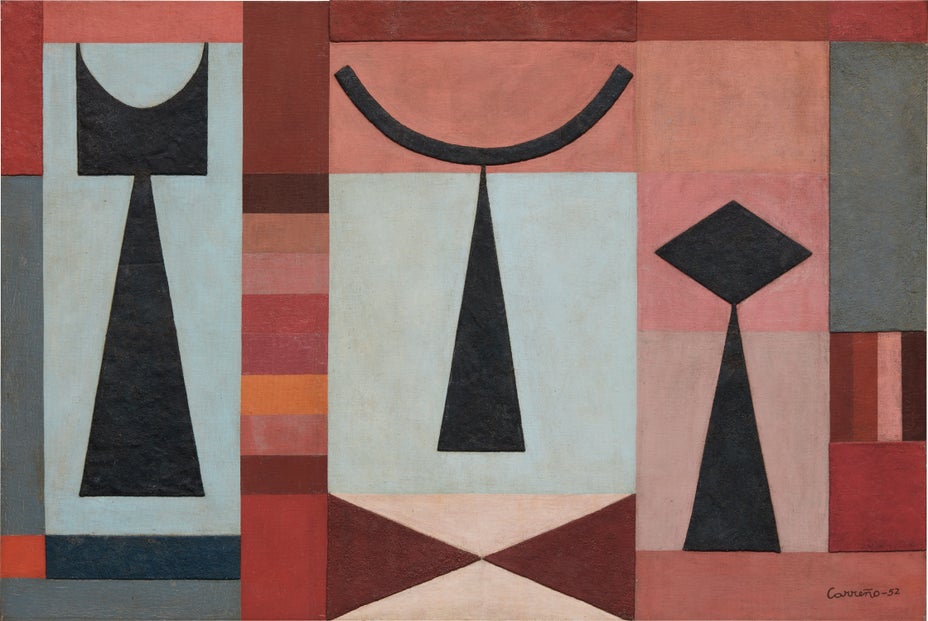
Geométrico
- Estimate
- $80,000 - 120,000
$137,500
Lot Details
oil and stucco on canvas
36 3/8 x 53 7/8 in. (92.4 x 136.8 cm)
Painted in 1952.
Specialist
Full-Cataloguing
Catalogue Essay
Along with Sandú Darié and Luís Martínez Pedro, Mario Carreño was a primary leader of the Concrete art movement in Cuba. After a period in which the artist spent time in New York, Carreño returned to Cuba in late 1951. The present lot epitomizes his distinct style of abstraction, which stemmed from his earlier figurative works depicting Cuban and Afro-Cuban culture. The painting presents structural clarity, delineated rectangular and linear elements, and features a brilliant color palette that evokes strong sentiment in the viewer and reinforces Carreño’s deep understanding of color theory. Geométrico includes Carreño’s signature crescent and triangular forms that recall Afro-Cuban motifs, evoking the cross-cultural heritage of Cuba while simultaneously presenting an entirely non-representational composition that has a strong universal appeal.
Provenance
Mario Carreño
Cuban | B. 1913 D. 1999Throughout his career, Mario Carreño produced a large body of diverse work ranging in style from Neo-Classical Figuration to Abstraction, and he is widely recognized as a key figure in Modern Cuban art. Carreño spent his formative years abroad, visiting Mexico in 1935 and later traveling throughout Europe in the 1940s. While in Europe, Carreño drew great inspiration from such contemporary avant-garde styles as Expressionism, Cubism and Abstraction.
Like Amelia Peláez, Carlos Enrique and other second-generation Vanguardia artists, Carreño aimed to incorporate European Modernist style into his oeuvre while developing a nationalist visual lexicon. His seminal works from the '40s, including Fuego en el Batey, Corte de Caña and Danza Afrocubana are brilliantly colored Duco works that each represent an essential element of Cuban identity.
Browse ArtistLike Amelia Peláez, Carlos Enrique and other second-generation Vanguardia artists, Carreño aimed to incorporate European Modernist style into his oeuvre while developing a nationalist visual lexicon. His seminal works from the '40s, including Fuego en el Batey, Corte de Caña and Danza Afrocubana are brilliantly colored Duco works that each represent an essential element of Cuban identity.