Property from a Distinguished European Family Collection
4Ο︎◆︎
Marino Marini
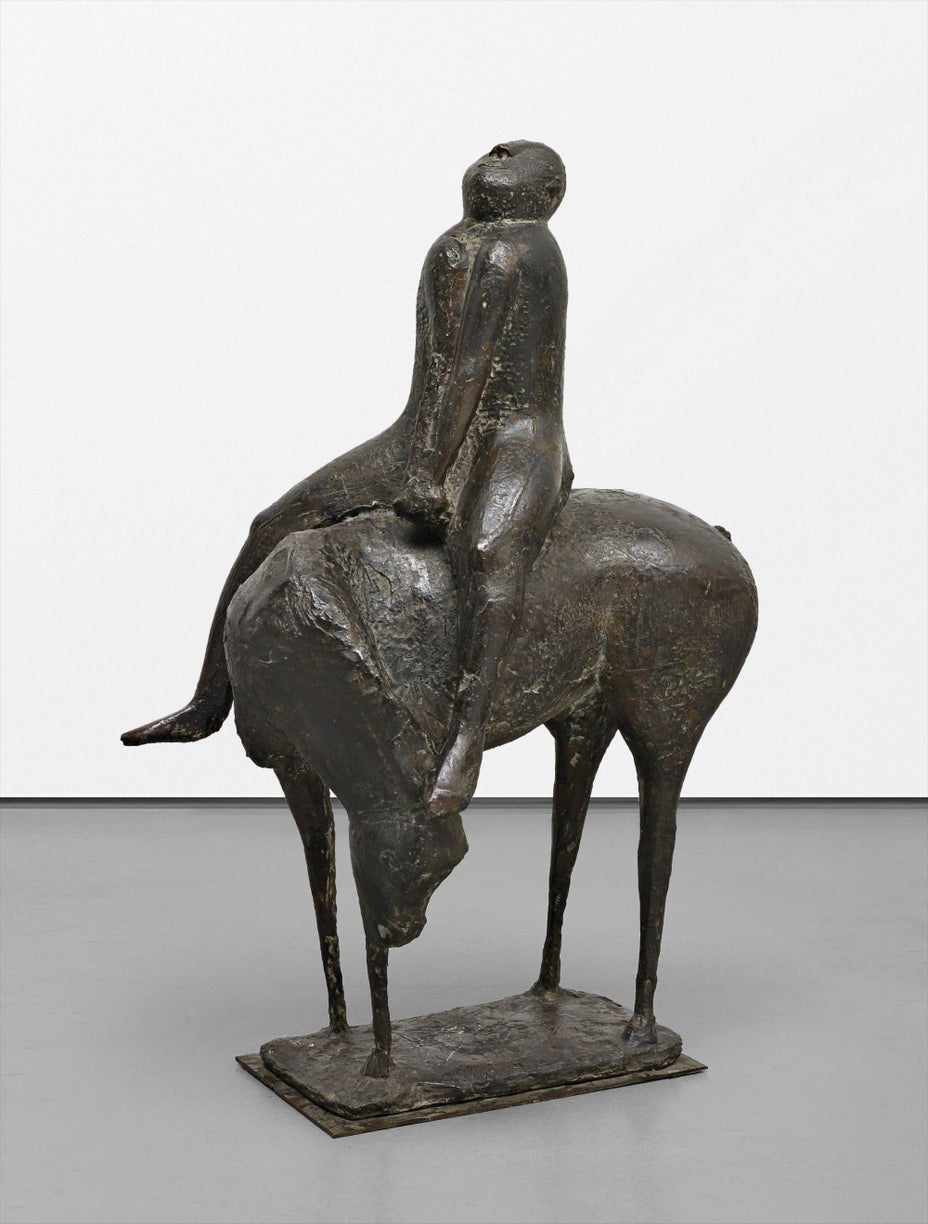
Cavaliere
Estimate
$900,000–1,200,000
Sold For
$905,000
bronze
41 3/8 x 19 5/8 x 26 7/8 in. (105 x 50 x 68.3 cm)
Incised "MM 1/0" on the base.
Conceived in 1947, from an edition of 8 and cast during the artist's lifetime.
Conceived in 1947, from an edition of 8 and cast during the artist's lifetime.
Full-Cataloguing
"My equestrian statues express the torment caused by the events of this century. The restlessness of my horse grows with each new work, the rider appears increasingly worn out, he has lost his dominance over the beast and the catastrophes to which he succumbs are similar to those which destroyed Sodom and Pompeii."
Marino Marini’s career was almost singularly focused on the investigation of the human condition as evinced by the relationship between the horse and his mount. Marini’s early explorations of the form exhibited the rounded modeling and harmonious union between man and beast that Marini so idolized in Etruscan sculpture. Prior to World War II, the relationship between horse and rider was a mutually beneficial symbiosis, yet, following the war, Marini’s faith in the direction of humanity was shaken to its core. By the 1950s, Marini’s horse and rider had become sharply angular forms, the rider more often than not in the process of being foisted from his perch. Marini ruptured this classical equilibrium and began to depict the rider as increasingly imperiled on his mount; the monumental solidity that characterized his earlier works is replaced by a sense of climax and crisis. What had been the embodiment of triumph and success – hardly is there a symbol more commanding than that of a commander astride his steed – was gradually transformed to an image of rupture, discord, and defeat.
This Cavaliere, conceived in 1947, marks this pivotal turning point in Marini’s oeuvre. The forms of the horse and the rider still retain their rounded naturalism, but the rider turns up his head in anguish as his horse bends its head low to the ground in a gesture of defeat. Marini uses this potent imagery as a vehicle to convey his own disquiet about the human condition and about the direction in which he believed humanity was moving following the war. This particular iteration of Marini’s horse and rider was so prized by Marini’s patron, and influential politician, Mr. Pietro Campili that Marini cast the current example specifically for him in 1965-66 as an additional work to the previous six he had cast earlier in the late 1940s and early 1950s. At the same time, Marini cast one more example for his own collection, which he later donated to the Neue Galerie, Bayerische Staatsgemaeldesammlungen, now the Pinkothek der Moderne, Munich. Several other casts of this work are in important public collections, including the Norton Simon Museum, Pasadena and the Blanden Memorial Art Musuem, Fort Dodge. The coated plaster version is in the collection of the Museo Marino Marini, San Pancrazio, Florence.
Marino Marini’s career was almost singularly focused on the investigation of the human condition as evinced by the relationship between the horse and his mount. Marini’s early explorations of the form exhibited the rounded modeling and harmonious union between man and beast that Marini so idolized in Etruscan sculpture. Prior to World War II, the relationship between horse and rider was a mutually beneficial symbiosis, yet, following the war, Marini’s faith in the direction of humanity was shaken to its core. By the 1950s, Marini’s horse and rider had become sharply angular forms, the rider more often than not in the process of being foisted from his perch. Marini ruptured this classical equilibrium and began to depict the rider as increasingly imperiled on his mount; the monumental solidity that characterized his earlier works is replaced by a sense of climax and crisis. What had been the embodiment of triumph and success – hardly is there a symbol more commanding than that of a commander astride his steed – was gradually transformed to an image of rupture, discord, and defeat.
This Cavaliere, conceived in 1947, marks this pivotal turning point in Marini’s oeuvre. The forms of the horse and the rider still retain their rounded naturalism, but the rider turns up his head in anguish as his horse bends its head low to the ground in a gesture of defeat. Marini uses this potent imagery as a vehicle to convey his own disquiet about the human condition and about the direction in which he believed humanity was moving following the war. This particular iteration of Marini’s horse and rider was so prized by Marini’s patron, and influential politician, Mr. Pietro Campili that Marini cast the current example specifically for him in 1965-66 as an additional work to the previous six he had cast earlier in the late 1940s and early 1950s. At the same time, Marini cast one more example for his own collection, which he later donated to the Neue Galerie, Bayerische Staatsgemaeldesammlungen, now the Pinkothek der Moderne, Munich. Several other casts of this work are in important public collections, including the Norton Simon Museum, Pasadena and the Blanden Memorial Art Musuem, Fort Dodge. The coated plaster version is in the collection of the Museo Marino Marini, San Pancrazio, Florence.