The Modern Form: Property from the Collection of Betty and Stanley Sheinbaum
7Ο︎
Marino Marini
Piccolo Cavaliere
Estimate
£400,000–600,000‡︎♠︎
Sold For
£422,250
stamped with the artist's initials 'M.M' on the base
hand chiselled bronze with variegated patina
40.6 x 33 x 16.5 cm (16 x 13 x 6 1/2 in.)
Conceived and cast in 1949, this work is from an edition of 6, all differently finished, and is accompanied by a certificate of authenticity from the Fondazione Marino Marini.
Phillips wishes to thank the Fondazione Marino Marini for their expertise and help with cataloguing this work.
Phillips wishes to thank the Fondazione Marino Marini for their expertise and help with cataloguing this work.
Full-Cataloguing
‘For many centuries, the image of the rider has maintained an epic character. Its object was to pay homage to a conqueror…’ (Marino Marini, quoted in Herbert Read, Patrick Waldberg & Gualtieri di San Lazzaro, Marino Marini, Complete Works, Milan, 1970, p. 491).
Throughout history, the image of a horseman and his horse has long held a revered place in Western art. Often depicting moments of celebrated triumphs, imperial victories of ancient empires and glorified wars, these archaic images have continued to influence and dominate the oeuvres of many esteemed artists. Yet in Marino Marini’s equestrian sculptures this traditional symbol of heroism, virility and strength is explored and challenged, presenting the rider in a new and provocative form. Executed in 1949, at the zenith of his artistic career, Piccolo Cavaliere is a striking testament to Marini’s dedication and inner engagement with this singular subject and his unique ability to redefine the aesthetic nature of sculpture with sensitive and carefully articulated attention. Hand worked with an iron bodkin, the surface of the sculpture underlines the textural and unique finish of the Piccolo Cavaliere. Pursuing a practice as timeless as the subject itself, Marini pushes his sculptures to their final conclusion, shaping malleable substances into truthful and poignant symbols.
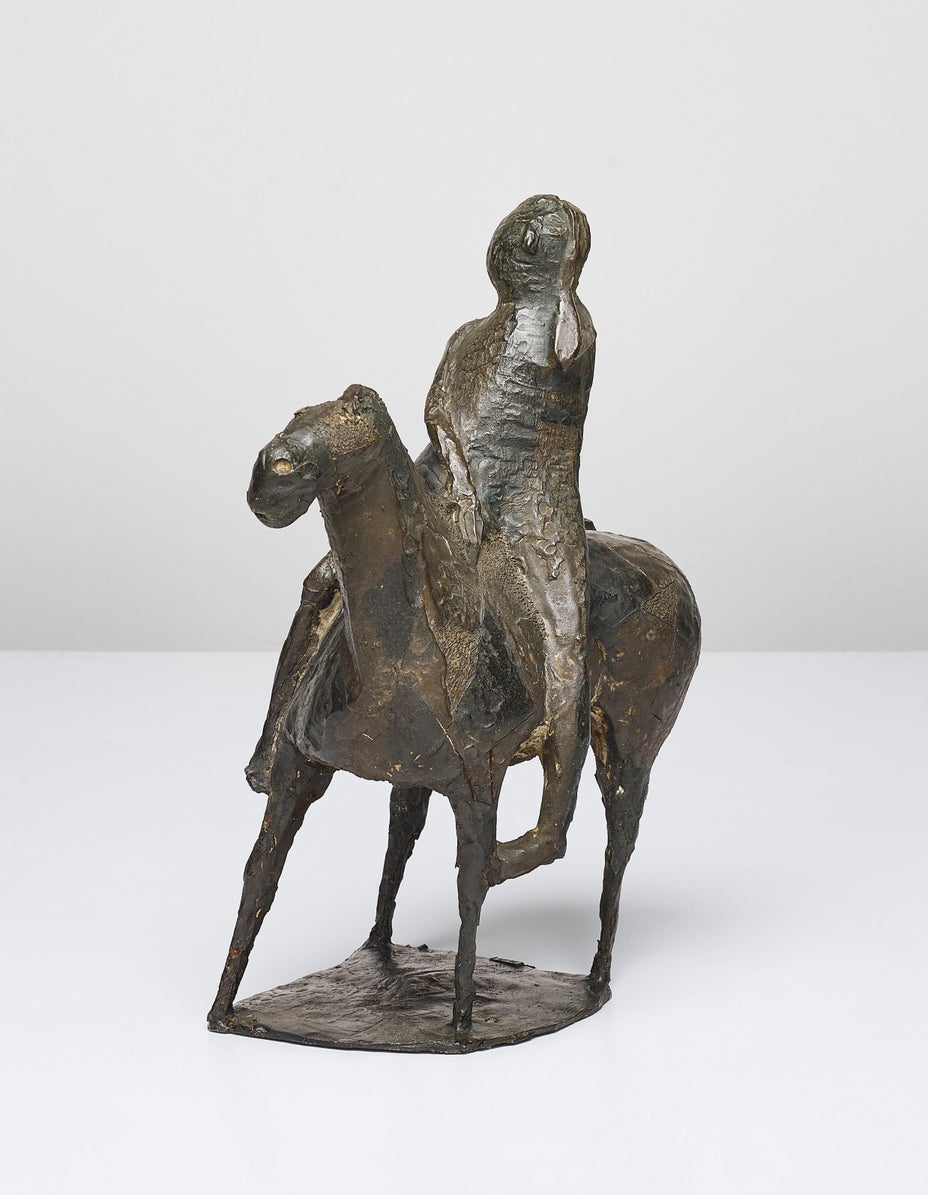
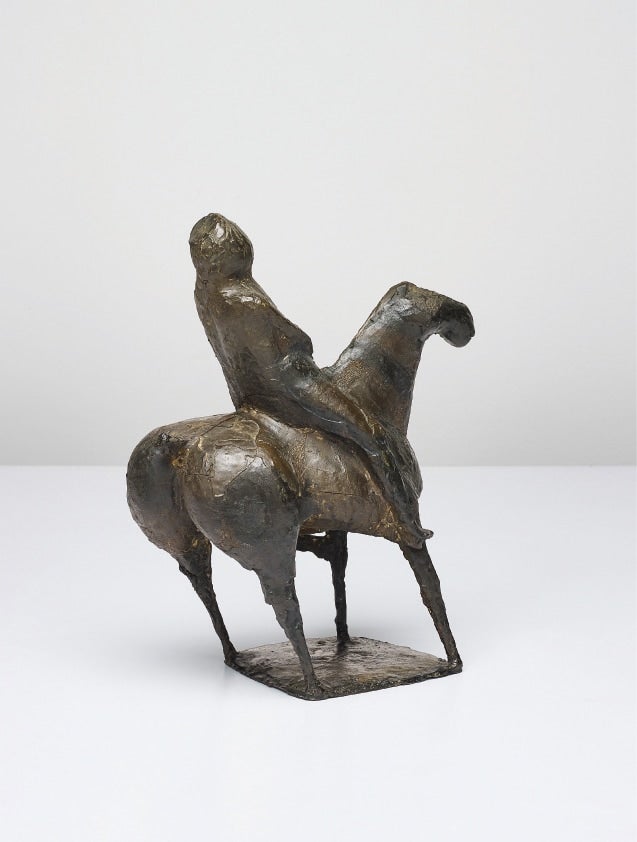
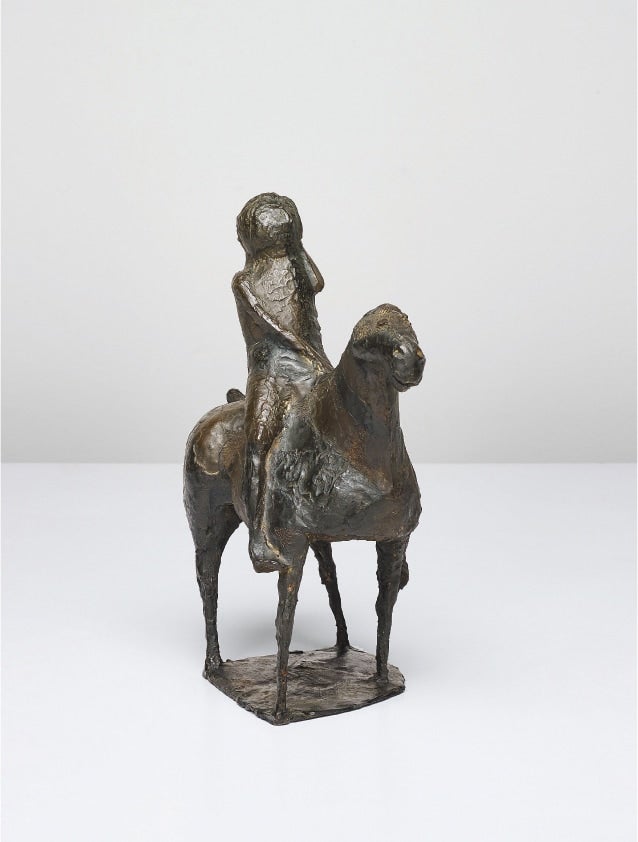
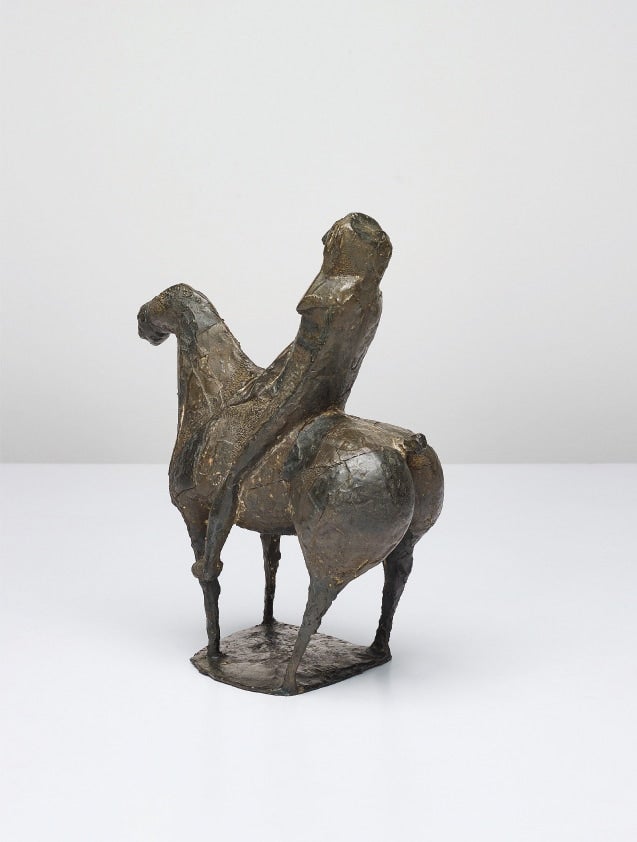
Purchased by Los Angeles collector Betty Sheinbaum from famed art dealer Eric Estorick in 1958 and remaining in the prolific collection until today, Piccolo Cavaliere shows a lone rider sitting precariously on the back of his horse. His slight, rigid frame leans back, one hand crossing his body, clutching for the static horse below him. The dynamic tension between the rider and the horse is palpable. Man as the master of beast is transposed as both rider and horse appear poised, on the edge of some ominous conflict. The horse’s rear legs appear to be on the brink of buckling, ready to jolt the rider from his position of power. Yet, wrought from the same material, the rider and his horse seem fused together in an almost organic, amalgamated entity, unable to truly separate from one another. Here, the sculpture is imbued with psychological complexity as the angularity of the rider’s form jars with the softer, rounder features of the horse below.
For Marini, the drama and dissonance of the horse and rider reflects a more universal crisis, ‘a search for a combination of bodies in space’ (Marino Marini, quoted in Herbert Read, Patrick Waldberg & Gualtieri di San Lazzaro, Marino Marini, Complete Works, Milan, 1970, p. 489). Firmly rooted in the devastation of his native Tuscany, Marini’s equestrian study confronts the reverberations felt by the artist after World War Two. During this time, the retreating German army in Italy was dependent upon requisitioned horse transport. Here the horses suffered terribly from the bombs and bullets of the advancing Allied liberators. From a train, Marini witnessed the agonising sight of a stricken horse rearing in terror.
In the 1950s Marini showed an increasing appreciation for the Commedia dell'arte and the world of the circus. Intently concerned with the craft of entertaining people, the artist regarded the acrobat as a metaphor of humanity, the constant balance between good and evil, life and death. This fascination is reflected in the festive circus figures and jugglers that often appear to dance around his horses. In the present work we see this concern reflected in the tessellating squares and diamonds that evoke the traditional dress of harlequin figures, like those painted by Pablo Picasso.
Marini's painstaking manual labour is clearly evident within this sculpture. Incised with closely-spaced marks, striations, file and chisel strokes, Piccolo Cavaliere is imbued with Marini’s own artistic presence, retaining the rhythmic notches of a truly incredible sculptor. The rough and corroded material of bronze lends itself beautifully to Marini’s raw and visceral vision. Using a subject that can be traced back to Palaeolithic cave-drawings or the sculptural reliefs of the Etruscans, it is a remarkable testimony to Marini as an artist to give such daring treatment to this timeless subject.
Throughout history, the image of a horseman and his horse has long held a revered place in Western art. Often depicting moments of celebrated triumphs, imperial victories of ancient empires and glorified wars, these archaic images have continued to influence and dominate the oeuvres of many esteemed artists. Yet in Marino Marini’s equestrian sculptures this traditional symbol of heroism, virility and strength is explored and challenged, presenting the rider in a new and provocative form. Executed in 1949, at the zenith of his artistic career, Piccolo Cavaliere is a striking testament to Marini’s dedication and inner engagement with this singular subject and his unique ability to redefine the aesthetic nature of sculpture with sensitive and carefully articulated attention. Hand worked with an iron bodkin, the surface of the sculpture underlines the textural and unique finish of the Piccolo Cavaliere. Pursuing a practice as timeless as the subject itself, Marini pushes his sculptures to their final conclusion, shaping malleable substances into truthful and poignant symbols.
Purchased by Los Angeles collector Betty Sheinbaum from famed art dealer Eric Estorick in 1958 and remaining in the prolific collection until today, Piccolo Cavaliere shows a lone rider sitting precariously on the back of his horse. His slight, rigid frame leans back, one hand crossing his body, clutching for the static horse below him. The dynamic tension between the rider and the horse is palpable. Man as the master of beast is transposed as both rider and horse appear poised, on the edge of some ominous conflict. The horse’s rear legs appear to be on the brink of buckling, ready to jolt the rider from his position of power. Yet, wrought from the same material, the rider and his horse seem fused together in an almost organic, amalgamated entity, unable to truly separate from one another. Here, the sculpture is imbued with psychological complexity as the angularity of the rider’s form jars with the softer, rounder features of the horse below.
For Marini, the drama and dissonance of the horse and rider reflects a more universal crisis, ‘a search for a combination of bodies in space’ (Marino Marini, quoted in Herbert Read, Patrick Waldberg & Gualtieri di San Lazzaro, Marino Marini, Complete Works, Milan, 1970, p. 489). Firmly rooted in the devastation of his native Tuscany, Marini’s equestrian study confronts the reverberations felt by the artist after World War Two. During this time, the retreating German army in Italy was dependent upon requisitioned horse transport. Here the horses suffered terribly from the bombs and bullets of the advancing Allied liberators. From a train, Marini witnessed the agonising sight of a stricken horse rearing in terror.
In the 1950s Marini showed an increasing appreciation for the Commedia dell'arte and the world of the circus. Intently concerned with the craft of entertaining people, the artist regarded the acrobat as a metaphor of humanity, the constant balance between good and evil, life and death. This fascination is reflected in the festive circus figures and jugglers that often appear to dance around his horses. In the present work we see this concern reflected in the tessellating squares and diamonds that evoke the traditional dress of harlequin figures, like those painted by Pablo Picasso.
Marini's painstaking manual labour is clearly evident within this sculpture. Incised with closely-spaced marks, striations, file and chisel strokes, Piccolo Cavaliere is imbued with Marini’s own artistic presence, retaining the rhythmic notches of a truly incredible sculptor. The rough and corroded material of bronze lends itself beautifully to Marini’s raw and visceral vision. Using a subject that can be traced back to Palaeolithic cave-drawings or the sculptural reliefs of the Etruscans, it is a remarkable testimony to Marini as an artist to give such daring treatment to this timeless subject.