15
Lygia Clark
Unidade I
Full-Cataloguing
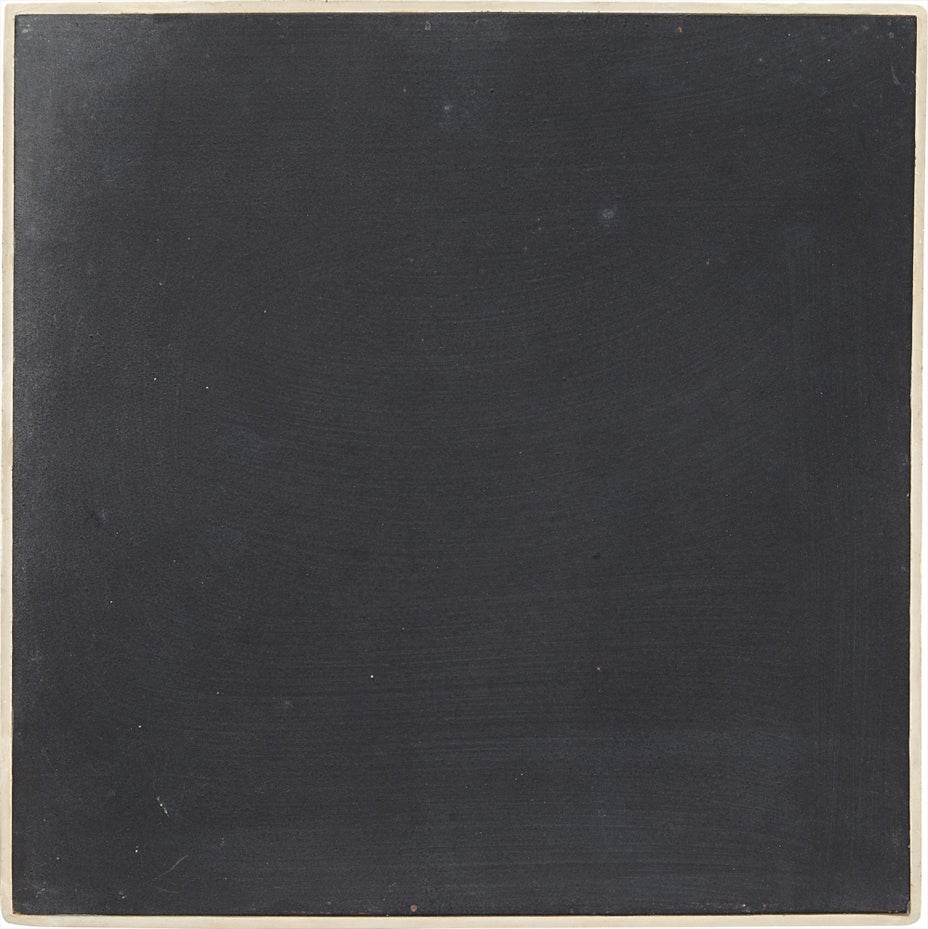
Such a supposition seems to be confirmed by one of the best known photographs of Lygia Clark, sitting elegantly in front of an arrangement of her Unidades displayed on the wall behind her, including the present lot. The disposition not only reveals a further correspondence with the way in which Oiticica’s Invenções were to be displayed, but also serves almost as a demonstration of the investigation Clark was proposing through the Unidades series, one which would become fundamental to her Neo-Concrete production and beyond.
The Unidades series (1958) actually predates the publication of the Neo-Concrete Manifesto in the weekend supplement of the national broadsheet Jornal do Brasil in March 1959. The Unidades show characteristics that would determine her path throughout the short lived but hugely influential Neo-Concrete movement. If the artist, prior to the manifesto, had begun to incorporate the actual framing device into the work’s compositional field, the Unidades demonstrate a process of sophisticated elimination of any elements that might be considered excessive to this purpose. They reduced, in other words, the process of incorporation of the frame to it most essential level. One could also speculate that the artist was playing with the limits between a line and an area within the picture’s surface. If this was indeed the case, then it would represent a mathematical problem that is very distinct to the approach of other contemporaneous artists involved with the precepts, as Clark herself then was, of concrete art. The distinction lies in the fact that mathematics are not invoked here as an accomplice of rationalism, of an a priori concept, but, on the contrary, it appears as an expression of pure subjectivity.
The Unidades appear therefore as visual testimonies of the discord that had begun in 1956 between the São Paulo concrete art group and Ferreira Gullar and his colleagues in Rio de Janeiro, which would ultimately lead to the declaration of independence brought by the Neo-Concrete Manifesto.
Lygia Clark
Brazilian | B. 1920 D. 1988Lygia Clark was a Brazilian artist associated with the Constructivist and Tropicalia movements. During the 1950s she was primarily known for her paintings and sculptures, but during the 1960s and 1970s she began to explore the idea of sensory perception. Along with other Brazilian artists including Helio Oiticica, she co-founded the Neo-Concrete movement based on the principle that art should be subjective and organic, liable to manipulation by the spectator. She sought new ways to engage the viewer ('the participant') with her work, which became increasingly abstract and holistic. Clark's focus on healing and art therapy redefined the relationship between art and the public, and has become a seminal point of reference for contemporary artists addressing the limitations of conventional art forms.